

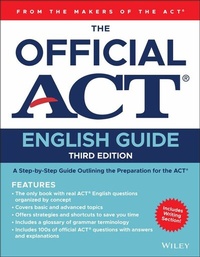
The Official ACT English Guide
Description

Succeed on the English section of the ACT with the only official guide created by the test makers themselves The Official ACT English Guide, 3rd Edition delivers expert-designed preparation directly from the people who wrote the test itself. This comprehensive guide walks students through the grammar, word usage, rhetorical skills, and test-taking strategy they'll need to manage test anxiety and perform at their best on exam day. This edition reflects the latest updates to the ACT English section format and question types. The book is a detailed roadmap to the test combining concept-based instruction with extensive practice opportunities, offering both foundational and advanced coverage of English mechanics and rhetoric. Its systematic approach helps you understand not just what to study, but how to approach each question type so you can complete them quickly and efficiently when you're under time pressure. The Official ACT English Guide also provides access to an online question pool tailored to individual learning needs, while detailed answer explanations reinforce understanding and identify knowledge gaps that require your attention before test day.
You'll find:
- Hundreds of official ACT English questions drawn from actual previous test administrations
- Time-saving strategies and shortcuts designed to maximize efficiency during the timed test
- Complete writing section coverage with scoring rubrics and sample essays at multiple performance levels
- Comprehensive glossary of grammar terminology for quick reference and concept reinforcement
- Systematic approach that builds understanding progressively from basic to advanced topics
Perfect for all high school students preparing for college admissions, pursuing merit scholarships, or aiming to stand out in competitive applicant pools, The Official ACT English Guide is an ideal resource to help you build the skills and confidence you'll need to succeed on the ACT.
More details
Other editions
Additional editions
Previous edition
Content
Chapter 1:
An Overview of the ACT English and Writing Tests
Each ACT is different in its makeup and content. This chapter gives you an idea of what you can expect when you take the ACT English test and the ACT writing test.
The Structure of the English Test
The 35-minute ACT English test consists of six or seven passages, or essays, each of which is accompanied by a sequence of multiple-choice test questions. In total, the English test contains 50 questions, 40 of which are scored.
The length of the essays on the English test will vary; longer essays of approximately 340 words will be accompanied by 10 questions, while shorter essays of approximately 185 words will be accompanied by five questions. A combination of either four longer essays and two shorter essays or three longer essays and four shorter essays will make up each test. Though the number of essays varies, each test will have the same number of total items. Different essay types-including informational, argumentative, and narrative-are employed to provide a variety of rhetorical situations. The essays cover a wide range of topics, from texts about legendary athletes such as Roberto Clemente to scientific texts about exploring Mars.
If you divide your time evenly across the English test's 50 questions, you will have 42 seconds to answer each question, including reading the required parts of the essay. If you'd rather read an essay before starting on its associated questions, spending 1 ½ minutes skimming through each long essay and roughly half that for each short essay leaves you about 30 seconds to respond to each question. These are general guidelines, but some question types will likely take less time to answer, while others will likely take more. Another way to think about pacing is that you have 35 minutes to answer all the questions, giving you approximately 7 minutes for each long essay and its questions and 3 ½ minutes for each short essay and its questions.
In the following example, you will see how certain types of questions will be formatted on the paper test. Brackets are used to identify the number of a sentence within a paragraph and the paragraph numbers. Questions about an entire paragraph will be identified by a box. Most question numbers appear below an underlined portion of a sentence. Be careful to replace only the underlined portion of the sentence as you test out the answer choices. Changes that have been made in previous sentences should be taken into account when answering subsequent questions.
Passage IV: Pinball and Chance
[1]
Doesn't anyone play pinball anymore? I was disappointed the other day when I took my kids to a game arcade. Not one of the many colorful machines with flashing lights were a47 pinball machine. Video games filled the room.
[2]
[1] I can understand why video games might seem more attractive than pinball. [2] Video screens which have been48 populated by movie stars, monsters, and heroes. [3] You can blow up cities, escape from dungeons, and battle all sorts of villains. [4] Pinball machines, on the other hand, are essentially all the same. [5] Some machines are bigger and fancier than others, but the object of pinball never changes: you have to keep a steel ball in play long enough to rack up a high score and win a free game.
- Which choice makes the sentence most grammatically acceptable?
- No Change
- was a
- were an actual
- are an actual
- Which choice makes the sentence most grammatically acceptable?
- No Change
- that are
- are
- Delete the underlined portion.
- For the sake of the logic and cohesion of Paragraph 2, Sentence 4 should be placed:
- where it is now.
- before Sentence 1.
- after Sentence 1.
- after Sentence 5.
Some questions will ask about the essay as a whole. They will be formatted like number 15 in the following example.
By the time we found our way back to the car, the sun was high in the sky. We had taken three hours to complete a hike we usually finished in forty-five minutes. Yet the hike felt shorter than ever. As we drove off, I remembered something else my grandmother used to say: "Miami time passes all too quickly."
Question 15 asks about the preceding passage as a whole.
- Suppose the writer's primary purpose had been to write a brief essay conveying a personal experience with "Miami time." Would this essay accomplish that purpose?
- Yes, because it presents the narrator's firsthand experience of a morning spent in Miami time.
- Yes, because it reveals that after a conversation with the grandmother, the narrator decided to live in Miami time.
- No, because it shares the views of more than one person with regard to the meaning of Miami time.
- No, because the term "Miami time" belonged to the grandmother, not to the narrator.
ACT Test Formats: Paper and Online
The ACT is available as a paper test and as an online test for both National (weekend) and State/District testing. For National testing, you may select to test on computer or paper, based on your personal preference and the available testing centers in your area. For in-school testing, the decision for computer or paper format is made by either the state or the district.
Questions will look slightly different online than they do on paper. On the computer-based ACT English test, when a portion of text is associated with a question, that text will be highlighted instead of underlined. Instead of numbers in boxes to refer to certain questions, you will see highlighted asterisks in brackets in the essay. If a question calls for sentence or paragraph numbering, the numbers of sentences within paragraphs and the paragraph numbers will be bracketed as they are on the paper test. The online test also includes tools allowing you to strike through answer choices you're ready to eliminate and flag questions you'd like to return to.
Regardless of format, what is most important is the knowledge and skills you have developed over your course of study. If you know the material, whether you choose answers by marking them on paper or clicking an option on a computer screen will likely make little difference.
Content of the ACT English Test
The ACT English test is designed to measure your ability to make the wide variety of decisions involved in revising and editing a given piece of writing. It focuses on three reporting categories that organize the types of questions you will answer and also make up the composite score you will receive. Each reporting category has a different number of questions associated with it. You will not see the specific number of questions given in a category but rather the percentage of the total test score each will represent. Here is a brief description of the three reporting categories and their percentages in the total score of the English test.
- Conventions of Standard English (punctuation, usage, and sentence structure): 38-43%
- Production of Writing (topic development, organization, unity, and cohesion): 38-43%
- Knowledge of Language (word choice, style, and tone): 18-23%
A reporting category is composed of a set of skills that you are expected to have; each question is based on one or more of these skills. For instance, for Conventions of Standard English questions, the skills range from correcting errors in grammar to recognizing the proper use of punctuation. You might find questions about subject-verb agreement, commas with coordinating conjunctions, and sentence fragments. Production of Writing questions might relate to logical transitions and evidence for arguments, and Knowledge of Language questions might ask about the mood and tone of an essay. Following is a more detailed breakdown of the skills that fall under each category.
Conventions of Standard English
Conventions of Standard English questions test the following knowledge and skills:
- Determine when to use punctuation marks, including periods, commas, apostrophes, colons, semicolons, dashes, and parentheses.
- Determine when to use subordinating and coordinating conjunctions to join clauses or revise fragments or fused sentences.
- Recognize and correct errors in subject-verb agreement.
- Recognize and correct disturbances in sentence structure, such as faulty placement of adjectives, participial phrase fragments, missing or incorrect relative pronouns, dangling or misplaced modifiers, faulty parallelism, run-on sentences, and weak conjunctions between independent clauses.
- Determine appropriate pronoun use, including correcting errors in agreement and case and clarifying ambiguous pronoun use.
- Use frequently confused words appropriately in context.
Production of Writing
Production of Writing questions test knowledge and skills in two areas of English composition.
Topic Development in Terms of Purpose and Focus
Examples of knowledge and skills tested in these questions include the following:
- Determine the relevance of material to the topic or the focus of the essay or paragraph.
- Identify the purpose of a word, phrase, or sentence (for example, identify a person, define a term, or describe an object).
- Use a word, phrase, or sentence to accomplish a specific purpose, such...
