

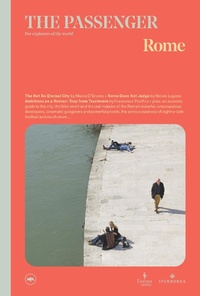
The Passenger: Rome
Published on 15. February 2022
192 pages
978-1-60945-742-6 (ISBN)
Description

The best new writing, photography, art, and reportage from and about Rome-in the series that's "like a literary vacation" (
Publishers Weekly).
If you believe recent chatter about Rome-in the media and by its residents-the city is on the verge of collapse. Each year, it slips further down the ranking of the world's most livable cities. To the problems faced by all large capitals-hit-and-run tourism, traffic, the divide between elegant, Airbnb-dominated city centers and run-down suburbs-in recent years Rome seems to have added a list of calamities of its own: a string of failing administrations, widespread corruption, the resurgence of fascist movements, rampant crime. A seemingly hopeless situation, perfectly symbolized by the fact that Rome currently leads the world in the number of self-combusting public buses.
One might expect mass migration in the face of problems like these-yet the vast majority of Romans don't think for a second of "betraying" their hometown, and the many newcomers who've populated it in recent decades resemble the natives in the profound love that binds them to the city.
The largest metropolis in Europe is a place of contradictions and opposites. We think of it as ancient, but it is profoundly modern-it was founded almost three millennia ago, but 92 per cent of its buildings have been built after 1945. To understand Rome and fix its problems, we should start considering it a normal city, not unlike Chicago or Manchester... just incomparably more beautiful. This volume is filled with portraits of Rome and thoughts not just on its famous past but its present and future, including:
Rome doesn't judge you by Nicola Lagioia · The soul of the city by Matteo Nucci · 39 memos for a book about Rome by Francesco Piccolo · Plus: a guide to the sounds of Rome by Letizia Muratori; the feigned unrest and real malaise of the suburbs; the influence of the Vatican; the excessive power of real estate speculators and the rule of gangs; disillusioned trappers; football fans of every age, and much more...
"A pleasure to read." - La Repubblica
If you believe recent chatter about Rome-in the media and by its residents-the city is on the verge of collapse. Each year, it slips further down the ranking of the world's most livable cities. To the problems faced by all large capitals-hit-and-run tourism, traffic, the divide between elegant, Airbnb-dominated city centers and run-down suburbs-in recent years Rome seems to have added a list of calamities of its own: a string of failing administrations, widespread corruption, the resurgence of fascist movements, rampant crime. A seemingly hopeless situation, perfectly symbolized by the fact that Rome currently leads the world in the number of self-combusting public buses.
One might expect mass migration in the face of problems like these-yet the vast majority of Romans don't think for a second of "betraying" their hometown, and the many newcomers who've populated it in recent decades resemble the natives in the profound love that binds them to the city.
The largest metropolis in Europe is a place of contradictions and opposites. We think of it as ancient, but it is profoundly modern-it was founded almost three millennia ago, but 92 per cent of its buildings have been built after 1945. To understand Rome and fix its problems, we should start considering it a normal city, not unlike Chicago or Manchester... just incomparably more beautiful. This volume is filled with portraits of Rome and thoughts not just on its famous past but its present and future, including:
Rome doesn't judge you by Nicola Lagioia · The soul of the city by Matteo Nucci · 39 memos for a book about Rome by Francesco Piccolo · Plus: a guide to the sounds of Rome by Letizia Muratori; the feigned unrest and real malaise of the suburbs; the influence of the Vatican; the excessive power of real estate speculators and the rule of gangs; disillusioned trappers; football fans of every age, and much more...
"A pleasure to read." - La Repubblica
More details
Other editions
Additional editions
Book
01/2022
Europa Editions (UK) Ltd
€21.50
Article not available at the moment
Content
- Intro
- Rome
- Contents
- Rome in Numbers
- The Not So Eternal City - Marco D'Eramo
- With no entrepreneurial tradition of any note, the Italian capital is held prisoner by forces that keep its development in check: bureaucracy, rogue developers, the Vatican - which owns a quarter of the city's real estate - and the damage caused by tourism, which has led to the depopulation of the city centre and rampant gentrification.
- Roman Soundscapes - Letizia Muratori
- Letizia Muratori takes us on an acoustic guide to her Rome, a city with its own beautiful and chaotic soundtrack.
- Rome Does Not Judge - Nicola Lagioia
- Nicola Lagioia has spent years studying the case of Luca Varani - the victim of a deranged, motiveless killing - delving into Rome's nightlife and trying to dig deeper into the subconscious of a city that seems lost, indecipherable, almost impossible to live in but at the same time buzzing with life.
- The Soul of the City - Matteo Nucci
- Rome has a contentious relationship with the river on which it is built and from which it is now separated by its muraglioni, the towering and seemingly unscalable walls along the riverbanks. And yet the Tiber is home to a whole world of its own, the story of which remains largely unknown.
- 39 Notes for a Book on Rome - Francesco Piccolo
- Is it possible to understand Rome? Some appear to have succeeded, but Francesco Piccolo, who moved there from Caserta, is still trying. There are many reasons to love the city, and he lists some here while awaiting the day when he, too, can proclaim that he not only loves but also understands Rome.
- Revolutions in the Suburbs - Leonardo Bianchi
- Uprisings staged by self-styled 'citizens exasperated' by the presence of migrant reception centres and Roma camps have spread through the outskirts of Rome. Behind these protests far-right groups fan the flames, passing themselves off as apolitical neighbourhood committees and attempting to give a voice to local people's frustrations.
- Maps of Inequality
- The Echo of the Fall - Christian Raimo
- Rome does everything to excess, from its size to its problems and even its monstrosities. Christian Raimo investigates this phenomenon by focusing on one area that extends from the old working-class districts of Fidene and Settebagni to the Marcigliana Nature Reserve, taking in along the way property speculation, what was once Europe's most polluting rubbish dump and its largest shopping centre.
- The Family - Floriana Bulfon
- The Casamonica clan is a network of Roma families that established themselves on the outskirts of the metropolis, where they have thrived in the social and institutional desert. Their empire is reflected in an aesthetic of violence that is reproduced in novels about the capital's underworld, in an open city that too often looks away as local and international narcos mingle with entrepreneurs and politicians to clean up their image and launder their cash.
- Ambitionz as a Roman: Trap from Trastevere - Francesco Pacifico
- Hanging out on the border of Monteverde and Trastevere, a group of kids from central Rome began to make music, achieving national success with their songs about alcohol, drugs and their dysfunctional, hopeless lives. These personal, apolitical stories form part of a nihilistic Roman tradition that describes a city without class consciousness, a city that is a social class unto itself.
- What We Talk About When We Talk About Calciotto - Daniele Manusia
- In Rome calciotto - eight-a-side football - is far more than just a pastime
- in the 'least professional city in Italy' it is the most serious and competitive activity there is. You give all you've got on the pitch, make and break friendships, tear ligaments, age prematurely but never grow up . Whatever else happens, though, it's got to be eight vs. eight.
- A Sign of the Times - Sarah Gainsforth
- An Author Recommends - Nadia Terranova
- The Playlist - Giulia Cavaliere
- Digging Deeper
- Copyright
