

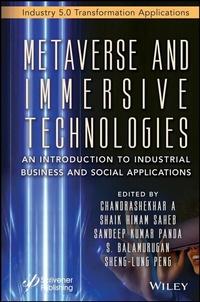
Metaverse and Immersive Technologies
Description

The book covers the multidimensional perspectives of the metaverse through the prism of virtual reality, augmented reality, blockchain, artificial intelligence, and IoT, ranging from rudimentary to advanced applications.
This book provides a thorough explanation of how the technology behind metaverse and other virtual reality technologies are changing the world. The primary objective is to present the revolutionary innovation of the 21st century--the metaverse--and exhibit its wide range of applications in different domains. Although blockchain and VR/AR were the first popularly known applications of the metaverse, several other applications also exist. While some still believe the metaverse is overhyped, in reality, it is transforming almost every industry--healthcare, 3D, 4D, industry, game industry, business management, artificial intelligence, and IoT, just to name a few.
This technological breakthrough not only paved the way for virtual reality but also provided useful solutions for other areas of technology. The unique nature of the technology, which is a single, shared, immersive, persistent, 3D virtual space where humans experience life in ways not possible in the physical world, makes it suitable for all real-world applications; it has great potential to transform business, and companies are already in the race for different product offerings.
Audience
AI and computer science researchers, engineers and graduate students, IT personnel in business as well as entrepreneurs and policymakers.
More details
Other editions
Additional editions
Persons
Chandrashekhar A, PhD, is an assistant professor in the Department of Mechatronics, ICFAI Foundation for Higher Education, Hyderabad, Telangana, India. He has 8 patents to his name and has published numerous research articles in international journals.
Shaik Himam Saheb, PhD, is an assistant professor in the Department of Mechatronics Engineering, ICFAI Foundation for Higher Education, Hyderabad, Telangana, India. He has published numerous research articles in international journals.
Sandeep Kumar Panda, PhD, is an associate professor in the Department of Data Science and Artificial Intelligence, Faculty of Science and Technology, ICFAI Foundation for Higher Education, Hyderabad, Telangana, India. He has published numerous research articles in international journals and has 18 Indian patents to his name. In 2020, he received the "Research and Innovation of the Year Award 2020" from the Govt. of India.
S. Balamurugan, PhD, is the Director of Research and Development, Intelligent Research Consultancy Services (iRCS), Coimbatore, Tamilnadu, India. He is also Director of the Albert Einstein Engineering and Research Labs (AEER Labs), as well as Vice-Chairman, Renewable Energy Society of India (RESI), India. He has published 45 books, 200+ international journals/conferences, and 35 patents.
Sheng-Lung Peng, PhD, is a professor in the Department of Creative Technologies and Product Design, National Taipei University of Business, Taiwan. He is an honorary professor of Beijing Information Science and Technology, University of China, and a supervisor of the Chinese Information Literacy Association and of the Association of Algorithms and Computation Theory. He has published more than 120 international journal and conference papers.
Content
Preface xxi
Acknowledgment xxv
1 Metaverse: A Study on Immersive Technologies 1
Dileep Kumar Murala and Sandeep Kumar Panda
1.1 Introduction 2
1.2 Related Works and Contributions 16
1.3 The Metaverse Architecture, Developments, and Tools 18
1.4 Advantages and Disadvantages of Metaverse 28
1.5 The Metaverse Challenges and Countermeasures 32
1.6 Future Research Directions 32
2 Metaverse and Blockchain 43
Vaishnavi Raj. K.A., Shresta Rongali, Bathula Jaya Teja and Shaik Himam Saheb
2.1 Introduction 44
2.2 Preparatories of Blockchain 45
2.3 Technical Understanding of Blockchain 48
2.4 Advanced Applications of Blockchain in Various Sectors 50
2.5 Web3 Technology 52
2.6 Metaverse and Blockchain Technology 55
2.7 Augmented Reality, Virtual Reality, and Mixed Reality 59
2.8 The Metaverse Projects 62
2.9 Conclusion 63
3 Blockchain in the Development of Metaverse 71
Dileep Kumar Murala and Sandeep Kumar Panda
3.1 Introduction 72
3.2 Related Work 73
3.3 Consensus Algorithms for Blockchain 75
3.4 Practical Byzantine Fault Tolerance (PBFT) 77
3.5 Blockchain in Metaverse 78
3.6 Blockchain Metaverse 82
3.7 Obstacles and Unresolved Problems 86
3.8 What Other Problems in the Metaverse Can Blockchain Help With? 89
3.9 Conclusion and Future Research Directions 90
4 Revolution of the Metaverse and Blockchain Technology 97
Sandeep Kumar Panda
4.1 Introduction 98
4.2 Blockchain 100
4.3 The Metaverse 104
4.4 Blockchain-Powered Metaverse 111
4.5 Overview of Blockchain Use Cases in the Metaverse 116
4.6 Conclusion 119
5 Metaverse: The New Era in Medical Field 127
M. Sreedhar, Shaik Himam Saheb and Kona Ravi Sandeep Kumar
5.1 Introduction 128
5.2 Discussion 136
5.3 Medical Cloud Plus 140
5.4 The Metaverse's Benefits and Drawbacks 141
5.5 Applications of Metaverse in Various Fields 143
5.6 Definition and Clinical Significance of Metaverse in Medicine 145
5.7 Conclusions 152
6 The Role of Immersive Reality (AR/VR/MR/XR) in Metaverse 159
Dileep Kumar Murala and Sandeep Kumar Panda
6.1 Introduction 160
6.2 Related Works 161
6.3 VR, AR, and MR's Responsibilities in the Metaverse 167
6.4 The Contribution of AR/VR to the Metaverse Development 169
6.5 How to Use the Metaverse Right Now 172
6.6 Unresolved Issues 176
6.7 Application for XR 178
6.8 Challenges in the Metaverse 180
6.9 Conclusion and Future Directions 183
7 Advances in Design and Manufacturing of VR Headset 191
Chandrashekhar Bendigeri and Devaraj E.
7.1 Introduction 192
7.2 Literature Survey 196
7.3 Technically Enriched Advance Computation Technologies 204
7.4 Arc Welding 205
7.5 Virtual Manufacturing 205
7.6 Virtual Reality 206
7.7 Virtual Welding: An Innovation Towards Virtual Reality for Welding and Training 207
7.8 Virtual Reality Metal Arc Welding System (VRMAWS) 208
7.9 Software's and Hardware Used in VRMAW 208
7.10 Virtual Design and Manufacturing 210
7.11 Conclusion 212
8 Augmented Reality in Computer-Aided Design (CAD) 217
Suresh Goka, Syed Quadir Moinuddin, Ashok Kumar Dewangan, Shaik Himam Saheb and Barla Madhavi
8.1 Introduction 218
8.2 AR System 220
8.3 Case Studies 222
8.4 Applications 226
8.5 Conclusions 228
9 Metaverse: Post-Pandemic Impact in Education 235
C.V. Suresh Babu and P. Preethi
9.1 Introduction 236
9.2 Background of the Study 237
9.3 Significance of the Study 239
9.4 Metaverse in Education 242
9.5 Research on Metaverse and Education Systems 243
9.6 Research Questions 249
9.7 Delimitations of the Study 251
9.8 Proposed Methodology 252
9.9 Characteristics of the Metaverse of Virtual Reality in Education 253
9.10 Modern Social Interaction 253
9.11 Using Virtualization to Produce Innovative Experiences That Are Highly Immersive 254
9.12 Limitation 254
9.13 Conclusions 254
10 Inspection of Defects through Corneal Topography of a Healthy Retina 259
V. V. Vidyasagar
10.1 Introduction 260
10.2 Structure of the Eye 260
10.3 Perspective Scale Model of Eye 262
10.4 Extended Reality Metaverse (XR) 267
10.5 Computer-Aided Geometrical Design 268
10.6 Human Eye Ball Model 270
10.7 Keratoconus Characteristic Topographical Patterns 272
10.8 Conclusion 290
11 The Metaverse in Industry and Logistics 295
M. Edwin, M. Saranya Nair and V. A. Nagarajan
11.1 Introduction: Metaverse -- State-of-the-Art 296
11.2 Metaverse as Creative Freedom 301
11.3 Development of Industrial Metaverse 302
11.4 Typical Products/Services in Metaverse 304
11.5 Role of Metaverse in Supply Chain 305
11.6 Forecast of the First Application Areas 307
11.7 Industrial Metaverse for Remote Manufacturing 308
11.8 Impact of Industrial Metaverse in Manufacturing Industry 309
11.9 Six Cases of Early Industrial and Commercial Metaverse Application 311
11.10 Issues in Metaverse 314
11.11 Challenges of Industrial Metaverse in Engineering Applications 315
11.12 Metaverse Accelerates Economic Development for Emerging Economies 316
11.13 The Metaverse in Logistics 316
11.14 Conclusion 319
12 Augmented Reality Applications in Gaming 325
Rohan Harish, Abhiram Vollala and Shaik Himam Saheb
12.1 Introduction 326
12.2 Augmented Reality Technology 326
12.3 History of AR 327
12.4 Types of Augmented Reality 327
12.5 Types of AR 331
12.6 Monitor-Based 331
12.7 Virtual Reality vs. Augmented Reality 332
12.8 Issues in Augmented Reality 333
12.9 Applications of Augmented Reality 333
12.10 Advertisement 337
12.11 Simulations 337
12.12 Navigation 338
12.13 Unity3D 340
12.14 CAD 340
12.15 Video Fames 340
12.16 Theme Park 340
12.17 Introduction of Unity3D 341
12.18 About Augmented Reality Based on Unity3D 342
12.19 The Main Technical Problem 342
12.20 Conclusion 343
13 Real-Time Applications of Virtual Reality 349
R. Pranith, Kavali Maruthi and Shaik Himam Saheb
13.1 Introduction 349
13.2 History of VR 350
13.3 Virtual Reality (VR) 353
13.4 Uses of VR in Different Industrial Sectors 354
13.5 VR in Gaming 355
13.6 Benefits of VR in the Gaming Industry 356
13.7 VR Technology for Business and Game Development 357
13.8 Global Virtual Reality (VR) 357
13.9 VR in the Indian Business Market 359
13.10 Virtual Reality Technology 359
13.11 Virtual Reality (VR) in Unity 364
13.12 VR (Virtual Reality) Games 367
13.13 Conclusion 373
14 Real-Time Applications of Mixed Reality 379
Sri Ganesh, Ram Pavan Reddy and Shaik Himam Saheb
14.1 Introduction 379
14.2 Technical Challenges 383
14.3 Mixed Reality Research in Switzerland 388
14.4 Current Challenges and Trends 391
14.5 Peek into the Future 392
14.6 Hologram Lens 393
14.7 Pros and Cons of Mixed Reality 395
14.8 Architecture of MR Systems 396
14.9 Unity Development for VR and Windows Mixed Reality 397
14.10 Future Research 398
14.11 Conclusion 400
15 Artificial Intelligence in the Development of Metaverse 407
Dileep Kumar Murala and Sandeep Kumar Panda
15.1 Introduction 408
15.2 Related Works 408
15.3 Artificial Intelligence 413
15.4 Artificial Intelligence for the Metaverse: A Focus on Technical Aspects 419
15.5 Artificial Intelligence for the Metaverse: Application Aspect 424
15.6 The Metaverse's Artificial Intelligence Future 429
15.7 Conclusion and Future Directions 430
16 The Internet of Things in Developing Metaverse 437
Dileep Kumar Murala and Sandeep Kumar Panda
16.1 Introduction 438
16.2 Related Works 442
16.3 The Connection Between the Metaverse and the Internet of Things 444
16.4 The Importance of Metaverse in the IoT 451
16.5 IoT's Contribution to the Creation of the Metaverse 454
16.6 Applications, Advantages and Challenges of IoT-Based Metaverse 455
16.7 Conclusion 458
References 460
Index 467
1
Metaverse: A Study on Immersive Technologies
Dileep Kumar Murala1 and Sandeep Kumar Panda2*
1 Computer Science and Engineering, Faculty of Science and Technology, ICFAI Foundation for Higher Education, Hyderabad, Telangana, India
2 Data Science and Artificial Intelligence, Faculty of Science and Technology, ICFAI Foundation for Higher Education, Hyderabad, Telangana, India
Abstract
The Metaverse is a concept that is currently being developed for the future generation of the Internet. It aims to provide an autonomous, completely immersive, and spatiotemporal virtual community where people can work, play, and interact. Recent advancements in cutting-edge technology such as augmented reality, Artificial Intelligence, and blockchain are making the once-fantastical metaverse seem more like a plausible reality. This paper presents an in-depth analysis of the technologies utilized in the Metaverse, providing a solid foundation from which to further study this fascinating field. To be more specific, we look into the fundamental characteristics of a novel distributed metaverse architecture in terms of ternary-world interactions. The benefits and drawbacks of the metaverse are then explored, along with the current pressing problems that metaverse systems face and the most cutting-edge solutions to those problems. Finally, we propose new avenues for metaverse system development study.
Keywords: Augmented reality, artificial intelligence, blockchain, metaverse
1.1 Introduction
1.1.1 The Emergence of the Metaverse
The term "metaverse," which was first used by author Neal Stephenson in his science fiction novel Snow Crash, was first published in 1992 [1]. "Meta" comes from the Greek for "beyond," and "verse" means "universal." The novel depicted the metaverse as a virtual counterpart to the real world or a dystopian version of the internet. Shared term "metaverse" is also used to describe virtual worlds where users can enter as digital avatars and conduct business or social interactions with other users. The metaverse is intended to be an alternative to the World Wide Web that is more immersive. There have been several expansions of the Metaverse. In the late 1970s, text-based interactive games like MUD (Multi-User Dungeon) were released, depicting a multiplayer virtual environment with role-playing, interactive narrative, and online conversation. At the time, the term "Metaverse" didn't exist. These games might be considered the forerunners of the Metaverse. Commercial virtual worlds like Second Life were created during the post-millennial era, which marked the start of the second phase. After that, a fully virtualized 3D environment was approved, such as OpenSimulator, which is normally compatible with Second Life [2].
The metaverse is an ever-present, cooperative online environment where users can participate in interactive narratives. It combines several technologies, including Mixed Reality (MR), Virtual Reality (VR), Extended Reality (XR), Augmented Reality (AR), the Internet of Things (IoT), Artificial Intelligence (AI), Non-Fungible Tokens (NFTs), and Information and Communications Technology (ICT) infrastructure. The Metaverse is currently being developed by IT firms as the successor to the mobile Internet. The Metaverse will eventually surpass the Internet in terms of transforming new service ecosystems in all spheres of human endeavor, including healthcare, education, entertainment, e-commerce, and smart industries. The excitement surrounding the Metaverse is primarily driven by two factors. First off, the COVID pandemic has caused a paradigm shift in how people currently engage in work, entertainment, and socializing. As more individuals get used to doing these physical activities in virtual reality, the Metaverse will become necessary. Second, the Metaverse is becoming a more real prospect thanks to newly developed technical enablers [3, 32].
1.1.2 Core Attributes of a Metaverse
The basic characteristics of the Metaverse include:
Synchronous and live: The Metaverse will be a living experience for everyone, just like "real life," with pre-scheduled and self-contained events.
Persistent: It simply keeps going without ever pausing, restarting, or stopping.
Available individually and concurrently: Everyone can join the Metaverse and participate in an event, venue, or activity with their agency. In a well-functioning economy, people and corporations should be able to create, own, invest in, sell, and be reimbursed for many acts that create value. These actions include creating, selling, and being remunerated for goods and services.
An experience: All aspects of the user's environment, including online and offline spaces, closed and open systems, and public and private networks, should be considered [33, 71].
A wide range of contributors: There should be a wide variety of content and activities, with many different people (some of whom work independently, others for for-profit enterprises) involved [4].
Offer unprecedented interoperability: There needs to be seamless sharing of information, digital assets, content, and other elements throughout the various platforms; for instance, a car built for Rocket League (or even Porsche's website) may be adapted for use in Roblox. The way things work in the digital world of today is comparable to the way a shopping mall operates, with each establishment having its own money, ID cards, proprietary units of measurement for items such as shoes or calories, and separate dress requirements, among other things [5, 72].
1.1.3 Key Features of Metaverse
Infrastructure: Answers to the question "What are the key characteristics of the metaverse?" would emphasize infrastructure. In the context of the metaverse, infrastructure refers primarily to the technological infrastructure supporting the metaverse. In addition to utilizing high-tech components such as GPUs, the infrastructure consists of communication technologies such as Wi-Fi, cloud computing, and 5G. The continued expansion of the metaverse is one of its defining features. Therefore, the metaverse architecture must offer ultra-low latency, tremendously fast speeds, and expanded capacity [34, 35]. A robust infrastructure serves as the basis for smooth, value-based experiences for all metaverse users. Recent endeavors make the emphasis on infrastructure as a crucial entrance among metaverse elements abundantly clear. The ICT Ministry of South Korea laid the groundwork for an alliance between seventeen distinct enterprises and eight distinct industry organizations. To promote the growth of the metaverse ecosystem, the industry alliance offers crucial opportunities for enhancing the metaverse's infrastructure [6, 73].
Human Interface Technologies: When discussing infrastructure as one of the primary metaverse characteristics, it is natural to resort to human interface technologies. For joining the metaverse, users can utilize technology such as VR headsets, haptics, AR glasses, and many more. The human interface technologies aid in transferring users to the metaverse's endless immersive places. However, advances are being made to human interface technology for the metaverse. Smartphones, laptops, tablets, and personal computers can also function as metaverse access points when equipped with the necessary features [7, 74].
Digital Avatars: Avatars are a key feature among the significant characteristics of the metaverse. Digital avatars are one of the core components of the metaverse's design. Users can develop digital avatars for unconventionally expressing their thoughts and feelings in the metaverse. You can use the metaverse features to create personalized digital avatars, allowing you to create a digital version of your favorite superhero. Intriguingly, the ability to create and modify digital avatars in the metaverse also provides new opportunities for gamification. Consequently, digital avatars build the foundation for an engaging and immersive experience within the metaverse. Imagine 4.66 billion internet users creating digital avatars, exploring the metaverse, exchanging knowledge, and engaging with other avatars. Isn't this a truly revolutionary experience?
Decentralization: Decentralization would be the second most prominent response to the question, "What are the key characteristics of the metaverse?" The metaverse is envisioned as an open, shared reality in which users can travel fluidly between platforms. Users of the Metaverse might generate their own virtual experiences and assets with monetary worth and sell them without the need for centralized authorities [37]. This is where decentralization, a prominent aspect of the metaverse, would be found. Some of the most important technologies promoting the democratization of the metaverse are blockchain, edge computing, and AI [8]. Users can obtain complete control and ownership over their assets and experiences in the metaverse through decentralization. Consequently, the decentralized character of the metaverse plays a significant role in deciding the freedom of users. Therefore, the decentralization aspect differentiates the metaverse from the current Internet [36].
