

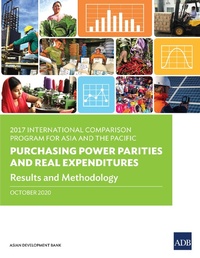
2017 International Comparison Program for Asia and the Pacific
Purchasing Power Parities and Real Expenditures-Results and Methodology
Asian Development Bank (Publisher)
Published on 1. October 2020
394 pages
978-92-9262-396-8 (ISBN)
Description

This publication provides a comprehensive account of the 2017 International Comparison Program (ICP) cycle for 22 economies in Asia and the Pacific. It provides in-depth analyses of estimates of purchasing power parities (PPPs), total and per capita real (PPP-converted) gross domestic product and its component expenditures, and price level indexes showing relative costs of living. The PPPs enable comparison in real terms across economies by removing the price level differences among them. This report also presents in detail the conceptual framework and methodological approaches used in implementing the ICP.
More details
Other editions
Additional editions
Asian Development Bank
2017 International Comparison Program for Asia and the Pacific
Purchasing Power Parities and Real Expenditures - Results and Methodology
Book
04/2021
Asian Development Bank
€101.00
Article exhausted; check different version
Content
- Cover
- Title
- Copyright
- Contents
- Tables, Figures, and Boxes
- Foreword
- Acknowledgments
- Abbreviations
- 1. An Introduction to the International Comparison Program
- What Is the International Comparison Program?
- International Comparison Program in Asia and the Pacific
- The 2017 International Comparison Program in Asia and the Pacific: Participating Economies
- Organization of the Report
- 2. Basic Concepts and Measures in the International Comparison Program
- The International Comparison Program and Components of Expenditure Side Gross Domestic Product
- Decomposition of Value Aggregates into Price and Volume Components
- Comparisons over Time
- Spatial Comparisons of National Accounts Aggregates across Economies
- Basic Measures in the International Comparison Program
- Purchasing Power Parities of Currencies
- Exchange Rates
- Nominal and Real Expenditure Aggregates
- Price Level Index
- Price Level Index and Real Exchange Rate
- Price Level Indexes Expressed Relative to Asia and the Pacific
- Uses and Applications of Purchasing Power Parities and Real Incomes
- Limitations and Caution in the Use of Purchasing Power Parities
- 3. Main Results and Analysis
- Introduction
- Economic Geography of the Region
- Road Map for the Main Results
- The Economy of Asia and the Pacific: Real Size and Distribution
- Size of the Economy of Asia and the Pacific
- Distribution of Nominal and Real Gross Domestic Product
- Per Capita Real and Nominal Incomes
- Disparities in Levels of Living
- Price Level Indexes for Gross Domestic Product of the Economies of the Region
- Household Final Consumption: Individual Consumption Expenditure by Households
- Size and Distribution
- Per Capita Real Levels and their Distribution
- Disparities and Inequality in Individual Consumption Expenditure by Households
- Household Final Consumption: Actual Individual Consumption by Households
- Size and Distribution
- Relative Disparities
- Price Levels
- Household Consumption
- Food and Its Components
- Nondurables, Semidurables, Durables, and Services
- Education and Health
- Transport, Communication, Recreation and Culture, and Restaurants and Hotels
- Government Final Consumption Expenditure
- Gross Fixed Capital Formation
- Domestic Absorption
- Price Level Indexes for Gross Domestic Product and Its Components
- Summary and Conclusion
- 4. A Comparative Analysis of the 2011 and 2017 Regional Results
- Introduction
- Updates and Revisions to the 2011 Cycle
- Revisions to Population and Gross Domestic Product Data
- Revisions Due to Changes in Productivity Adjustment Methodology
- Revisions to Purchasing Power Parities in 2011
- Consistency between the 2017 Cycle and Extrapolations from Revised 2011 Benchmark Comparisons
- Are the Results from the 2017 Cycle Broadly Consistent with Extrapolations from 2011?
- Size and Distribution of the Asia and Pacific Economy, 2011 (Revised)
- Growth and Inflation in the Economies, Subregions, and the Region, 2011-2017
- Economy-Level Decomposition of Real GDP at Current Prices
- Real Gross Domestic Product at Current and Constant Prices
- A Framework for Calculating Regional and Subregional Growth and Inflation
- Conclusion
- 5. Governance and Organization of the 2017 International Comparison Program
- Introduction
- Governance Structure: Global Level
- The Governing Board
- The Global Office
- The Inter-Agency Coordination Group and Its Agencies
- Regional Implementing Agencies
- Implementing Agencies from Participating Economies
- The Technical Advisory Group
- Regional Governance: Asia and the Pacific
- Participating Economies in the 2017 ICP Asia and the Pacific
- Governance Structure
- Implementing Agencies from Participating Economies
- The Regional Advisory Board
- Experts Group
- 6. Methodology and Approaches
- Introduction
- National Accounts and the ICP
- Structure and Components of Gross Domestic Product Expenditures
- Actual Individual Consumption by Households
- Hierarchical Approach to Compilation of Purchasing Power Parities
- Basic Headings: Building Blocks of the ICP
- Higher Level Aggregates
- Data Requirements for the ICP: Sources and Methods
- National Accounts Data
- Expenditure Weights
- Price Data
- Requirements for Valid Price and Volume Comparisons
- Scope of Price Surveys
- Price Survey Framework
- Preparation of Product Lists
- Background
- Structured Product Descriptions
- Household Consumption: Regional and Global Core Lists
- Health and Education
- Government Services and Compensation of Employees
- Government Occupations
- Machinery and Equipment
- Construction
- Dwellings
- Price Data Validation
- Intra-Economy Validation
- Inter-Economy Validation
- Comparing ICP and CPI Temporal Price Movements for Household Data Validation
- ICP Asia Pacific Software Suite for Data Management and Validation
- Expenditure Data from National Accounts
- Gross Domestic Product Expenditures: Compilation Methods
- Fiscal versus Calendar Year GDP Estimates
- Expenditure Weights
- Statistical Discrepancy
- Net Purchases Abroad
- Nonprofit Institutions Serving Households
- Validation of Gross Domestic Product Weights
- Gross Domestic Product: Data Management and Validation Tools
- Technical Approaches in the 2017 ICP in Asia and the Pacific
- Household Prices
- Product Splitting
- Importance
- Identification of Outliers
- Data and Purchasing Power Parity Computations for Household Consumption
- Compensation of Employees for General Government
- Productivity Adjustment Method for Wages and Salaries of Government Employees
- Construction
- Relevance Indicators
- Resource Mix by Type of Construction
- Identification of Outlier Prices in Construction
- Approach for Computing Purchasing Power Parities for Construction
- Machinery and Equipment
- Identification of Outliers
- Quality and Price Splitting Procedure
- Effect of Price Clustering on Basic Heading Purchasing Power Parities
- Dwellings
- Quantity Indicator or Volume Approach
- Rental Price Approach
- Analysis of Housing Results from Quantity and Rental Approaches
- The New ADB Approach: Linked Rental Price and Quantity Indicator Purchasing Power Parities with Quality Adjustments
- Comparison of Results between Various Approaches
- Conclusion
- Methods for Computing Purchasing Power Parities
- Index Number Methods for Computing Purchasing Power Parities of Currencies
- Item Level Price Comparisons
- Basic Heading Level Price Comparisons: The Country-Product-Dummy Method
- Reference Purchasing Power Parities for Some Basic Headings
- Computing Purchasing Power Parities for Higher Level Aggregates: The Gini-Éltet-Köves-Szulc Method
- Non-Additivity of Sub-Aggregates in Real Terms
- Methodology for Global Linking: Linking Asia and the Pacific to the Rest of the World
- Global Linking and the Fixity Principle
- Linking at Different Levels of Aggregation
- Conclusions
- 7. Economy Results and Experiences in Implementing the 2017 International Comparison Program
- Introduction
- Bangladesh
- Bhutan
- Brunei Darussalam
- Cambodia
- People's Republic of China
- Fiji
- Hong Kong, China
- India
- Indonesia
- Lao People's Democratic Republic
- Malaysia
- Maldives
- Mongolia
- Myanmar
- Nepal
- Pakistan
- Philippines
- Singapore
- Sri Lanka
- Taipei,China
- Thailand
- Viet Nam
- 8. A History of Global and Regional Comparisons of Prices and Real Expenditures
- Purchasing Power Parities and International Real Income Comparisons: Early Developments
- International Comparison Project Phases I, II, and III: Laying the Foundation
- International Comparisons of Prices and Real Expenditures: Transitioning from a Project to a Program
- The Eurostat-OECD International Comparisons
- Alternative Sources of Purchasing Power Parities
- The Penn World Table
- Maddison's Industry of Origin Approach
- University of Queensland International Comparison Data
- The 2005 International Comparison Program: A New Beginning for Regionalization
- International Comparison Program 2011: A Phase for Consolidation
- Friends of the Chair Report on the 2011 ICP and Implications for the 2017 ICP
- Future Directions in the ICP
- 9. Summary and Moving Forward
- The 2017 Cycle in Asia and the Pacific
- A Summary of Results from the 2017 ICP in Asia and the Pacific
- Size and Distribution of the Economies
- Per Capita Real Incomes and Inequality
- Price Level Indexes
- Asia and the Pacific in 2011 and 2017: A Comparative Analysis
- The ICP in Asia and the Pacific: Moving Forward
- COVID-19 and the Next ICP Cycle
- Methodology for Measuring PPPs and Real Expenditures for Housing
- Increasing Frequency of ICP Cycles and the Use of Rolling Price Survey Approach
- Sustainability of the ICP in the Region
- Appendixes
- 1 Statistical Tables: Purchasing Power Parities and Real Expenditures, 2017
- 2 Statistical Tables: Purchasing Power Parities and Real Expenditures, 2011 Revised
- 3 Household Price Survey Coverage by Type of Outlet and Location, 2017
- 4 2017 International Comparison Program Expenditure Classification
- 5 List of Reference Purchasing Power Parities
- 6 Deriving Price Level Indexes and Per Capita Real Expenditure Indexes with Asia and the Pacific = 100
- 7 Participating Economies: Implementing Agencies and Local Currency Units
- 8 Timeline: 2017 International Comparison Program for Asia and the Pacific
- Glossary
- References
