

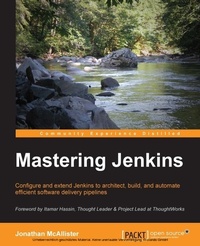
Mastering Jenkins
Configure and extend Jenkins to architect, build, and automate efficient software delivery pipelines
Published on 7. October 2025
334 pages
978-1-78439-283-3 (ISBN)
Description

Configure and extend Jenkins to architect, build, and automate efficient software delivery pipelines
Key Features
Book DescriptionWith the software industry becoming more and more competitive, organizations are now integrating delivery automation and automated quality assurance practices into their business model. Jenkins represents a complete automation orchestration system, and can help converge once segregated groups into a cohesive product development and delivery team. By mastering the Jenkins platform and learning to architect and implement Continuous Integration, Continuous Delivery, and Continuous Deployment solutions, your organization can learn to outmanoeuvre and outpace the competition. This book will equip you with the best practices to implement advanced continuous delivery and deployment systems in Jenkins. The book begins with giving you high-level architectural fundamentals surrounding Jenkins and Continuous Integration. You will cover the different installation scenarios for Jenkins, and see how to install it as a service, as well as the advanced XML configurations. Then, you will proceed to learn more about the architecture and implementation of the Jenkins Master/Save node system, followed by creating and managing Jenkins build jobs effectively. Furthermore, you'll explore Jenkins as an automation orchestration system, followed by implementing advanced automated testing techniques. The final chapters describe in depth the common integrations to Jenkins from third-party tools such as Jira, Artifactory, Amazon EC2, and getting the most out of the Jenkins REST-based API. By the end of this book, you will have all the knowledge necessary to be the definitive resource for managing and implementing advanced Jenkins automation solutions for your organization.What you will learn
Create and manage various types of build jobs, and implement automation tasks to support a software project of any kind
Get to grips with the automated testing architecture, and scalable automated testing techniques
Facilitate the delivery of software across the SDLC by creating scalable automated deployment solutions
Manage scalable automation pipelines in Jenkins using the latest build, test, and deployment strategies
Implement a scalable master / slave build automation platform, which can support Windows, Mac OSX, and Linux software solutions
Cover troubleshooting and advanced configuration techniques for Jenkins slave nodes
Support a robust build and delivery system by implementing basic infrastructure as code solutions in configuration management tools such as Ansible
Who this book is forIf you are a novice or intermediate-level Jenkins user who has used Jenkins before but are not familiar with architecting solutions and implementing it in your organization, then this is the book for you. A basic understanding of the core elements of Jenkins is required to make the best use of this book.
Key Features
Book DescriptionWith the software industry becoming more and more competitive, organizations are now integrating delivery automation and automated quality assurance practices into their business model. Jenkins represents a complete automation orchestration system, and can help converge once segregated groups into a cohesive product development and delivery team. By mastering the Jenkins platform and learning to architect and implement Continuous Integration, Continuous Delivery, and Continuous Deployment solutions, your organization can learn to outmanoeuvre and outpace the competition. This book will equip you with the best practices to implement advanced continuous delivery and deployment systems in Jenkins. The book begins with giving you high-level architectural fundamentals surrounding Jenkins and Continuous Integration. You will cover the different installation scenarios for Jenkins, and see how to install it as a service, as well as the advanced XML configurations. Then, you will proceed to learn more about the architecture and implementation of the Jenkins Master/Save node system, followed by creating and managing Jenkins build jobs effectively. Furthermore, you'll explore Jenkins as an automation orchestration system, followed by implementing advanced automated testing techniques. The final chapters describe in depth the common integrations to Jenkins from third-party tools such as Jira, Artifactory, Amazon EC2, and getting the most out of the Jenkins REST-based API. By the end of this book, you will have all the knowledge necessary to be the definitive resource for managing and implementing advanced Jenkins automation solutions for your organization.What you will learn
Create and manage various types of build jobs, and implement automation tasks to support a software project of any kind
Get to grips with the automated testing architecture, and scalable automated testing techniques
Facilitate the delivery of software across the SDLC by creating scalable automated deployment solutions
Manage scalable automation pipelines in Jenkins using the latest build, test, and deployment strategies
Implement a scalable master / slave build automation platform, which can support Windows, Mac OSX, and Linux software solutions
Cover troubleshooting and advanced configuration techniques for Jenkins slave nodes
Support a robust build and delivery system by implementing basic infrastructure as code solutions in configuration management tools such as Ansible
Who this book is forIf you are a novice or intermediate-level Jenkins user who has used Jenkins before but are not familiar with architecting solutions and implementing it in your organization, then this is the book for you. A basic understanding of the core elements of Jenkins is required to make the best use of this book.
All prices
More details
Edition
Digital original
Language
English
Place of publication
Birmingham
United Kingdom
Target group
Professional and scholarly
US School Grade: College Graduate Student
Edition type
Digital original
File size
7,90 MB
ISBN-13
978-1-78439-283-3 (9781784392833)
Copyright in bibliographic data and cover images is held by Nielsen Book Services Limited or by the publishers or by their respective licensors: all rights reserved.
Schweitzer Classification
Other editions
Additional editions
Persons
McAllister Jonathan :
Jonathan McAllister has been creating software and automations since he was a child. As an avid computer technologist, he has had 13 years' professional experience in software development, test, and delivery practices. During his career, he has architected and implemented software build, test, and delivery solutions for cutting-edge technology organizations across diverse technology stacks. Jonathan has most recently been focusing on build pipelines, continuous integration, continuous delivery, microservice architecture, standardized processes, agile and Kanban, and the implementation of highly scalable automation solutions. He has worked and consulted for some of the industry's most notable companies, including Microsoft, Merck, Logitech, and Oracle. His focus is entirely on designing scalable software build, delivery, and test pipelines in an effort to streamline releases through standardization and help develop strategies that can elevate revenue through modern continuous practices.
Jonathan McAllister has been creating software and automations since he was a child. As an avid computer technologist, he has had 13 years' professional experience in software development, test, and delivery practices. During his career, he has architected and implemented software build, test, and delivery solutions for cutting-edge technology organizations across diverse technology stacks. Jonathan has most recently been focusing on build pipelines, continuous integration, continuous delivery, microservice architecture, standardized processes, agile and Kanban, and the implementation of highly scalable automation solutions. He has worked and consulted for some of the industry's most notable companies, including Microsoft, Merck, Logitech, and Oracle. His focus is entirely on designing scalable software build, delivery, and test pipelines in an effort to streamline releases through standardization and help develop strategies that can elevate revenue through modern continuous practices.
Content
Table of Contents
Installing and configuring Jenkins
Distributed builds (Master/Slave mode)
Creating Dashboards, Views, and Jobs in Jenkins
Managing Views and Jobs in Jenkins
Advanced automated testing techniques
Scalable software deployments
Build & release pipelines
Continuous Delivery & Continuous Deployment
Integrating Jenkins with other tools
Understanding the Jenkins REST API
Installing and configuring Jenkins
Distributed builds (Master/Slave mode)
Creating Dashboards, Views, and Jobs in Jenkins
Managing Views and Jobs in Jenkins
Advanced automated testing techniques
Scalable software deployments
Build & release pipelines
Continuous Delivery & Continuous Deployment
Integrating Jenkins with other tools
Understanding the Jenkins REST API

