

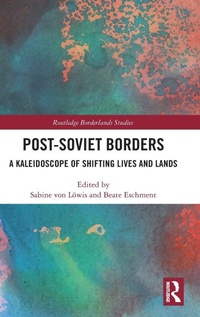
Post-Soviet Borders
A Kaleidoscope of Shifting Lives and Lands
1st Edition
Published on 18. August 2022
Book
Hardback
232 pages
978-0-367-77008-2 (ISBN)
Description
This book investigates how borders in former Soviet Union territories have evolved and shifted in the thirty years since the end of the Cold War.
The collapse of the Soviet Union in 1991 led to fifteen independent states and numerous de facto states; but this process of rebordering is not finished, and social, economic, infrastructural, cultural and political networks and spaces continue to develop. This book explores the intersection between these geopolitical shifts and the individual lived experience, drawing on cases from across border regions in the Caucasus, Central Asia and Eastern Europe. Throughout, the book introduces and frames the case studies with well-informed theoretical, conceptual and methodological overviews that situate them within border studies in general and post-Soviet border spaces in particular. Overall, the book demonstrates that like a kaleidoscope, the dynamic elements in these newly evolved border regions are similar yet strikingly different in their juxtapositions, with the appearance of new configurations often dependent on changing geopolitical constellations.
This timely guide to the post-Soviet world thirty years after the Cold War will be of interest to researchers across border studies, politics, geography, social anthropology, history, Eastern European Studies, Central Asian Studies, and Caucasian Studies.
The collapse of the Soviet Union in 1991 led to fifteen independent states and numerous de facto states; but this process of rebordering is not finished, and social, economic, infrastructural, cultural and political networks and spaces continue to develop. This book explores the intersection between these geopolitical shifts and the individual lived experience, drawing on cases from across border regions in the Caucasus, Central Asia and Eastern Europe. Throughout, the book introduces and frames the case studies with well-informed theoretical, conceptual and methodological overviews that situate them within border studies in general and post-Soviet border spaces in particular. Overall, the book demonstrates that like a kaleidoscope, the dynamic elements in these newly evolved border regions are similar yet strikingly different in their juxtapositions, with the appearance of new configurations often dependent on changing geopolitical constellations.
This timely guide to the post-Soviet world thirty years after the Cold War will be of interest to researchers across border studies, politics, geography, social anthropology, history, Eastern European Studies, Central Asian Studies, and Caucasian Studies.
More details
Series
Language
English
Place of publication
London
United Kingdom
Publishing group
Taylor & Francis Ltd
Target group
College/higher education
Postgraduate and Undergraduate Advanced
Illustrations
12 s/w Abbildungen, 10 s/w Photographien bzw. Rasterbilder, 2 s/w Zeichnungen, 1 s/w Tabelle
1 Tables, black and white; 2 Line drawings, black and white; 10 Halftones, black and white; 12 Illustrations, black and white
Dimensions
Height: 240 mm
Width: 161 mm
Thickness: 18 mm
Weight
543 gr
ISBN-13
978-0-367-77008-2 (9780367770082)
Copyright in bibliographic data and cover images is held by Nielsen Book Services Limited or by the publishers or by their respective licensors: all rights reserved.
Schweitzer Classification
Other editions
Additional editions
Book
05/2024
1st Edition
Routledge
€63.30
Shipment within 15-20 days
E-Book
08/2022
1st Edition
Routledge
€52.99
Available for download
E-Book
08/2022
1st Edition
Routledge
€52.99
Available for download
Persons
Sabine von Loewis is a senior researcher and head of the 'Conflict Dynamics and Border Regions' research cluster at the Centre for East European and International Studies (ZOiS) in Berlin, Germany.
Beate Eschment is a Central Asia specialist and researcher at the Centre for East European and International Studies (ZOiS) in Berlin, Germany.
Beate Eschment is a Central Asia specialist and researcher at the Centre for East European and International Studies (ZOiS) in Berlin, Germany.
Content
Part 1: Dynamics of Bordering in the Post-Soviet Space 1. Dynamics of Bordering in the Post-Soviet Space over the Last 30 Years Beate Eschment, Ketevan Kutsishvili, Sabine von Loewis 2. Between the 'Opening to the West' and the Trauma of Re-Bordering: Towards a Genealogy of Post-Soviet State Border Studies Tatiana Zhurzhenko 3.The Territorial Challenge in the Early Soviet State Stephan Rindlisbacher 4. Dialoguing Borders in the Post-Soviet Space through Citizen Science - Ukrainian Borderland Perspectives Johanna Jaschik, Machteld Venken Part 2: Western part 5. Within and Across Borders: Trust and Distrust in Russia's Exclave of Kaliningrad Rita Sanders 6. Transnistria: The Everyday of a De Facto Border Mikhail I. Klyuchnikov, Simon G. Pavlyuk, Nikita L. Turo Part 3: South Caucasus 7. Experiencing the Border, Encountering the State: The Ingiloy at the Azerbajani-Georgian Borderland Nino Aivazhvili-Gehne 8. Borderisation of South Ossetia: The Perspective of the Border Population Ariane Bachelet 9. Connected and Disconnected by the Border: The Shaping of the Turkish-Georgian Borderland Giorgi Cheishvili Part 4: Central Asia 10. Rethinking the Meaning of Neighbourhood: The Transformation of the Fergana Valley's Transborder Infrastructure Asel Murzakulova 11. Integration vs Disintegration: State Borders and Border Conflicts in the Isfara Valley Saodat Olimova, Muzaffar Olimov 12. Post-Soviet Decline or China-Induced Prosperity? Agricultural and Socio-Economic Change in the Kazakhstan-China Borderlands Henryk Alff