

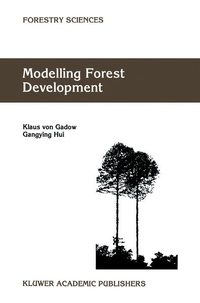
Modelling Forest Development
Published on 30. November 2001
Book
Paperback/Softback
IX, 213 pages
978-1-4020-0276-2 (ISBN)
Description
In an lUlffianaged woodland, forest development follows a succession of periods of undisturbed natural growth, interrupted by intermediate loss or damage of trees caused by fire or wind or other natural hazards. In a managed woodland, the most important periodic disturbances are the thinning operations, which are often carried out at regular intervals and which usually have a significant effect on the future evolution of the resource. Thus, a realistic model of forest development includes both natural growth and thinnings. The key to successful timber management is a proper understanding of growth processes, and one of the objectives of modelling forest development is to provide the tools that enable foresters to compare alternative silvicultural treatments. Foresters need to be able to anticipate the consequences of a particular thinning operation. In most cases, total timber volume is not a very appropriate measure for quantifying growth or yields, or changes caused by thinning operations. Yield in economic terms is defined by the dimensions and quality attributes of the harvestable logs, and estimating timber products is a central issue of production-oriented growth and yield research. Introduction 2 Growth modelling is also an essential prerequisite for evaluating the consequences of a particular management action on the future development of an important natural resource, such as a woodland ecosystem.
More details
Series
Edition
Softcover reprint of the original 1st ed. 1999
Language
English
Place of publication
Dordrecht
Netherlands
Target group
Professional and scholarly
Research
Illustrations
IX, 213 p.
Dimensions
Height: 234 mm
Width: 156 mm
Thickness: 13 mm
Weight
360 gr
ISBN-13
978-1-4020-0276-2 (9781402002762)
DOI
10.1007/978-94-011-4816-0
Schweitzer Classification
Other editions
Additional editions
Klaus von Gadow | Gangying Hui
Modelling Forest Development
Book
12/1998
Kluwer Academic Publishers
€91.00
Article exhausted; check different version
Content
1 Introduction.- Types of Forest Models.- Data Requirements.- 2 Projecting Regional Timber Resources.- Empirieal Yield Functions.- Yield Functions based on MAI Estimates.- 3 Modelling Stand Development.- Height.- Basal Area.- Potential Density.- State-Space Models.- Stand Volume and Product Yields.- Thinning Models.- 4 Size Class Models.- Diameter Growth.- Diameter-Height Relations.- Estimating Product Yields.- Modelling Thinnings.- 5 Individual Tree Growth.- Generating Spatial Structures.- Competition Indices.- Spatial Growth Models.- Spatial Thinning Models.- 6 Model Evaluation.- Qualitative Evaluations.- Quantitative Evaluations.- List of Symbols.- Literature.