

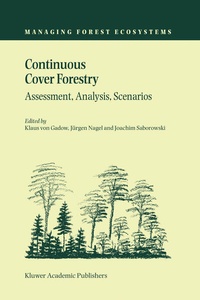
Continuous Cover Forestry
Assessment, Analysis, Scenarios
Published on 30. June 2002
Book
Hardback
XI, 348 pages
978-1-4020-0659-3 (ISBN)
Description
The large-scale application of new silvicultural systems has become a political reality in many parts of the world. This involves a gradual transformation of traditional silvicultural practice towards Continuous Cover Forestry, also known as near-natural forest management, favouring mixed uneven-aged stands, site-adapted tree species and selective harvesting. Selective harvesting systems have a long tradition. Specific CCF-related resource assessment, forecasting and sustainable harvest control techniques have been developed, but details about their use are not widely known. The objective of this volume is to present state-of-the-art research results and techniques relating to CCF management with an emphasis on systems engineering and modelling. Using a very simple classification based on the development of timber volume over age or time we may distinguish two types of sustainable forest management systems. Rotation forest management (RFM) systems, characterized by standard silvicultural treatments and repetitive cycles of clearfelling followed by planting; and continuous cover forestry (CCF) systems which are characterized by selective harvesting and natural regeneration, resulting in uneven-aged structures and frequently also in multi-species forests. The distinction is usually the result of decisions relating to the cost of timber harvesting, simplicity of management, or various intangible benefits. The oldest and most perfect examples of CCF systems are the so called plenter selection forests found in France, Switzerland, Slowenia and Germany. Today, CCF systems are encountered in various regions of Europe, North America and in some tropical and sub-tropical forests of South Africa, Asia and South America.
More details
Series
Edition
2002 ed.
Language
English
Place of publication
Dordrecht
Netherlands
Target group
Professional and scholarly
College/higher education
Research
Product notice
sewn/stitched
Cloth over boards
Illustrations
XI, 348 p.
Dimensions
Height: 241 mm
Width: 160 mm
Thickness: 28 mm
Weight
791 gr
ISBN-13
978-1-4020-0659-3 (9781402006593)
DOI
10.1007/978-94-015-9886-6
Schweitzer Classification
Other editions
Additional editions
Klaus von Gadow | Jürgen Nagel | Joachim Saborowski
Continuous Cover Forestry
Assessment, Analysis, Scenarios
E-Book
03/2013
1st Edition
Springer
€149.79
Available for download
Klaus von Gadow | Jürgen Nagel | Joachim Saborowski
Continuous Cover Forestry
Assessment, Analysis, Scenarios
Book
12/2010
Springer
€160.49
Shipment within 15-20 days
Content
Resource Assessment and Monitoring.- Stand Canopy Closure Estimated by Line Sampling with airborne Lidar.- Resource assessment techniques for Continuous Cover Forest systems.- Continuous cover forestry - new challenges for remote sensing.- An efficient approach to combine remote sensing and sample-based inventory for forest enterprises changing to near-natural forest management.- Monitoring of Forests under Continuous Cover System Management "Tools for the Regionalisation of Forest Inventories".- Analysis of Genetic Structure.- Reproduction in continuous cover forests - the geneticist's perspective.- Effects of different silvicultural treatments on the genetic structure of european beech populations (Fagus sylvatica L.).- Target-diameter felling and consequences for gentic structures in a beech stand (Fagus sylvatica L.).- Analysis of Forest Structure.- Calibrating predicted diameter distribution with additional information for structurally diverse forest stands.- Forest structure and diameter growth in maritime pine in a Mediterranean area.- Analysis of mapped point patterns by nearest-neighbor indices - on the nearest-neighbor reciprocity and edge-effect corrections-.- Spatial, Age and Diameter Structure of the Semi-natural Scots Pine Stands on Coastal Dunes in Latvia.- Scenarios and control.- Stem number guide curves for uneven-aged forests - development and limitations.- A growth model and harvest allocation algorithm for timber and non-timber product management planning in Iwokrama Forest, Guyana.- Generating management alternatives for multi-species stands using the decision-support system Bwin pro.- Using logistic regression to model tree selection preferences for harvesting in forests in conversion.- A methodology for the retrospective analysis ofthe releasement response of old aged european beech trees.- Preliminary study for a flexible growth model to predict the consequences of CCF in Wales.- Tree diversity, landscape diversity, and economics of maple-birch forests: Implications of Markovian models.- Economic Evaluation of Uneven-aged Management.- Regional Experiences.- Continuous cover forestry in the United States - experience with Southern Pines.- Continuous cover forestry systems in tropical and subtropical forests - current state and future perspectives.- The place of Continuous Cover Forestry among the Silvicultural Systems in Poland.