

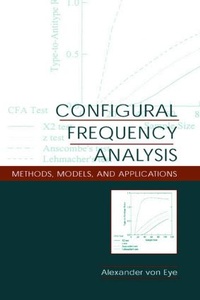
Configural Frequency Analysis
Methods, Models, and Applications
1st Edition
Published on 1. June 2002
Book
Paperback/Softback
470 pages
978-0-8058-4324-8 (ISBN)
Description
Configural Frequency Analysis (CFA) provides an up-to-the-minute comprehensive introduction to its techniques, models, and applications. Written in a formal yet accessible style, actual empirical data examples are used to illustrate key concepts. Step-by-step program sequences are used to show readers how to employ CFA methods using commercial software packages, such as SAS, SPSS, SYSTAT, S-Plus, or those written specifically to perform CFA.
CFA is an important method for analyzing results involved with categorical and longitudinal data. It allows one to answer the question of whether individual cells or groups of cells of cross-classifications differ significantly from expectations. The expectations are calculated using methods employed in log-linear modeling or a priori information. It is the only statistical method that allows one to make statements about empty areas in the data space.
Applied and or person-oriented researchers, statisticians, and advanced students interested in CFA and categorical and longitudinal data will find this book to be a valuable resource. Developed since 1969, this method is now used by a large number of researchers around the world in a variety of disciplines, including psychology, education, medicine, and sociology. Configural Frequency Analysis will serve as an excellent text for courses on configural frequency analysis, categorical variable analysis, or analysis of contingency tables. Prerequisites include an understanding of descriptive statistics, hypothesis testing, statistical model fitting, and some understanding of categorical data analysis and matrix algebra.
CFA is an important method for analyzing results involved with categorical and longitudinal data. It allows one to answer the question of whether individual cells or groups of cells of cross-classifications differ significantly from expectations. The expectations are calculated using methods employed in log-linear modeling or a priori information. It is the only statistical method that allows one to make statements about empty areas in the data space.
Applied and or person-oriented researchers, statisticians, and advanced students interested in CFA and categorical and longitudinal data will find this book to be a valuable resource. Developed since 1969, this method is now used by a large number of researchers around the world in a variety of disciplines, including psychology, education, medicine, and sociology. Configural Frequency Analysis will serve as an excellent text for courses on configural frequency analysis, categorical variable analysis, or analysis of contingency tables. Prerequisites include an understanding of descriptive statistics, hypothesis testing, statistical model fitting, and some understanding of categorical data analysis and matrix algebra.
Reviews / Votes
"The text provides a most comprehensive complete overview of approaches, ideas and techniques."-Short Book Reviews
"This book provides both introductory and advanced material on CFA....the strengths...include the careful, clear, and accurate exposition of ideas of CFA and the large number of clear examples....I would definitely consider it for adoption as a supplemental course text...and recommend it to any investigators who wish to use CFA."
-Michael J. Rovine
Pennsylvania State University
"...both applied researchers and statisticians interested in CFA will find it a very valuable resource....Typically the raw frequencies are presented which is extremely helpful because readers will be able to reanalyze all the examples and verify the results given in the text...it uses interesting real data examples to illustrate the CFA models and explains how substantive conclusions can be drawn from applications of these models....Readers should have an easy time analyzing their own data with CFA."
-Christof Schuster
University of Notre Dame
More details
Language
English
Place of publication
Philadelphia
United States
Publishing group
Taylor & Francis Inc
Target group
College/higher education
Professional and scholarly
Dimensions
Height: 229 mm
Width: 152 mm
Weight
870 gr
ISBN-13
978-0-8058-4324-8 (9780805843248)
Copyright in bibliographic data and cover images is held by Nielsen Book Services Limited or by the publishers or by their respective licensors: all rights reserved.
Schweitzer Classification
Other editions
Additional editions
E-Book
01/2003
1st Edition
Psychology Press Ltd
€86.99
Available for download
E-Book
01/2003
1st Edition
Psychology Press Ltd
€86.99
Available for download
Book
06/2002
1st Edition
Psychology Press
€215.41
Shipment within 10-20 days
Person
Alexander von Eye
Content
Contents: Preface. Part I: Concepts and Methods of CFA. Introduction: The Goals and Steps of Configural Frequency Analysis. Log-Linear Base Models for CFA. Statistical Testing in Global CFA. Descriptive Measures for Global CFA. Part II: Models and Applications of CFA. Global Models of CFA. Regional Models of CFA. Comparing k Samples. Part III: Methods of Longitudinal CFA. CFA of Differences. CFA of Level, Variability, and Shape of Series of Observations. Part IV: The CFA Specialty File and Alternative Approaches to CFA. More Facets of CFA. Alternative Approaches to CFA. Part V: Computational Issues. Software to Perform CFA. Part VI: References and Indices.Appendices: A Brief Introduction to Log-Linear Modeling. Table of a*-Levels for the Bonferroni and Holm Adjustments.