

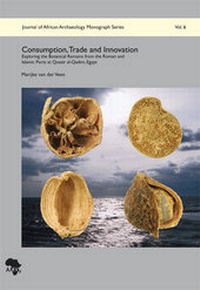
Consumption, Trade and Innovation
Exploring the Botanical Remains from the Roman and Islamic Ports at Quseir al-Qadim, Egypt
1st Edition
Published on 15. March 2011
Book
Hardback
XIV, 313 pages
978-3-937248-23-3 (ISBN)
More details
Series
Language
English
Place of publication
Frankfurt
Germany
Target group
Professional and scholarly
College/higher education
Illustrations
104
42 Tabellen, 11 Register, 1 Titelbild, 16 farbige Abbildungen, 104 s/w Abbildungen
Illustrations (some col.), maps
Dimensions
Height: 30 cm
Width: 21.2 cm
Thickness: 24 mm
Weight
2100 gr
ISBN-13
978-3-937248-23-3 (9783937248233)
Schweitzer Classification
Persons
Marijke van der Veen is Professor of Archaeology at the University of Leicester. Her research focuses on ancient agriculture and the archaeology of food, with a specialization in archaeobotany. Current research projects include a reconstruction of foodways and the development of horticulture in north-west Europe. She is author of Crop Husbandry Regimes (1992), and editor of The Exploitation of Plant Resources in Ancient Africa (1999), Luxury Foods (2003), Garden Agriculture (2005) and Agricultural Innovation (2010), the latter three issues of the journal World Archaeology.
Content
Foreword and Acknowledgements
Chronology Table
1 INTRODUCTION
1.1 Aims and Research Questions
1.2 The Indian Ocean Trade
Roman period trade
Islamic period trade
1.3 Quseir al-Qadim - Myos Hormos/Kusayr
1.4 Data Collection and Methods
Sampling strategy
Identification
Quantification and data presentation
Preservation
1.5 Chronology (Marijke van der Veen and Derek Hamilton)
Dating the Islamic assemblage - ceramics, coins and texts
Dating the Islamic assemblage - radiocarbon dates
Chronology of the Islamic assemblage
Summary
1.6 Contexts and Botanical Dataset
Contextual information - Roman
Contextual information - Islamic
The botanical assemblage
2 SPICES - CULINARY AND MEDICINAL COMMODITIES
(Marijke van der Veen, Alison Cox & Jacob Morales)
2.1 Introduction
2.2 Spices at the Ports
Pepper
Rice
Coconut
Mung bean
Myrobalans
Ginger
Turmeric
Cardamom
Fagara
Betelnut
Summary: patterns of trade at the ports
2.3 The Luxury of Long-Distance Trade
Spices as preservatives
Spices as commodities
Spices as articles of desire
3 SUMMER CROPS - FROM TRADE TO INNOVATION
(Marijke van der Veen & Jacob Morales)
3.1 Introduction
3.2 Summer Crops at the Ports
Rice
Citrus fruits
Cotton
Sugar cane
Aubergine
Taro
Banana
Sorghum
Pearl millet
Cowpea
Watermelon
Summary
3.3 Dispersal of Summer Crops into the Islamic World
Pre-Islamic dispersal
Islamic-period dispersal
Patterns of dispersal
3.4 Agricultural Innovation
Types of agricultural innovation
Nature of agricultural innovation
Agricultural innovation in Egypt
COLOUR PLATES
4 FOOD AND FOODWAYS - PATTERNS OF EVERYDAY LIFE
(Marijke van der Veen, Alison Cox & Jacob Morales)
4.1 Introduction
4.2 Food Consumption at the Ports
Cereals
Pulses
Fruits
Nuts
Oilseeds
Vegetables
Herbs and spices
Others
Preservation - desiccation versus carbonization
Summary
4.3 Animals, Fodder and Dung
4.4 Identifying Foodways
Watermelon - fruit flesh versus seeds
Citrus fruits - rind versus juice
Grapes and pomegranates - fresh versus dried fruits
Pulses - cooked dish versus snack food
Aubergine - overcoming bitterness
Others
4.5 Spatial Distribution of Waste Disposal
Cereals - food versus fodder
Food in the Roman port (1st-early-3rd centuries AD)
Food in the Islamic port (mid-11th-13th centuries AD)
Food in the Late Islamic port (14th and 15th centuries AD)
4.6 Patterns of Everyday Life
Nutrition and health
Eating as practice
5 WOODWORKING AND FIREWOOD - RESOURCE EXPLOITATION
(Marijke van der Veen, Rowena Gale & Dirk Übel)
5.1 Introduction
5.2 Maritime Artefacts
Roman ship-rigging artefacts
Islamic ship timbers
Pegs and wood shavings
5.3 Everyday Objects
Individual artefact classes
Summary
5.4 Firewood
5.5 Changing Resource Exploitation
Ship-building
Wood selection in everyday objects
Firewood
6 MYOS HORMOS AND KUSAYR - DIFFERENT WORLDS
6.1 Commodities and Trade
6.2 Agricultural Crops and Innovation
6.3 Food and Consumption
6.4 Myos Hormos and Kusayr - Different Worlds
Bibliography
Appendices (C14 dates; Data tables)
Index
Chronology Table
1 INTRODUCTION
1.1 Aims and Research Questions
1.2 The Indian Ocean Trade
Roman period trade
Islamic period trade
1.3 Quseir al-Qadim - Myos Hormos/Kusayr
1.4 Data Collection and Methods
Sampling strategy
Identification
Quantification and data presentation
Preservation
1.5 Chronology (Marijke van der Veen and Derek Hamilton)
Dating the Islamic assemblage - ceramics, coins and texts
Dating the Islamic assemblage - radiocarbon dates
Chronology of the Islamic assemblage
Summary
1.6 Contexts and Botanical Dataset
Contextual information - Roman
Contextual information - Islamic
The botanical assemblage
2 SPICES - CULINARY AND MEDICINAL COMMODITIES
(Marijke van der Veen, Alison Cox & Jacob Morales)
2.1 Introduction
2.2 Spices at the Ports
Pepper
Rice
Coconut
Mung bean
Myrobalans
Ginger
Turmeric
Cardamom
Fagara
Betelnut
Summary: patterns of trade at the ports
2.3 The Luxury of Long-Distance Trade
Spices as preservatives
Spices as commodities
Spices as articles of desire
3 SUMMER CROPS - FROM TRADE TO INNOVATION
(Marijke van der Veen & Jacob Morales)
3.1 Introduction
3.2 Summer Crops at the Ports
Rice
Citrus fruits
Cotton
Sugar cane
Aubergine
Taro
Banana
Sorghum
Pearl millet
Cowpea
Watermelon
Summary
3.3 Dispersal of Summer Crops into the Islamic World
Pre-Islamic dispersal
Islamic-period dispersal
Patterns of dispersal
3.4 Agricultural Innovation
Types of agricultural innovation
Nature of agricultural innovation
Agricultural innovation in Egypt
COLOUR PLATES
4 FOOD AND FOODWAYS - PATTERNS OF EVERYDAY LIFE
(Marijke van der Veen, Alison Cox & Jacob Morales)
4.1 Introduction
4.2 Food Consumption at the Ports
Cereals
Pulses
Fruits
Nuts
Oilseeds
Vegetables
Herbs and spices
Others
Preservation - desiccation versus carbonization
Summary
4.3 Animals, Fodder and Dung
4.4 Identifying Foodways
Watermelon - fruit flesh versus seeds
Citrus fruits - rind versus juice
Grapes and pomegranates - fresh versus dried fruits
Pulses - cooked dish versus snack food
Aubergine - overcoming bitterness
Others
4.5 Spatial Distribution of Waste Disposal
Cereals - food versus fodder
Food in the Roman port (1st-early-3rd centuries AD)
Food in the Islamic port (mid-11th-13th centuries AD)
Food in the Late Islamic port (14th and 15th centuries AD)
4.6 Patterns of Everyday Life
Nutrition and health
Eating as practice
5 WOODWORKING AND FIREWOOD - RESOURCE EXPLOITATION
(Marijke van der Veen, Rowena Gale & Dirk Übel)
5.1 Introduction
5.2 Maritime Artefacts
Roman ship-rigging artefacts
Islamic ship timbers
Pegs and wood shavings
5.3 Everyday Objects
Individual artefact classes
Summary
5.4 Firewood
5.5 Changing Resource Exploitation
Ship-building
Wood selection in everyday objects
Firewood
6 MYOS HORMOS AND KUSAYR - DIFFERENT WORLDS
6.1 Commodities and Trade
6.2 Agricultural Crops and Innovation
6.3 Food and Consumption
6.4 Myos Hormos and Kusayr - Different Worlds
Bibliography
Appendices (C14 dates; Data tables)
Index