

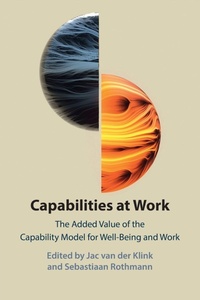
Capabilities at Work
The Added Value of the Capability Model for Well-Being and Work
Will be published approx. on 2. July 2026
Book
Paperback/Softback
200 pages
978-1-009-60056-9 (ISBN)
Description
This book examines how the capability approach offers fresh ways to think about work, well-being, and social justice. It argues that work should not only provide income but also empower people to achieve their life goals, develop skills, and participate fully in society. Drawing on research and real-world examples, Jac van der Klink and Sebastiaan Rothmann show how organisations and policies can enhance employees' health, satisfaction, and capabilities. The chapters explore how human resource management, public administration, and organisational leadership can create fairer workplaces by removing barriers that limit potential, improving the quality of work, and ensuring access to opportunities for all. A key theme is equity: work should reduce disparities and foster inclusion across gender, socio-economic, and cultural divides. Timely and relevant, the text appeals to academics, practitioners, policymakers, and advocates seeking practical ways to make work more meaningful. This title is also available Open Access on Cambridge Core.
More details
Language
English
Place of publication
Cambridge
United Kingdom
Product notice
Paperback (trade)
Illustrations
Worked examples or Exercises
ISBN-13
978-1-009-60056-9 (9781009600569)
Copyright in bibliographic data and cover images is held by Nielsen Book Services Limited or by the publishers or by their respective licensors: all rights reserved.
Schweitzer Classification
Other editions
Additional editions
Jac van der Klink | Sebastiaan Rothmann
Capabilities at Work
The Added Value of the Capability Model for Well-Being and Work
Book
approx. 07/2026
Cambridge University Press
€129.50
Not yet published
Persons
Jac van der Klink is Emeritus Professor at Tilburg University, the Netherlands, and Extraordinary Professor at Northwest University, South Africa. He studied medicine and psychology and has worked as both a professional and scientist, specialising in the capability approach to work. Jac has published more than 250 scientific and professional articles and books. Sebastiaan Rothmann is Professor of Industrial Psychology at North-West University, South Africa. He has published about work capabilities, well-being and performance in 277 peer-reviewed articles, book chapters, and books. The Society for Industrial/Organisational Psychology of South Africa awarded him a fellowship for his contributions to the science and practice.
Content
Part I. The Capability Model in Relation to Work: 1. The capability model for work: an introduction; 2. Capabilities and work: new developments toward sustainability and well-being at work; 3. The capability approach in relation to contributive justice; 4. The paradox of capability assessment: investigational requirements associated with adopting capability as an informational focus of a theory of justice; 5. Integrative aspects of the capability approach; 6. Integrating the capability approach with other theories of work and employee health and well-being; Part II. Applications of the Capability Model at Different Levels in the Organisation: Conceptual and Practical Considerations: 7. Introducing justice into the governance of corporations; 8. Linking the capability approach for sustainable employability to strategic and inclusive human resource management; 9. The capability model applied to working individuals: decent and flourishing work; 10. Practical applications of the capability approach; Part III. Work Capabilities in Different Contexts: 11. (Cross-)cultural perspectives on the capability approach; 12. Decent work and social justice from the vantage point of the global south: decoloniality and the capability approach as parrhesia; 13. Work capabilities in different occupations and countries; 14. The capability approach: a guiding framework for work capabilities and leadership; 15. Future work and the capability approach: digitalisation, globalisation and climate change.