


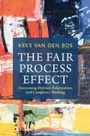
The Fair Process Effect
Overcoming Distrust, Polarization, and Conspiracy Thinking
Published on 9. November 2023
Book
Paperback/Softback
174 pages
978-1-009-21900-6 (ISBN)
Description
The Fair Process Effect aims to shed light on why there are so many instances of distrust, polarization, and conspiracy thinking in our world and what we can do about this. The book focuses on the fair process effect as a mechanism that may help to start overcoming these important issues of societal discontent. This is a positive effect that people exhibit when they have been treated in genuinely fair and just ways by fellow human beings and societal authorities. Current insights presented in the book aid the understanding of why people may experience discontent, distrust, and disillusionment. Furthermore, these insights can be used to start countering exaggerated levels of distrust, heightened polarization, and unfounded conspiracy thinking. To this end, Van den Bos develops a coherent and modern account of the fair process effect, targeted at understanding and managing these pertinent issues.
Reviews / Votes
'As one of the world's most important scientific contributors to the study of fair processes throughout his career, Kees van den Bos covers the literature comprehensively. In this book, he uses his encyclopedic knowledge to define and operationalize the research on perceived procedural justice as applied to societal discontent, polarization, conspiracy thinking, and the prevention of unwarranted distrust. It is an extraordinary accomplishment.' Robert Folger, University of Central Florida, USA 'Brilliant! Written by one of the pre-eminent scholars in the field of social justice, this clear and cogent presentation of research, theory, and application of the fair process effect - a remarkably powerful social psychological phenomenon - is a 'must read' for social psychologists, sociologists, political scientists, legal scholars, and policy makers.' Allan Lind, Duke University, USA 'Scholars and practitioners in management and law recognize the value of building rules and institutions around the psychological principles of the fair process effect. This deeply researched, compellingly written and engagingly optimistic book highlights the benefits of using this same model to address the political issues of polarization, distrust, and conspiracy thinking.' Tom Tyler, Yale University, USA 'This book is timely, providing a comprehensive review of social psychological research on the topic and showcasing the practical applicability of research in addressing societal issues. This study is accessible to even novice readers, illustrating how research can contribute to solving social problems ... Recommended.' S. Reysen, CHOICEMore details
Language
English
Place of publication
Cambridge
United Kingdom
Target group
College/higher education
Edition type
New edition
Product notice
Paperback (trade)
Illustrations
Worked examples or Exercises
Dimensions
Height: 225 mm
Width: 150 mm
Thickness: 13 mm
Weight
268 gr
ISBN-13
978-1-009-21900-6 (9781009219006)
Copyright in bibliographic data and cover images is held by Nielsen Book Services Limited or by the publishers or by their respective licensors: all rights reserved.
Schweitzer Classification
Other editions
Additional editions
Book
11/2023
Cambridge University Press
€88.00
Shipment within 15-20 days
Person
Kees van den Bos is Professor of Social Psychology and Professor of Empirical Legal Science at Utrecht University, the Netherlands. His research answers basic questions as to why perceived fairness and justice matter so much to people. These insights are used by citizens, practitioners, and governments to understand and prevent con¿icts and discontent in society.
Content
Preface; Part I. Introduction; 1. A Framework for Understanding Societal Discontent; Part II. Perceiving Procedural Fairness: 2. Criteria; 3. Psychological Processes; Part III. The Fair Process Effect: 4. Basic Review; 5. Psychological Processes; Part IV. Examining Societal Discontent: 6. Distrust; 7. Polarization; 8. Conspiracy Thinking; Part V. Overcoming Societal Discontent: 9. Opening Up; 10. The Future; Acknowledgements; References; Index.