

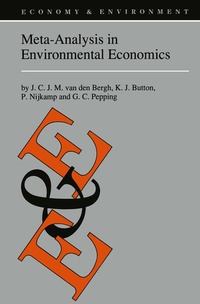
Meta-Analysis in Environmental Economics
Published on 4. December 2010
Book
Paperback/Softback
VII, 219 pages
978-90-481-4862-2 (ISBN)
Description
Meta-analysis is a formal synthesis of results and findings of scientific studies, which can assist in gaining new insights, explaining differences between results of similar studies, or determine useful directions of research. In this book we focus on the use of meta-analysis in environmental economics and related fields of study.
The first part of the book covers the overall meta-approach methodology for social sciences and economics in particular. This is followed by technical and non-technical discussions of statistical and rough-set techniques for analysis. At appropriate places this is supplemented with reviews of applications in environmental economics and related fields.
In the second part of the book a number of case studies show different aspects of the application of meta-analysis. The research areas considered include, among others, tourism multipliers, air pollution valuation, risk and value of life, pesticide price policy, travel time savings, and transport externality and policy issues. The benefits of the appropriate application of meta-analysis in environmental economics are a better use of existing information and knowledge, removal of some of the subjectivity from analysis and forecasting, and greater clarity as to where future efforts in environmental economic analysis can most gainfully be deployed.
The first part of the book covers the overall meta-approach methodology for social sciences and economics in particular. This is followed by technical and non-technical discussions of statistical and rough-set techniques for analysis. At appropriate places this is supplemented with reviews of applications in environmental economics and related fields.
In the second part of the book a number of case studies show different aspects of the application of meta-analysis. The research areas considered include, among others, tourism multipliers, air pollution valuation, risk and value of life, pesticide price policy, travel time savings, and transport externality and policy issues. The benefits of the appropriate application of meta-analysis in environmental economics are a better use of existing information and knowledge, removal of some of the subjectivity from analysis and forecasting, and greater clarity as to where future efforts in environmental economic analysis can most gainfully be deployed.
More details
Series
Edition
Softcover reprint of hardcover 1st ed. 1997
Language
English
Place of publication
Dordrecht
Netherlands
Target group
Professional and scholarly
Research
Illustrations
VII, 219 p.
Dimensions
Height: 235 mm
Width: 155 mm
Thickness: 13 mm
Weight
359 gr
ISBN-13
978-90-481-4862-2 (9789048148622)
DOI
10.1007/978-94-015-8865-2
Schweitzer Classification
Other editions
Additional editions
J.C. van den Bergh | Kenneth J. Button | Peter Nijkamp
Meta-Analysis in Environmental Economics
Book
06/1997
Kluwer Academic Publishers
€106.99
Shipment within 15-20 days
Persons
Professor Dr P. Nijkamp
has received the 1996 Spinoza Award, an annual award to honour outstanding scientific merit and to stimulate innovative future research.
Content
A Meta-Analysis and Environmental Policy Evaluation.- 1 Environmental Policy Evaluation.- 2 Meta-Approaches to Environmental Policy Assessment.- 3 Meta-Approaches: Methodological Remarks.- 4 Review of Meta-Analysis with Applications to Economics.- B Methodology of Meta-Analysis in Environmental Economics.- 5 Statistical Meta-Analysis.- 6 Measurement and Uncertainty Issues in Environmental Economics and Decision Analysis.- 7 Basic Principles of Rough Set Analysis.- 8 Technical Issues in Rough Set Analysis.- C Application of Meta-Analysis to Environmental Case Studies.- 9 Multiplier Effects in Tourist Regions.- 10 Air Quality and Property Value.- 11 Working Conditions in Industrial Sectors: Valuations of Life.- 12 Effectiveness of Pesticide Price Policies in Agriculture.- 13 Effectiveness of Traffic Restraint Policies.- 14 Impacts of Mobility and Transport Policy.- D Conclusions and Guidelines.- 15 Summary Conclusions and Guidelines.- References.