

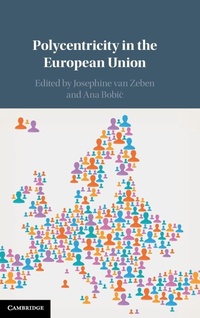
Polycentricity in the European Union
Published on 11. April 2019
Book
Hardback
340 pages
978-1-108-42354-0 (ISBN)
Description
Supranational governance is being challenged by politicians and citizens around the EU as over-centralized and undemocratic. This book is premised on the idea that polycentric governance, developed by Vincent and Elinor Ostrom, is a fruitful place to start for addressing this challenge. Assessing the presence of, and potential for, polycentric governance within the EU means approaching established principles and practices from a new perspective. While the debate on these issues is rich, longstanding and interdisciplinary, it has proven difficult to sidestep the 'renationalisation/federalisation' dichotomy. The aim of this volume is not to reject the EU's institutional structure but provide a different benchmark for the assessment of its functioning. Polycentric theory highlights the importance of multilevel horizontal relationships within the EU - between states, but also between many sub-state actors, all the way down to individuals. This helps us answer the question: how do we achieve self-governance in an interdependent world?
More details
Language
English
Place of publication
Cambridge
United Kingdom
Target group
Professional and scholarly
College/higher education
Product notice
sewn/stitched
Cloth over boards
Illustrations
Worked examples or Exercises; 9 Tables, black and white
Dimensions
Height: 234 mm
Width: 213 mm
Thickness: 23 mm
Weight
590 gr
ISBN-13
978-1-108-42354-0 (9781108423540)
Copyright in bibliographic data and cover images is held by Nielsen Book Services Limited or by the publishers or by their respective licensors: all rights reserved.
Schweitzer Classification
Other editions
Additional editions
Josephine van Zeben
Polycentricity in the European Union
E-Book
04/2019
Cambridge University Press
€83.99
Available for download
Josephine van Zeben | Ana Bobic
Polycentricity in the European Union
E-Book
04/2019
Cambridge University Press
€100.99
Available for download
Persons
Josephine van Zeben is a Fellow at Worcester College and Tutor in EU and Public Law. In 2013, she was a postdoctoral researcher at the Vincent and Elinor Ostrom Workshop in Political Theory and Policy Analysis. Dr van Zeben holds a degree in Social Sciences from Utrecht University, as well as law degrees from the University of Edinburgh, the University of Amsterdam and Harvard Law School. She has also been a Lecturer at the ETH Zurich since 2012. Her research focuses on how pluricentric systems - such as the EU - can best be structured to address complex regulatory problems. Ana Bobic is a Postdoctoral Researcher at the LEVIATHAN Project at the Hertie School of Governance, Berlin. She works on questions of accountability in EU economic governance, with a focus on the role of judicial and constitutional review. At the Faculty of Law, University of Oxford, she completed the D.Phil. as a Graduate Assistance Fund Scholar and the M.Jur. as the OSI/University of Oxford scholar. She previously obtained B.A. LL.M. summa cum laude at the Faculty of Law, University of Zagreb, Croatia in 2011. Ana was also a lecturer in Constitutional and Administrative Law at Keble College, University of Oxford.
Content
Introduction: the potential of a polycentric European Union Josephine van Zeben and Ana Bobic; 1. Polycentricity as a theory of governance Josephine van Zeben; 2. Polycentric features of the European Union Josephine van Zeben; 3. Democratic self-government in the EU's polycentric system: theoretical remarks Francis Cheneval; 4. Polycentric subsidiary Josephine van Zeben and Kalypso Nicolaidis; 5. Polycentricity and the internal market Josephine van Zeben and Ana Bobic; 6. The shared system of rules in a polycentric European Union Ana Bobic; 7. The promises and drawbacks of EU citizenship for a polycentric Union Martijn van den Brink; 8. Self-organisation of third-country nationals in the EU: polycentric governance by the 'other' Iris Goldner Lang; 9. Peaceful contestation Damjan Kukovec; 10. Access to justice in polycentric governance Leticia Diez Sanchez; 11. Access to information in polycentric governance Vigjilenca Abazi; 12. The capacity to learn in the polycentric European Union Sacha Garben; Conclusions: pathways to polycentricity Josephine van Zeben and Ana Bobic.