

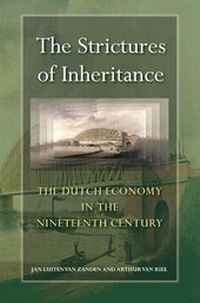
The Strictures of Inheritance
The Dutch Economy in the Nineteenth Century
Will be published approx. on 18. April 2004
Book
Hardback
416 pages
978-0-691-11438-5 (ISBN)
Description
A major feat of research and synthesis, this book presents the first comprehensive history of the Dutch economy in the nineteenth century--an important but poorly understood piece of European economic history. Based on a detailed reconstruction of extensive economic data, the authors account for demise of the Dutch economy's golden age. After showing how institutional factors combined to make the Dutch economy a victim of its own success, the book traces its subsequent emergence as a modern industrial economy. Between 1780 and 1914, the Netherlands went through a double transition. Its economy--which, in the words of Adam Smith, was approaching a "stationary state" in the eighteenth century--entered a process of modern economic growth during the middle decades of the nineteenth. At the same time, the country's sociopolitical structure was undergoing radical transformation as the decentralized polity of the republic gave way to a unitary state. As the authors show, the dramatic transformation of the Dutch political structure was intertwined with equally radical changes in the institutional structure of the economy.
The outcome of this dual transition was a rapidly industrializing economy on one side and, on the other, the neocorporatist sociopolitical structure that would characterize the Netherlands in the twentieth century. Analyzing both processes with a focus on institutional change, this book argues that the economic and political development of the Netherlands can be understood only in tandem.
The outcome of this dual transition was a rapidly industrializing economy on one side and, on the other, the neocorporatist sociopolitical structure that would characterize the Netherlands in the twentieth century. Analyzing both processes with a focus on institutional change, this book argues that the economic and political development of the Netherlands can be understood only in tandem.
Reviews / Votes
"A scientific masterpiece... The political dimension of the book renders its economic material more juicy and appealing to a wider audience."--P.A.G. Van Bergeijk, NRC Handelsblad "This is a major work."--A. van der Zwan, Trouw "The authors demonstrate how the economic history of the Netherlands between 1780 and 1914 can be effectively rewritten on the basis of insights derived from the 'new institutional economics'... This is a wonderful book."--W. Fritschy, Nederlandse Staatscourant "This immensely impressive book is underpinned by a major collaborative research project ... to reconstruct the Dutch national accounts from 1800-1913... This fine book stands as a major landmark, not only in the economic history of The Netherlands, but of Europe as a whole."--David Ormrod, Economic History ReviewMore details
Series
Language
English
Place of publication
New Jersey
United States
Target group
Professional and scholarly
College/higher education
Product notice
Trade binding
Illustrations
32 line illus. 54 tables.
Dimensions
Height: 229 mm
Width: 152 mm
Weight
709 gr
ISBN-13
978-0-691-11438-5 (9780691114385)
Copyright in bibliographic data and cover images is held by Nielsen Book Services Limited or by the publishers or by their respective licensors: all rights reserved.
Schweitzer Classification
Other editions
Additional editions
Jan Luiten van Zanden | Arthur van Riel
The Strictures of Inheritance
The Dutch Economy in the Nineteenth Century
E-Book
07/2022
1st Edition
Princeton University Press
€134.99
Available for download
Persons
Jan Luiten van Zanden is Professor of Economic History at Utrecht University and a senior research scholar at the International Institute of Social History. Arthur van Riel is a Senior Economist in the Dutch Ministry of the Interior and a member of the Netherlands's Economic Institute in Rotterdam.