

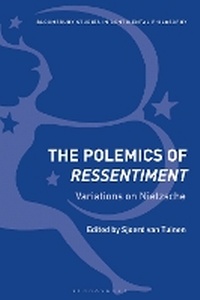
The Polemics of Ressentiment
Variations on Nietzsche
Published on 28. November 2019
Book
Paperback/Softback
256 pages
978-1-350-14171-1 (ISBN)
Description
The rise of populism, cynicism, fanaticism and fundamentalism challenges us to reconsider the problem of ressentiment. Characterized by Nietzsche as the self-poisoning of the will through internalising trauma in the form of a postponed and imaginary revenge, the concept of ressentiment is making a comeback in political
discourse.
Unlike resentment, the feeling of injustice, ressentiment is an intrinsically polemical notion. It implies a political drama in which there is no inherent good sense in its application and no universal criterion. Drawing on psychoanalysis, political theory, media theory and philosophy, this book examines a wide variety of ideological contexts, offering an examination of the divergent senses in which the concept of ressentiment is used today.
discourse.
Unlike resentment, the feeling of injustice, ressentiment is an intrinsically polemical notion. It implies a political drama in which there is no inherent good sense in its application and no universal criterion. Drawing on psychoanalysis, political theory, media theory and philosophy, this book examines a wide variety of ideological contexts, offering an examination of the divergent senses in which the concept of ressentiment is used today.
Reviews / Votes
A remarkably timely volume, exploring ressentiment as a problem of voluntary servitude and clearly articulating its critical and polemical value, in a good mix of contributions from prominent thinkers and early-career researchers. One of the richest and most coherently framed discussions of ressentiment in Continental philosophy in recent decades. -- Oliver Davis, Co-Director, Centre for Research in Philosophy, Literature and the Arts, Warwick University, UKMore details
Series
Language
English
Place of publication
London
United Kingdom
Publishing group
Bloomsbury Publishing PLC
Target group
College/higher education
Dimensions
Height: 234 mm
Width: 156 mm
Weight
363 gr
ISBN-13
978-1-350-14171-1 (9781350141711)
Copyright in bibliographic data and cover images is held by Nielsen Book Services Limited or by the publishers or by their respective licensors: all rights reserved.
Schweitzer Classification
Other editions
Additional editions
E-Book
05/2018
1st Edition
Bloomsbury Academic
€38.49
Available for download
E-Book
05/2018
1st Edition
Bloomsbury Academic
€38.99
Available for download
Person
Sjoerd van Tuinen is Assistant Professor in Philosophy and Co-Founder of the Erasmus Institute for Public Knowledge, at Erasmus University Rotterdam, The Netherlands.
Content
Preface
Acknowledgements
Table of Contents
Introduction
Sjoerd van Tuinen Erasmus University Rotterdam, The Netherlands
PART I Ressentiment as Involuntary Servitude
1. The Politics of Ressentiment and the Problem of Voluntary Servitude
Saul Newman, Goldsmiths, University of London, UK
2. Servitude of Pain: Reflections on the Passivity and Activity of Affects in Spinoza's Ethics
Marc Roelli, Zurich University of the Arts, Switzerland
3. The Problem of Ressentiment in Nietzsche and Deleuze`s Nietzsche
Simon Scott, University of Warwick, UK
4. The Irenics of Ressentiment: From Good Sense to Common Sense
Sjoerd van Tuinen, Erasmus University Rotterdam, The Netherlands
PART II Ressentiment and/or Envy
5. Envy: Sin of Sins, Painful Birth of Desire. Towards a Metapsychology of Ressentiment
Frank Vande Veire, University of Ghent, Belgium
6. Resentment and Ressentiment, Dignity and Honour: A Genealogical Analysis
Guido Vanheeswijck, University of Antwerp, Belgium
7. How the Other Becomes Our Beast. Postmodernity's Production of Ressentiment: a Mode D'emploi in Six Steps
Robert Pfaller, University of Applied Arts, Vienna, Austria
8. Failure as Triumph. The political Anthropology of the Death Drive in Slavoj Zizek
Christoph Narholz, Karlsruhe University of Arts and Design, Germany
PART III Ressentiment and Democracy
9. The Return of Ressentiment: the Dutch Debate on Right Wing Populism
Merijn Oudenampsen, University of Tilburg, The Netherlands
10. Resentment and Democracy
Sjaak Koenis, Maastricht University, The Netherlands
11. The Revenge of the Masses: Ressentiment or Amor Fati?
Daniel de Zeeuw, Amsterdam School for Cultural Analysis (ASCA) The Netherlands
12. The Power of Ambivalence
Sjoerd van Tuinen interviews Peter Sloterdijk, former Director of theKarlsruhe University of Arts and Design, Germany
13. A Commentary to Peter Sloterdijk's Remarks on Shakespeare's "The Merchant of Venice"
(Efrain Kristal, University ofCalifornia, Los Angeles, USA
Index
Acknowledgements
Table of Contents
Introduction
Sjoerd van Tuinen Erasmus University Rotterdam, The Netherlands
PART I Ressentiment as Involuntary Servitude
1. The Politics of Ressentiment and the Problem of Voluntary Servitude
Saul Newman, Goldsmiths, University of London, UK
2. Servitude of Pain: Reflections on the Passivity and Activity of Affects in Spinoza's Ethics
Marc Roelli, Zurich University of the Arts, Switzerland
3. The Problem of Ressentiment in Nietzsche and Deleuze`s Nietzsche
Simon Scott, University of Warwick, UK
4. The Irenics of Ressentiment: From Good Sense to Common Sense
Sjoerd van Tuinen, Erasmus University Rotterdam, The Netherlands
PART II Ressentiment and/or Envy
5. Envy: Sin of Sins, Painful Birth of Desire. Towards a Metapsychology of Ressentiment
Frank Vande Veire, University of Ghent, Belgium
6. Resentment and Ressentiment, Dignity and Honour: A Genealogical Analysis
Guido Vanheeswijck, University of Antwerp, Belgium
7. How the Other Becomes Our Beast. Postmodernity's Production of Ressentiment: a Mode D'emploi in Six Steps
Robert Pfaller, University of Applied Arts, Vienna, Austria
8. Failure as Triumph. The political Anthropology of the Death Drive in Slavoj Zizek
Christoph Narholz, Karlsruhe University of Arts and Design, Germany
PART III Ressentiment and Democracy
9. The Return of Ressentiment: the Dutch Debate on Right Wing Populism
Merijn Oudenampsen, University of Tilburg, The Netherlands
10. Resentment and Democracy
Sjaak Koenis, Maastricht University, The Netherlands
11. The Revenge of the Masses: Ressentiment or Amor Fati?
Daniel de Zeeuw, Amsterdam School for Cultural Analysis (ASCA) The Netherlands
12. The Power of Ambivalence
Sjoerd van Tuinen interviews Peter Sloterdijk, former Director of theKarlsruhe University of Arts and Design, Germany
13. A Commentary to Peter Sloterdijk's Remarks on Shakespeare's "The Merchant of Venice"
(Efrain Kristal, University ofCalifornia, Los Angeles, USA
Index