

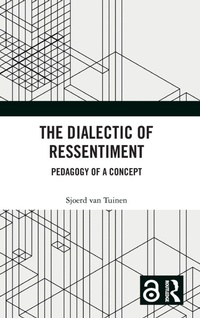
The Dialectic of Ressentiment
Pedagogy of a Concept
1st Edition
Published on 31. July 2023
Book
Hardback
312 pages
978-1-032-47021-4 (ISBN)
Description
Drawing upon a wide variety of authors, approaches, and ideological contexts, this book offers a comprehensive and detailed critique of the distinct and polemical senses in which the concept of ressentiment (and its cognate 'resentment') is used today. It also proposes a new mode of addressing ressentiment in which critique and polemics no longer set the tone: care.
Contemporary tendencies in political culture such as neoliberalism, nationalism, populism, identity politics, and large-scale conspiracy theories have led to the return of the concept of ressentiment in armchair political analysis. This book argues that, due to the tension between its enormous descriptive power and its mutually contradicting ideological performances, it is necessary to 'redramatize' the concept of ressentiment. By what right do we possess and use the concept of ressentiment, and what makes the phenomenon worth knowing? Inspired by Marxist political epistemology, affect theory, postcolonialism, and feminism, the book maps, delimits, and assesses four irreducible ways in which ressentiment can be articulated: the ways of the priest, the physician, the witness, and the diplomat. The first perspective is typically embodied by conservative (Scheler, Girard) and liberal (Smith, Rawls) political theory; the second, by Nietzsche, Deleuze and Foucault; whereas the standpoint of the witness is found in the writings of Amery, Fanon and Adorno; and the diplomat's is the author's own, albeit inspired by philosophers such as Ahmed, Stiegler, Stengers, and Sloterdijk. In producing a dialectical sequence between all four typical modes of enunciation, the book demonstrates how the first three reinterpretations of ressentiment are already implied in the theater set up in Nietzsche's late polemical books, while the fourth proposes a line of flight out of it.
The Dialectic of Ressentiment will be of interest to scholars and advanced students working in critical theory, social and political philosophy, cultural studies, sociology, history, literature, political science, anthropology, and Nietzsche scholarship. It will also appeal to anyone interested in the politics of anger, discourse ethics, trauma studies, and memory politics.
The Open Access version of this book, available at www.taylorfrancis.com, has been made available under a Creative Commons Attribution-Non Commercial-No Derivatives 4.0 license.
Contemporary tendencies in political culture such as neoliberalism, nationalism, populism, identity politics, and large-scale conspiracy theories have led to the return of the concept of ressentiment in armchair political analysis. This book argues that, due to the tension between its enormous descriptive power and its mutually contradicting ideological performances, it is necessary to 'redramatize' the concept of ressentiment. By what right do we possess and use the concept of ressentiment, and what makes the phenomenon worth knowing? Inspired by Marxist political epistemology, affect theory, postcolonialism, and feminism, the book maps, delimits, and assesses four irreducible ways in which ressentiment can be articulated: the ways of the priest, the physician, the witness, and the diplomat. The first perspective is typically embodied by conservative (Scheler, Girard) and liberal (Smith, Rawls) political theory; the second, by Nietzsche, Deleuze and Foucault; whereas the standpoint of the witness is found in the writings of Amery, Fanon and Adorno; and the diplomat's is the author's own, albeit inspired by philosophers such as Ahmed, Stiegler, Stengers, and Sloterdijk. In producing a dialectical sequence between all four typical modes of enunciation, the book demonstrates how the first three reinterpretations of ressentiment are already implied in the theater set up in Nietzsche's late polemical books, while the fourth proposes a line of flight out of it.
The Dialectic of Ressentiment will be of interest to scholars and advanced students working in critical theory, social and political philosophy, cultural studies, sociology, history, literature, political science, anthropology, and Nietzsche scholarship. It will also appeal to anyone interested in the politics of anger, discourse ethics, trauma studies, and memory politics.
The Open Access version of this book, available at www.taylorfrancis.com, has been made available under a Creative Commons Attribution-Non Commercial-No Derivatives 4.0 license.
More details
Language
English
Place of publication
London
United Kingdom
Publishing group
Taylor & Francis Ltd
Target group
College/higher education
Academic, Postgraduate, and Undergraduate Advanced
Dimensions
Height: 235 mm
Width: 157 mm
Thickness: 22 mm
Weight
622 gr
ISBN-13
978-1-032-47021-4 (9781032470214)
Copyright in bibliographic data and cover images is held by Nielsen Book Services Limited or by the publishers or by their respective licensors: all rights reserved.
Schweitzer Classification
Other editions
Additional editions
Book
11/2024
1st Edition
Routledge
€64.40
Shipment within 10-20 days
E-Book
07/2023
1st Edition
Routledge
€0.00
Available for download
E-Book
07/2023
1st Edition
Routledge
€0.00
Available for download
Person
Sjoerd van Tuinen is Associate Professor of Philosophy at Erasmus University Rotterdam. Driven by affinities across the arts and humanities, he publishes on critical theory, metaphysics, aesthetics, and the history of philosophy.
Content
Introduction 1. The Resentment-Ressentiment Complex 2. What is Ressentiment? 3. The Priest 4. The Physician 5. The Witness 6. The Diplomat