

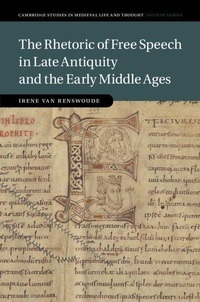
The Rhetoric of Free Speech in Late Antiquity and the Early Middle Ages
Published on 26. September 2019
Book
Hardback
288 pages
978-1-107-03813-4 (ISBN)
Description
The early Middle Ages is not a period traditionally associated with free speech. It is still widely held that free speech declined towards the end of Antiquity, disappearing completely at the beginning of the Middle Ages, and only re-emerging in the Renaissance, when people finally learned to think and speak for themselves again. Challenging this tenacious image, Irene van Renswoude reveals that there was room for political criticism and dissent in this period, as long as critics employed the right rhetoric and adhered to scripted roles. This study of the rhetoric of free speech from c.200 to c.900 AD explores the cultural rules and rhetorical performances that shaped practices of delivering criticism from Antiquity to the Middle Ages, examining the rhetorical strategies of letters and narratives in the late antique and early medieval men, and a few women, who ventured to speak the truth to the powerful.
More details
Series
Language
English
Place of publication
Cambridge
United Kingdom
Target group
Professional and scholarly
Dimensions
Height: 235 mm
Width: 157 mm
Thickness: 20 mm
Weight
574 gr
ISBN-13
978-1-107-03813-4 (9781107038134)
Copyright in bibliographic data and cover images is held by Nielsen Book Services Limited or by the publishers or by their respective licensors: all rights reserved.
Schweitzer Classification
Other editions
Additional editions
Irene van Renswoude
The Rhetoric of Free Speech in Late Antiquity and the Early Middle Ages
Book
06/2021
Cambridge University Press
€49.10
Shipment within 15-20 days
Irene van Renswoude
Rhetoric of Free Speech in Late Antiquity and the Early Middle Ages
E-Book
09/2019
Cambridge University Press
€21.99
Available for download
Person
Irene van Renswoude is Professor of Medieval Manuscripts and Cultural History at the Universiteit van Amsterdam, and researcher at Huygens Instituut voor Nederlandse Geschiedenis, a research institute of the Royal Netherlands Academy of Arts and Sciences. She was awarded the Heineken Young Scientist Award for History in 2014 for her research on free speech and censorship, and is a member of the editorial board of Medieval Worlds and the Journal for the History of Knowledge. She is the co-editor of several volumes, including Strategies of Writing: Studies on Texts and Trust in the Middle Ages (2008) and The Annotated Book in the Early Middle Ages (2018).
Content
Introduction; Part I: 1. The steadfast martyr; 2. Hilary of Poitiers; 3. The detached philosopher; 4. Ambrose of Milan; 5. The silent ascetic; Part II: 6. The frank holy man; 7. Gregory of Tours; 8. The wise adviser; 9. Agobard of Lyon; 10. Pope Gregory; Epilogue.