

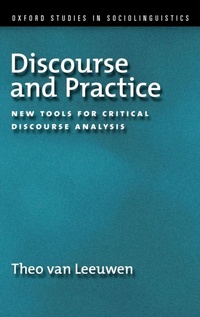
Discourse and Practice
New Tools for Critical Analysis
Published on 10. April 2008
Book
Hardback
192 pages
978-0-19-532330-6 (ISBN)
Description
Adding a new introduction and two previously unpublished papers, Discourse and Practice: New Tools for Critical Discourse Analysis brings together Van Leeuwen's methodological work on discourse analysis of the last 15 years. Discourse, Van Leeuwen argues, is a resource for representation, a knowledge about some aspect of reality which can be drawn upon when that aspect of reality has to be represented, a framework for making sense of things. And they are plural. There can be different discourses, different ways of making sense of the same aspect of reality that serve different interests and will therefore be used in different social contexts.
However abstract some discourses are, discourses ultimately always represent doings, Van Leeuwen argues. Doing is the foundation of knowing, and social practices are the foundation of discourses. Studying children's books, newspaper reports, brochures and other texts, as well as photographs and children's toys, Van Leeuwen investigates what can happen when practices are transformed into discourses and provides analytical tools for reconstructing discourses from texts.
Throughout the book, Van Leeuwen makes connections between sociological and linguistic or semiotic concepts and methods to ensure the social and critical relevance of his analytical categories. Van Leeuwen's work has already been widely used by critical discourse analysts across the world. This volume will be a welcome guide for anyone looking for a form of discourse analysis that is both explicit and methodical, and critically incisive.
However abstract some discourses are, discourses ultimately always represent doings, Van Leeuwen argues. Doing is the foundation of knowing, and social practices are the foundation of discourses. Studying children's books, newspaper reports, brochures and other texts, as well as photographs and children's toys, Van Leeuwen investigates what can happen when practices are transformed into discourses and provides analytical tools for reconstructing discourses from texts.
Throughout the book, Van Leeuwen makes connections between sociological and linguistic or semiotic concepts and methods to ensure the social and critical relevance of his analytical categories. Van Leeuwen's work has already been widely used by critical discourse analysts across the world. This volume will be a welcome guide for anyone looking for a form of discourse analysis that is both explicit and methodical, and critically incisive.
More details
Series
Language
English
Place of publication
New York
United States
Target group
College/higher education
Dimensions
Height: 240 mm
Width: 161 mm
Thickness: 15 mm
Weight
452 gr
ISBN-13
978-0-19-532330-6 (9780195323306)
Copyright in bibliographic data and cover images is held by Nielsen Book Services Limited or by the publishers or by their respective licensors: all rights reserved.
Schweitzer Classification
Other editions
Additional editions
E-Book
05/2008
1st Edition
OUP eBook
€27.49
Available for download
Book
05/2008
Oxford University Press Inc
€62.60
Shipment within 15-20 days
E-Book
05/2008
1st Edition
OUP eBook
€27.49
Available for download
Person
Theo van Leeuwen has worked as a film and television producer and scriptwriter in Holland and Australia. He then studied linguistics and combined the methods of linguistic analysis with his knowledge of visual communication in developing his approach to social semiotics.
Content
Preface; ; Chapter 1: Discourse as the recontextualization of social practice; ; 1. The supersedure of meaning by function; ; 2. Discourse as the recontextualization of social practice; ; 3. Social practices; ; Chapter 2: Representing social actors; ; 1. A sociosemantic inventory; ; 2. Our Race Odyssey; ; 3. Exclusion; ; 4. Role Allocation; ; 5. Genericisation and specification; ; 6. Assimilation; ; 7. Association and dissociation; ; 8. Indetermination and differentiation; ; 9. Nomination and categorization; ; 10. Functionalisation and identification; ; 11. Personalisation and impersonalisation; ; 12. Overdetermination; ; 13. Conclusion; ; Chapter 3: Representing social action ; 1. Introduction; ; 2. Reactions; ; 3. Material and semiotic action; ; 4. Objectivation and descriptivization; ; 5. De-agenitalization ; 6. Generalization and abstraction; ; 7. Overdetermination; ; 8. Conclusion; ; Chapter 4: Time in discourse; ; 1. Introduction; ; 2. The socio-semantics of location and extent; ; 2.1. Time summons; ; 2.2. Synchronisation; ; 2.3. Punctuality; ; 2.4. Exact and inexact timing; ; 2.5. Unique and recurring timing; ; 3. Experiencing Duration; ; 4. Managing Time; ; 5. Two examples; ; Chapter 5: Space in discourse; ; 1. Introduction; ; 2. Locating action; ; 3. Arranging and interpreting space; ; 4. Description and legitimation; ; 5. Subjective and objective space; ; 6. Word and image; ; Chapter 6: The discursive construction of legitimation; ; 1. Introduction; ; 2. Authorization; ; 3. Moral evaluation; ; 4. Rationalization; ; 5. Mythopoesis; ; 6. Multimodal legitimation; ; 7. Legitimation and context; ; Chapter 7: The discursive construction of purpose; ; 1. Introduction; ; 2. Purpose and Legitimation; ; 3. The grammar of purpose; ; Chapter 8: The visual representation of social actors; ; 1. Word and image; ; 2. The image and the viewer; ; 3. Depicting people; ; Chapter 9: Representing social actors with toys; ; 1. Introduction; ; 2. Roles, identities, meanings; ; 3. Preschool Playmobil; ; 4. Playing with Playmobil