

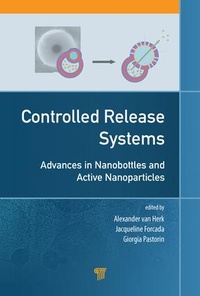
Controlled Release Systems
Advances in Nanobottles and Active Nanoparticles
1st Edition
Published on 2. December 2015
Book
Hardback
574 pages
978-981-4613-21-7 (ISBN)
Description
In the area of controlled release of active substances, such as drugs, a strong interest in nanoparticles as carriers of active ingredients has arisen. Some of the active components are extremely hydrophobic, without cellular permeability and susceptible to metabolic degradation. Owing to this, their use is limited. This kind of agent can be transported without any problem through physiological media by using nanoparticles. The size of particles is an important parameter because it governs the efficiency of the delivery system. For this type of application, particles that have a diameter smaller than 1 ?m are especially useful. Polymeric nanoparticles that have diameters in the colloidal range are produced by means of polymerization processes in dispersed media. Drugs are taken up into the nanoparticles by adsorption, absorption, or "entrapment," or covalent bonding and they are delivered (release) by desorption, diffusion, polymer degradation, or a combination of these mechanisms.
Nanoparticles (including nanogels) that release their contents by external triggering open up new possibilities for therapeutic strategies. External triggering by light, heat, change in pH, or application of ultrasound opens up the possibility to release the material on demand. If only a part of the wall of the nanoparticle (nanocapsule) is responsive, we are dealing with the so-called nanobottles, a nanocontainer with the active substance and a lid on the container that can be "opened" and "closed" by external triggering.
This book focuses on responsive nanoparticles and brings together two interesting areas: nanoparticles and responsive polymers. The concept of the book is that of a systematic approach from nanoparticles synthesis via responsive polymers to nanobottles. The second part of the book presents contributions from experts in the field and provides a state-of-the-art overview of the field.
Nanoparticles (including nanogels) that release their contents by external triggering open up new possibilities for therapeutic strategies. External triggering by light, heat, change in pH, or application of ultrasound opens up the possibility to release the material on demand. If only a part of the wall of the nanoparticle (nanocapsule) is responsive, we are dealing with the so-called nanobottles, a nanocontainer with the active substance and a lid on the container that can be "opened" and "closed" by external triggering.
This book focuses on responsive nanoparticles and brings together two interesting areas: nanoparticles and responsive polymers. The concept of the book is that of a systematic approach from nanoparticles synthesis via responsive polymers to nanobottles. The second part of the book presents contributions from experts in the field and provides a state-of-the-art overview of the field.
More details
Language
English
Place of publication
Singapore
Singapore
Target group
College/higher education
Professional and scholarly
Academic and Postgraduate
Illustrations
75 s/w Abbildungen, 20 farbige Abbildungen
20 Illustrations, color; 75 Illustrations, black and white
Dimensions
Height: 229 mm
Width: 152 mm
Weight
932 gr
ISBN-13
978-981-4613-21-7 (9789814613217)
Copyright in bibliographic data and cover images is held by Nielsen Book Services Limited or by the publishers or by their respective licensors: all rights reserved.
Schweitzer Classification
Other editions
Additional editions
Alex van Herk | Jacqueline Forcada | Giorgia Pastorin
Controlled Release Systems
Advances in Nanobottles and Active Nanoparticles
E-Book
01/2016
Pan Stanford Publishing Pte Ltd
€152.99
Available for download
Persons
Jacqueline Forcada is associate professor in chemical engineering at the University of the Basque Country, Spain, and group leader at the Department of Applied Chemistry. Her research focuses on the synthesis, characterization, modeling, and biotechnological applications of functionalized polymeric and hybrid nanoparticles and nanogels.
Alex van Herk is team leader and senior researcher at the Institute of Chemical and Engineering Sciences, Singapore, since 2012 and visiting professor in Polymer Reaction Engineering at the Eindhoven University of Technology, the Netherlands. His field of research is nanotechnology, water-based coatings, and emulsion polymerization. He has edited four books and authored more than 180 papers.
Giorgia Pastorin joined the Faculty of Science at the National University of Singapore in June 2006, as assistant professor in the Department of Pharmacy. She became associate professor in the same department in July 2011. Her research interests focus on drug delivery (through the development of functionalized nanomaterials for potential biomedical applications) and medicinal chemistry (through the synthesis of heterocyclic molecules, as potent and selective GPCR ligands and potential therapeutics for several pathological conditions, including Parkinson's disease and cancer.
Alex van Herk is team leader and senior researcher at the Institute of Chemical and Engineering Sciences, Singapore, since 2012 and visiting professor in Polymer Reaction Engineering at the Eindhoven University of Technology, the Netherlands. His field of research is nanotechnology, water-based coatings, and emulsion polymerization. He has edited four books and authored more than 180 papers.
Giorgia Pastorin joined the Faculty of Science at the National University of Singapore in June 2006, as assistant professor in the Department of Pharmacy. She became associate professor in the same department in July 2011. Her research interests focus on drug delivery (through the development of functionalized nanomaterials for potential biomedical applications) and medicinal chemistry (through the synthesis of heterocyclic molecules, as potent and selective GPCR ligands and potential therapeutics for several pathological conditions, including Parkinson's disease and cancer.
Content
Responsive Polymer Nanoparticles. General Introduction and Definitions. Responsive Polymers: Types and Properties. Types of Responsive Polymeric Nanoparticles and Comparison with Responsive Macroscopic Materials. Synthetic Strategies to Produce Responsive Polymer Nanoparticles. Approaches to Targeting of Nanoparticles towards Tissues/Organs. Characterization of Responsiveness. Selection of Nanoparticles for Treatment of Certain Diseases. State of the Art on Synthesis and Applications of Polymeric Nanoparticles. Nanogels. Magnetic Latex. Nanocapsules, Liposomes, Bubble Liposomes, Layer-by-Layer Approach, Micelles. Inorganic Nanoparticles/Capsules. Carbon Nanotubes. Dendrimers. Cancer. Neurodegenerative Diseases (Alzheimer, Parkinson). Nanocardiology. Immunotherapy and Vaccines.