

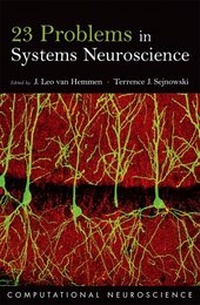
23 Problems in Systems Neuroscience
Published on 5. January 2006
Book
Hardback
548 pages
978-0-19-514822-0 (ISBN)
Description
The complexity of the brain and the protean nature of behavior remain the most elusive area of science, but also the most important. van Hemmen and Sejnowski invited 23 experts from the many areas--from evolution to qualia--of systems neuroscience to formulate one problem each. Although each chapter was written independently and can be read separately, together they provide a useful roadmap to the field of systems neuroscience and will serve as a source of inspirations for future explorers of the brain.
Reviews / Votes
With such an attractive list of topics, this book is sure to find a wide audience at every level of interest, from lay readers to students and academics. * Nature *More details
Series
Language
English
Place of publication
New York
United States
Target group
Professional and scholarly
Researchers, students, and professors in neuroscience cognitive psychology, computational neuroscience, cognitive science, and philosophy
Illustrations
12 pp colour plates, numerous halftones and line drawings
Dimensions
Height: 160 mm
Width: 236 mm
Thickness: 33 mm
Weight
887 gr
ISBN-13
978-0-19-514822-0 (9780195148220)
Copyright in bibliographic data and cover images is held by Nielsen Book Services Limited or by the publishers or by their respective licensors: all rights reserved.
Schweitzer Classification
Other editions
Additional editions
J. Leo van Hemmen | Terrence J. Sejnowski
23 Problems in Systems Neuroscience
E-Book
12/2005
1st Edition
OUP USA
€106.99
Available for download
J. Leo van Hemmen | Terrence J. Sejnowski
23 Problems in Systems Neuroscience
E-Book
12/2005
1st Edition
OUP USA
€107.99
Available for download
Persons
Edited by J. Leo van Hemmen, Department of Physics, Technical University Munich, Germany and Terrence J. Sejnowski, Howard Hughes Medical Institute, Computational Neurobiology Laboratory, Salk Institute for Biological Studies, USA
Content
Part I How have brains evolved? ; 1. Shall we ever understand the fly's brain? ; 2. Can we understand the action of brain in natural environments? ; 3. Hemisphere dominance of brain function-which functions are lateralized and why? ; Part II How is the cerebral cortex organized? ; 4. What is the function of the thalamus? ; 5. What is a neuronal map, how does it arise, and what is it good for? ; 6. What is fed back? ; Part III How do neurons interact? ; 7. How Can the Brain be so Fast? ; 8. What is the Neural Code? ; 9. Are single cortical neurons independent or are they obedient members of a huge orchestra? ; 10. What is the other 85% of V1 doing? ; Part IV What can brains compute? ; 11. Which computation runs in visual cortical columns? ; 12. Are neurons adapted for specific computations? Examples from temporal coding in the auditory system ; 13. How is time represented in the brain? ; 14. How general are neural codes in sensory systems? ; 15. How does the hearing system perform auditory scene analysis? ; 16. How does our visual system achieve shift and size invariance? ; 17. What is reflected in sensory neocortical activity: External stimuli or what the cortex does with them? ; 18. Do perception and action result from different brain circuits? The three visual systems hypothesis ; 19. What are the projective fields of cortical neurons? ; 20. How are the features of objects integrated into perceptual wholes that are selected by attention? ; 21. Where are the switches on this thing? ; 22. Synesthesia: What does it tell us about the emergence of qualia, metaphor, abstract thought and language? ; 23. What are the neural correlates of consciousness?