

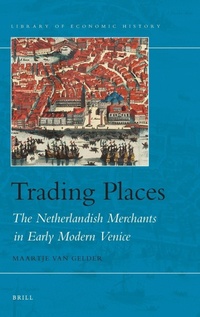
Trading Places
The Netherlandish Merchants in Early Modern Venice
Published on 20. May 2009
Book
Hardback
261 pages
978-90-04-17543-3 (ISBN)
Description
Trading Places is winner of the triennial Historical Research Award of Italy Studies (2012).
This book deals with the Netherlandish merchant community in sixteenth- and seventeenth-century Venice. It examines the merchants' commercial activities, their social and communal relations, as well as their interaction with the Venetian state, which was accustomed to protect its own trade. The Netherlandish merchants in Venice, as part of an extensive international trading network, were ideally placed to connect Mediterranean and Atlantic commerce. They quickly became the most important group of foreign merchants in the city at a time of rapid economic changes. Drawing on a wide variety of primary sources, this book shows how these immigrant traders used their strong commercial position to secure a place in Venice. It demonstrates how the changing balance of international commerce affected early modern Venetian society.
This book deals with the Netherlandish merchant community in sixteenth- and seventeenth-century Venice. It examines the merchants' commercial activities, their social and communal relations, as well as their interaction with the Venetian state, which was accustomed to protect its own trade. The Netherlandish merchants in Venice, as part of an extensive international trading network, were ideally placed to connect Mediterranean and Atlantic commerce. They quickly became the most important group of foreign merchants in the city at a time of rapid economic changes. Drawing on a wide variety of primary sources, this book shows how these immigrant traders used their strong commercial position to secure a place in Venice. It demonstrates how the changing balance of international commerce affected early modern Venetian society.
Reviews / Votes
AWARDSTrading Places is winner of the triennial Historical Research Award of Italy Studies (2012).
REVIEWS
"Trading Places offers both a useful confirmation of the great diversity and cosmopolitan nature of Mediterranean cities and a starting point for further studies of Netherlandish communities in early modern Venice and the Mediterranean." - Elizabeth Horodowich, New Mexico State University, in: Journal of Modern History 84/3 (September 2012), pp. 748-750
"Van Gelder's book represents a significant and valuable addition to the literature on commerce and society in early modern Venice." - Dennis Romano, Syracuse University, in: Renaissance Quarterly 64/1 (Spring 2011), pp. 289-291
"Trading Places is an important addition, not only to studies in Dutch commerce in Italy specifically but also to the more general research topic of Dutch merchants abroad [...] An outstanding achievement." - Henk Looijesteijn, Internationaal Instituut voor Sociale Geschiedenis, in: Tijdschrift voor Sociale en Economische Geschiedenis 8/3 (2011), pp. 117-121
"Rijk geschakeerd en voortreffelijk onderbouwd." - F. Vermeylen, in: De Zeventiende Eeuw 27/1 (2011), pp. 112-113
More details
Series
Language
English
Place of publication
Leiden
Netherlands
Target group
Professional and scholarly
All those interested in early modern merchant networks and trade, the history of Venice and the Mediterranean, and the economic expansion of the Dutch Republic.
Product notice
Laminated cover
Dimensions
Height: 240 mm
Width: 160 mm
Thickness: 16 mm
Weight
577 gr
ISBN-13
978-90-04-17543-3 (9789004175433)
Copyright in bibliographic data and cover images is held by Nielsen Book Services Limited or by the publishers or by their respective licensors: all rights reserved.
Schweitzer Classification
Other editions
Additional editions

Maartje van Gelder
Trading Places: The Netherlandish Merchants in Early Modern Venice
Software
05/2009
Brill
Unfortunately, price unknown
Available (delivery time upon request)
Person
Maartje van Gelder, Ph.D. (2007) in History, University of Amsterdam, is lecturer in Early Modern History at the same university. She works on early modern Dutch relations with the Mediterranean, with particular interest for Venice.
Content
Introduction
- A reversal of fortunes
- The decline of Venice and the rise of Amsterdam
- Merchant communities
- Approach and sources
Chapter 1. Venice
- Entering the city
- The inhabitants of Venice
- The Venetian state
- Declining Venetian commerce
- Immigrant traders in Venice: Germans, Ottomans, and Jews
Chapter 2. Unlocking the Venetian market: changing trade relations in the 1590s
- Early trade relations between Venice and the Low Countries
- In desperate need of cereals
- Importing Baltic grain into Venice
Chapter 3. Combining the new with the old: Netherlandish-Venetian trade after the 1590s
- The case of Cornelis Jansen
- Expanding commercial contacts
- Amsterdam-Mediterranean trade in 1646-1647
- Continuing overland trade
Chapter 4. The community of Netherlandish merchants in Venice
- The number of Netherlandish merchants in Venice
- The provenance of the Netherlandish merchants
- Forging family ties, economic partnerships, and bonds of friendship
- Religious differences?
Chapter 5. Individual and collective strategies
- Becoming Venetian citizens
- Petitions and privileges
- Banquets and charity
- Ambassadors and consuls
Chapter 6. At home in early modern Venice
- Finding a home
- A wealthy lifestyle
- Venetian relations
- Entering the Venetian patriciate
Conclusion
Bibliography
Index
- A reversal of fortunes
- The decline of Venice and the rise of Amsterdam
- Merchant communities
- Approach and sources
Chapter 1. Venice
- Entering the city
- The inhabitants of Venice
- The Venetian state
- Declining Venetian commerce
- Immigrant traders in Venice: Germans, Ottomans, and Jews
Chapter 2. Unlocking the Venetian market: changing trade relations in the 1590s
- Early trade relations between Venice and the Low Countries
- In desperate need of cereals
- Importing Baltic grain into Venice
Chapter 3. Combining the new with the old: Netherlandish-Venetian trade after the 1590s
- The case of Cornelis Jansen
- Expanding commercial contacts
- Amsterdam-Mediterranean trade in 1646-1647
- Continuing overland trade
Chapter 4. The community of Netherlandish merchants in Venice
- The number of Netherlandish merchants in Venice
- The provenance of the Netherlandish merchants
- Forging family ties, economic partnerships, and bonds of friendship
- Religious differences?
Chapter 5. Individual and collective strategies
- Becoming Venetian citizens
- Petitions and privileges
- Banquets and charity
- Ambassadors and consuls
Chapter 6. At home in early modern Venice
- Finding a home
- A wealthy lifestyle
- Venetian relations
- Entering the Venetian patriciate
Conclusion
Bibliography
Index