

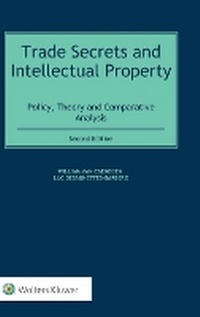
Trade Secrets and Intellectual Property
Policy, Theory and Comparative Analysis
2nd Edition
Published on 23. April 2025
Book
Hardback
296 pages
978-90-411-8664-5 (ISBN)
Description
Trade secrets law is probably the least harmonized part of IP law. Nonetheless, there is a growing realization that variable rules concerning trade secrets impact investment decisions, multinational businesses, and hiring policies. Recently this realization has resulted in the introduction of a new Trade Secrets Directive in the EU, which has harmonized trade secrets law across the Union. Nonetheless, agreement about the policy underpinnings, theoretical basis and economic impacts of trade secrets law remains elusive around the globe. Legal approaches vary fundamentally, and application of the law is far from uniform. Although there has been a recent trend towards strengthening trade secrets protection, both in civil and criminal law, as it tends to militate against labour mobility, freedom to imitate, and open circulation of what needs to be known to compete, there are many who support a more nuanced approach that emphasizes the benefits of unrestricted information flows for competitive markets.
Opting for a comparative and critical approach, this book proposes a nuanced analysis of:
- the competing theories that underlie trade secrets law, its theoretical justifications, and the varied doctrinal approaches found around the globe;
- the law in the US, the UK, France and Germany and the new EU Trade Secrets Directive;
- statute laws, international instruments, recent court decisions, and works of notable scholars in the field;
- topics such as the competition for control over knowledge between employees and employers; the growth of industrial espionage, country rivalry and third-party liability; the extent and precise parameters of criminal liability; and the policy implications of excessive restrictions on the transfer of employee knowledge and know-how.
This book provides a clear understanding of this multifaceted area of law which is often a fallback or last resort when commercial dealings and relationships go wrong. The authors' analysis of the underlying policy goals and theoretical dimension of the legal status of trade secrets, including choices in relation to the application of criminal law and concepts of property, will prove of enormous value to academics, policymakers, and corporate counsel.
Opting for a comparative and critical approach, this book proposes a nuanced analysis of:
- the competing theories that underlie trade secrets law, its theoretical justifications, and the varied doctrinal approaches found around the globe;
- the law in the US, the UK, France and Germany and the new EU Trade Secrets Directive;
- statute laws, international instruments, recent court decisions, and works of notable scholars in the field;
- topics such as the competition for control over knowledge between employees and employers; the growth of industrial espionage, country rivalry and third-party liability; the extent and precise parameters of criminal liability; and the policy implications of excessive restrictions on the transfer of employee knowledge and know-how.
This book provides a clear understanding of this multifaceted area of law which is often a fallback or last resort when commercial dealings and relationships go wrong. The authors' analysis of the underlying policy goals and theoretical dimension of the legal status of trade secrets, including choices in relation to the application of criminal law and concepts of property, will prove of enormous value to academics, policymakers, and corporate counsel.
More details
Edition
2nd ed.
Language
English
Place of publication
Alphen aan den Rijn
Netherlands
Product notice
sewn/stitched
Cloth over boards
Dimensions
Height: 234 mm
Width: 156 mm
Thickness: 18 mm
Weight
590 gr
ISBN-13
978-90-411-8664-5 (9789041186645)
Copyright in bibliographic data and cover images is held by Nielsen Book Services Limited or by the publishers or by their respective licensors: all rights reserved.
Schweitzer Classification