

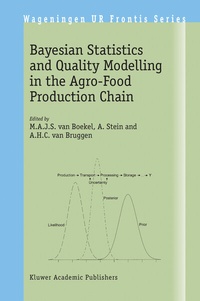
Bayesian Statistics and Quality Modelling in the Agro-Food Production Chain
Published on 16. August 2004
Book
Paperback/Softback
V, 163 pages
978-1-4020-1917-3 (ISBN)
Description
The food market is changing from a producer-controlled to a consumer-directed market. A main driving force is consumer concern about agricultural production methods and food safety. More than before, the consumer demands transparency of the production and processing chain.
A food chain can be quite complex and the use of models has become indispensable to handle this complexity. Modelling tools are becoming increasingly important to guide the decisions for production of high-quality and safe agricultural foods. With the aid of models it becomes possible to control and predict quality attributes, so that product innovation can be done more efficiently. However, quality is an elusive concept, and there is always an aspect of subjectivity and uncertainty.
A novel approach in the agro-food chain would be to tackle subjective elements and uncertainty in modelling by using Bayesian statistics and Bayesian Belief Networks. Bayesian approaches use prior probabilities (partly accounting for subjectivity) to estimate posterior probabilities, resulting in higher accuracy than is possible with classical statistical techniques. Thus, the variability and uncertainty in data and decisions, inherent in a complex food chain, can be dealt with.
A food chain can be quite complex and the use of models has become indispensable to handle this complexity. Modelling tools are becoming increasingly important to guide the decisions for production of high-quality and safe agricultural foods. With the aid of models it becomes possible to control and predict quality attributes, so that product innovation can be done more efficiently. However, quality is an elusive concept, and there is always an aspect of subjectivity and uncertainty.
A novel approach in the agro-food chain would be to tackle subjective elements and uncertainty in modelling by using Bayesian statistics and Bayesian Belief Networks. Bayesian approaches use prior probabilities (partly accounting for subjectivity) to estimate posterior probabilities, resulting in higher accuracy than is possible with classical statistical techniques. Thus, the variability and uncertainty in data and decisions, inherent in a complex food chain, can be dealt with.
More details
Other editions
Additional editions
M.A.J.S. van Boekel | A. Stein | A.H.C. van Bruggen
Bayesian Statistics and Quality Modelling in the Agro-Food Production Chain
Book
03/2004
Springer
€160.49
Shipment within 15-20 days
Content
From the contents:
Preface.- Introduction to Bayesian statistics.- Methodology.- Bayesian approaches to quality and safety in primary food production.- Bayesian approaches to quality and safety in food technology.- Bayesian approaches in the food chain, nutrition and epidemiology.- List of participants.