

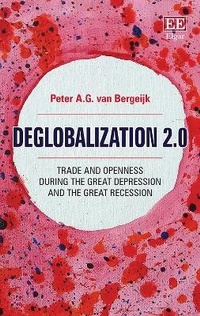
Deglobalization 2.0
Trade and Openness During the Great Depression and the Great Recession
Published on 9. April 2020
Book
Paperback/Softback
224 pages
978-1-83910-840-2 (ISBN)
Description
The rapid integration of global governments, businesses and capital has faced a dramatic and often hostile backlash in recent years. As populist agendas worldwide gain momentum, Deglobalization 2.0 explores the key drivers of reactionary movements.
From the 'Make America Great Again' movement in the US, to Continental European populism, Peter van Bergeijk explains the critical catalysts of anti-globalization sentiment. Through a historical lens, this book draws out similarities and differences between contemporary developments and the economic crises of the 1930s, offering a unique understanding of the political and economic drivers of deglobalization. Focusing on wealth inequality, social uncertainty and international competition for economic supremacy, van Bergeijk examines and offers answers for the lacunae in the globalization debate.
Provocative, insightful and accessible, this book confronts the deglobalization issue as a matter of real urgency and is thus vital reading for policy makers and managers working in international affairs and economic relations. It also offers guidance for academics in international economics and relations moving into the uncharted territory of deglobalization processes.
From the 'Make America Great Again' movement in the US, to Continental European populism, Peter van Bergeijk explains the critical catalysts of anti-globalization sentiment. Through a historical lens, this book draws out similarities and differences between contemporary developments and the economic crises of the 1930s, offering a unique understanding of the political and economic drivers of deglobalization. Focusing on wealth inequality, social uncertainty and international competition for economic supremacy, van Bergeijk examines and offers answers for the lacunae in the globalization debate.
Provocative, insightful and accessible, this book confronts the deglobalization issue as a matter of real urgency and is thus vital reading for policy makers and managers working in international affairs and economic relations. It also offers guidance for academics in international economics and relations moving into the uncharted territory of deglobalization processes.
Reviews / Votes
'This is an insightful and thought-provoking book that ranges widely in its analysis of deglobalization. All students of the international economy should read the latest work of this well-respected economist.'--Andrew K. Rose, University of California, Berkeley, US
More details
Language
English
Place of publication
Cheltenham
United Kingdom
Target group
Professional and scholarly
Dimensions
Height: 234 mm
Width: 156 mm
ISBN-13
978-1-83910-840-2 (9781839108402)
Copyright in bibliographic data and cover images is held by Nielsen Book Services Limited or by the publishers or by their respective licensors: all rights reserved.
Schweitzer Classification
Person
Peter A.G. van Bergeijk, Professor of International Economics and Macroeconomics, International Institute of Social Studies, Erasmus University, The Hague, the Netherlands
Content
Contents: Preface 1. Spoilers 2. Setting the stage 3. Deglobalization is not new! 4. What drives deglobalization? 5. Is deglobalization good or bad? 6. The future of deglobalization References Index