

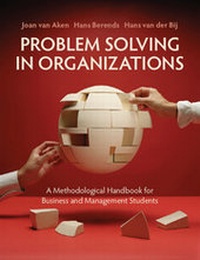
Problem Solving in Organizations
A Methodological Handbook for Business and Management Students
2nd Edition
Published on 21. June 2012
Book
Paperback/Softback
259 pages
978-1-107-61914-2 (ISBN)
Description
This concise introduction to the methodology of problem solving in organizations is an indispensable guide to the design and execution of practical business improvement projects in real organizational settings. The methodology is design-oriented and theory-informed. It encourages students to use the theory gained in their disciplinary courses by showing them how to do so in a fuzzy, ambiguous and politically charged, real-life organizational context. The book provides an in-depth discussion of the various aspects and steps of the process of business and organizational problem-solving. Rather than presenting the methodology as a recipe to be followed, the authors demonstrate how to adapt the approach to specific situations and to be flexible in scheduling the work at the various steps in the process. It will be indispensable to MBA and other students who venture outside the university walls to do real-life fieldwork.
Reviews / Votes
'This engaging book provides an evidence-based approach to solving organizational problems. It explores ways to think about, assess, act and resolve the messy problems that managers, consultants and other professionals face in their work lives. Business students and educators will find valuable guidance for developing the competencies that managing and organizing require.' Denise Rousseau, Carnegie Mellon University 'Understanding how to design and implement solutions to problems in real organizational settings is one of the most effective keys to success in the world of work. Founded on years of experience and research, the authors provide a systematic and practical guide in developing these essential skills. This indispensable handbook shows how to formulate problems and apply evidence-based knowledge in designing, implementing, and evaluating solutions.' Andrew H. Van de Ven, University of MinnesotaMore details
Edition
2nd Revised edition
Language
English
Place of publication
Cambridge
United Kingdom
Target group
Professional and scholarly
College/higher education
Edition type
Revised edition
Product notice
Paperback (trade)
Illustrations
2 Tables, black and white; 19 Line drawings, unspecified
Dimensions
Height: 246 mm
Width: 174 mm
Thickness: 12 mm
Weight
520 gr
ISBN-13
978-1-107-61914-2 (9781107619142)
Copyright in bibliographic data and cover images is held by Nielsen Book Services Limited or by the publishers or by their respective licensors: all rights reserved.
Schweitzer Classification
Other editions
New editions
Joan Ernst Van Aken | Hans Berends
Problem Solving in Organizations
A Methodological Handbook for Business and Management Students
Book
02/2018
3rd Edition
Cambridge University Press
€65.40
Shipment within 15-20 days
Persons
Joan Ernst van Aken is Professor Emeritus of Organization Science at the School of Industrial Engineering, Eindhoven University of Technology, The Netherlands. Hans Berends is Assistant Professor at the Department of Innovation, Technology, Entrepreneurship and Marketing in the School of Industrial Engineering, Eindhoven University of Technology, The Netherlands. Hans van der Bij is Associate Professor at the Department of Innovation Management and Strategy in the Faculty of Economics and Business, Groningen University, The Netherlands.
Content
List of figures; List of tables; List of boxes; Preface to the first edition; Preface to the second edition; Part I. Fundamentals: 1. Scope and nature of this handbook; 2. Student projects; 3. Problem-solving projects; 4. Generic design theory; 5. Using problem-solving projects to develop generic theory; Part II. The Problem-solving Project: 6. Intake and orientation; 7. Theory-informed diagnosis of business problems; 8. Solution design; 9. Change plan design and the actual change process; 10. Evaluation, learning and termination; Part III. On Methods: 11. Qualitative research methods; 12. Searching and using scholarly literature; 13. Quality criteria for research; Part IV. Case Material: 14. Cases; References.