

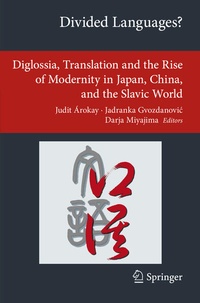
Divided Languages?
Diglossia, Translation and the Rise of Modernity in Japan, China, and the Slavic World
Published on 30. January 2014
Book
Paperback/Softback
XIII, 259 pages
978-3-319-03520-8 (ISBN)
Description
The present volume is a collection of papers presented at the international conference "Linguistic Awareness and Dissolution of Diglossia" held in July 2011 at Heidelberg University. The aim is to reevaluate and compare the processes of dissolution of diglossia in East Asian and in European languages, especially in Japanese, Chinese and in Slavic languages in the framework of the asymmetries in the emergence of modern written languages. Specialists from China, Japan, Great Britain, Germany and the U.S. contributed to the volume by introducing their research focusing on aspects of the dissolution of diglossic situations and the role of translation in the process. The first group of texts focuses on the linguistic concept of diglossia and the different processes of its dissolution, while the second investigates the perception of linguistic varieties in historical and transcultural perspectives. The third and final group analyses the changing cultural role and function of translations and their effect on newly developing literary languages.
More details
Series
Language
English
Place of publication
Cham
Switzerland
Publishing group
Springer International Publishing
Target group
Professional and scholarly
Research
Illustrations
XIII, 259 p.
Dimensions
Height: 235 mm
Width: 155 mm
Thickness: 16 mm
Weight
423 gr
ISBN-13
978-3-319-03520-8 (9783319035208)
DOI
10.1007/978-3-319-03521-5
Schweitzer Classification
Other editions
Additional editions
Judit Árokay | Jadranka Gvozdanovic | Darja Miyajima
Divided Languages?
Diglossia, Translation and the Rise of Modernity in Japan, China, and the Slavic World
E-Book
01/2014
1st Edition
Springer
€53.49
Available for download
Content
Part I: Diglossia and Functional Variation.- Understanding the Essence of Diglossia.- Czech Diglossia: Dismantling or Dissolution?.- Diglossia and its Discontent: The Linguistics of National Crisis in Early Twentieth-Century China.- Chinese Diglossia: Past and Present.- Shifting Patterns of Chinese Diglossia: Why the Dialects May Be Headed for Extinction.- Part II: Linguistic Awareness and Changing Perceptions of Varieties.- Discourse on Poetic Language in Early Modern Japan and the Awareness of Linguistic Change.- Genbun itchi and Questione della lingua: Theoretical Intersections in the Creation of a New Written Language in Meiji Japan and Renaissance Italy.- Linguistic Awareness and Language Use: The Chinese Literati at the Beginning of the Twentieth Century.- Homogenization or Hierarchization?--A Problem of Written Language in the Public Sphere of Modern Japan.- Part III: Diglossia and Translation.- Modeling the Shifting Face of the Discourse Mediator.- Translation within the Polyglossic Linguistic System of Early Meiji-Period Japan.- Genbun itchi and Literary Translations in Later Nineteenth-Century Japan: The Role of Literary Translations in Forming the "De-aru" Style.- The Role of Russian in the Dissolution of Diglossia in Japan: Translations by Futabatei Shimei.