

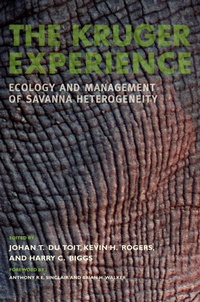
The Kruger Experience
Ecology And Management Of Savanna Heterogeneity
Published on 1. October 2003
Book
Paperback/Softback
536 pages
978-1-55963-982-8 (ISBN)
Description
Kruger National Park in South Africa has one of the most extensive sets of records of any protected area in the world, and throughout its history has supported connections between science and management. In recognition of that long-standing tradition comes The Kruger Experience, the first book to synthesize/summarize a century of ecological research and management in two million hectares of African savanna. The Kruger Experience places the scientific and management experience in Kruger within the framework of modern ecological theory and its practical applications. The book uses a cross-cutting theme of ecological heterogeneity -- the idea that ecological systems function across a full hierarchy of physical and biological components, processes, and scales, in a dynamic space-time mosaic. Contributors, who include many esteemed ecologists who have worked in Kruger in recent years, examine a range of topics covering broad taxonomic groupings and ecological processes.
The book's four sections explore: the historical context of research and management in Kruger, the theme of heterogeneity, and the current philosophy in Kruger for linking science with management; the template of natural components and processes, as influenced by management, that determine the present state of the Kruger ecosystem; how species interact within the ecosystem to generate further heterogeneity across space and time; humans as key components of savanna ecosystems; In addition to the editors, contributors include William J. Bond, Jane Lubchenco, David Mabunda, Michael G.L. ("Gus") Mills, Robert J. Naiman, Norman Owen-Smith, Steward T.A. Pickett, Stuart L. Pimm, and Robert J. Scholes. The book is an invaluable new resource for scientists and managers involved with large, conserved ecosystems as well as for conservation practitioners and others with interests in adaptive management, the societal context of conservation, links between research and management in parks, and parks/academic partnerships.
The book's four sections explore: the historical context of research and management in Kruger, the theme of heterogeneity, and the current philosophy in Kruger for linking science with management; the template of natural components and processes, as influenced by management, that determine the present state of the Kruger ecosystem; how species interact within the ecosystem to generate further heterogeneity across space and time; humans as key components of savanna ecosystems; In addition to the editors, contributors include William J. Bond, Jane Lubchenco, David Mabunda, Michael G.L. ("Gus") Mills, Robert J. Naiman, Norman Owen-Smith, Steward T.A. Pickett, Stuart L. Pimm, and Robert J. Scholes. The book is an invaluable new resource for scientists and managers involved with large, conserved ecosystems as well as for conservation practitioners and others with interests in adaptive management, the societal context of conservation, links between research and management in parks, and parks/academic partnerships.
More details
Language
English
Place of publication
United States
Publishing group
Princeton University Press
Target group
College/higher education
Professional and scholarly
Product notice
Paperback (trade)
Dimensions
Height: 234 mm
Width: 156 mm
Thickness: 28 mm
Weight
748 gr
ISBN-13
978-1-55963-982-8 (9781559639828)
Copyright in bibliographic data and cover images is held by Nielsen Book Services Limited or by the publishers or by their respective licensors: all rights reserved.
Schweitzer Classification
Other editions
Additional editions
E-Book
07/2006
Island Press
€67.49
Available for download