

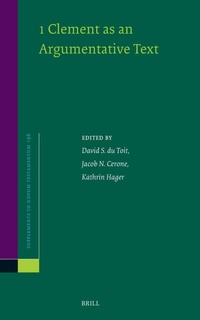
1 Clement as an Argumentative Text
Published on 2. October 2025
Book
Hardback
396 pages
978-90-04-74205-5 (ISBN)
Description
This volume explores the significance of 1 Clement as an argumentative text - a text that substantiates and offers reasons for a specific course of action which readers of the work should take. The contributions to this volume analyze the various argumentative strategies the author of 1 Clement employs in service of the letter's overall aims. Some essays focus on the cultural knowledge underlying the argumentation, while others on the function and use of Scripture. Several essays offer insights from other disciplines - theories of argumentation, metaphor, and (literary and cultural) space, as well as historical anthropology - to facilitate the analysis of 1 Clement's argument. The final two essays investigate the way the argumentative structure of 1 Clement was interpreted and used in two very different contexts of reception.
More details
Series
Language
English
Place of publication
Leiden
Netherlands
Target group
Professional and scholarly
Product notice
sewn/stitched
Cloth over boards
Dimensions
Height: 235 mm
Width: 155 mm
Thickness: 22 mm
Weight
726 gr
ISBN-13
978-90-04-74205-5 (9789004742055)
Copyright in bibliographic data and cover images is held by Nielsen Book Services Limited or by the publishers or by their respective licensors: all rights reserved.
Schweitzer Classification
Persons
Jacob N. Cerone is a doctoral candidate in New Testament at the University of Erlangen-Nuremberg. He is an in-house editor of the Encyclopedia of the Bible and Its Reception (de Gruyter, Berlin), Series Editor of Classic Studies on the Apostolic Fathers (Pickwick), and Series Editor of Patristic Essentials (Fontes Press). He is also a coeditor of the Apostolic Fathers Greek Reader (GlossaHouse) and Daily Scriptures (Eerdmans)
David du Toit is Professor of New Testament (History and Literature of Early Christianity) at the University of Erlangen-Nuremberg. He was awarded a doctoral degree (1996: Theios Anthropos. Zur Verwendung von ????? ???????? und sinnverwandten Ausdruecken in der Literatur der Kaiserzeit, published 1997) as well as a Habilitation (2006: Der abwesende Herr. Narrative und geschichtstheologische Strategien im Markusevangelium zur Bewaeltigung der Abwesenheit des Auferstandenen) by the Humboldt University of Berlin. He is editor of the series WMANT and FoSub. His main research interests include early Christology, the Gospel of Mark, Early Christianity and Greco-Roman culture, semantics and lexicography of early Christian Greek, methodology in Historical-Jesus-research.
Kathrin Hager is a doctoral candidate at the chair for New Testament at the University of Erlangen-Nuremberg and is pastor in the Evangelisch-Lutherische Kirchengemeinde Eckenhaid. From 2017-2023 she was an assistant to the chair of New Testament, first at the Ludwig-Maximilians-Universitaet Muenchen and then at the Friedrich-Alexander-Universitaet. Her dissertation project focuses on the foundation of ethics in 1 Clement.
David du Toit is Professor of New Testament (History and Literature of Early Christianity) at the University of Erlangen-Nuremberg. He was awarded a doctoral degree (1996: Theios Anthropos. Zur Verwendung von ????? ???????? und sinnverwandten Ausdruecken in der Literatur der Kaiserzeit, published 1997) as well as a Habilitation (2006: Der abwesende Herr. Narrative und geschichtstheologische Strategien im Markusevangelium zur Bewaeltigung der Abwesenheit des Auferstandenen) by the Humboldt University of Berlin. He is editor of the series WMANT and FoSub. His main research interests include early Christology, the Gospel of Mark, Early Christianity and Greco-Roman culture, semantics and lexicography of early Christian Greek, methodology in Historical-Jesus-research.
Kathrin Hager is a doctoral candidate at the chair for New Testament at the University of Erlangen-Nuremberg and is pastor in the Evangelisch-Lutherische Kirchengemeinde Eckenhaid. From 2017-2023 she was an assistant to the chair of New Testament, first at the Ludwig-Maximilians-Universitaet Muenchen and then at the Friedrich-Alexander-Universitaet. Her dissertation project focuses on the foundation of ethics in 1 Clement.
Content
Notes on Contributors
1 First Clement as an Argumentative Text: Introduction
?David du Toit
2 Res publica restituta as the Premise of the Argument of 1?Clement
?L.L. Welborn
3 The Rhetoric of Slavery and the Argument for Concord in 1?Clement
?Jeremiah Bailey
4 The Argumentative Function of the Gift: God's Benefactions in 1?Clement 19:2-21:1
?Kathrin Hager
5 Vindication and Admonition: The Argumentative Function of Wisdom 2:24 in 1?Clement 3-6
?Jacob N. Cerone
6 The Narrative on Cain's Fratricide (Genesis 4:3-8 LXX) in 1?Clement 3:4-4:7 and Its Aetiological Function in the Argument
?Cilliers Breytenbach
7 The Role (and Absence) of Genesis 1-4 in the Argument of 1?Clement
?David J. Downs
8 A Grapevine's Lesson for Imbeciles: "Miserable Are Those Who Waffle and Waver!"
Argumentation in 1?Clement 23, 2?Clement 11, and Their Common Source
?James A. Kelhoffer
9 Obedience to God in 1?Clement 13-14: The Spirit's Commandment and the Lord's Precepts as "Holy Words" to Be Obeyed
?Paul A. Hartog
10 Argumentation in 1?Clement: A Consensualist Reading
?Tanja Forderer
11 Metaphorical Argumentation in 1?Clement: The Life Journey and Competition Metaphors
?Jonathan Reichel
12 Contested Space and Dangerous Places: Literary Space and Argumentation in 1?Clement
?David du Toit
13 A Spatio-Rhetorical Examination of the Persuasive Strategies of 1?Clement
?Harry O. Maier
14 With "Heart" and "Soul": On Moral Anthropology and Its Argumentative Use in 1?Clement
?Hermut Loehr
15 Out of Order: Reading the Argument of 1?Clement in the Sequence of the Liturgical Cycle of Cambridge, University Library, Add. 1700
?Dan Batovici
16 The Interpretation of Argumentative Structures in 1?Clement in Its Early Modern Editions and Translations
?Patrick Bahl
Index
1 First Clement as an Argumentative Text: Introduction
?David du Toit
2 Res publica restituta as the Premise of the Argument of 1?Clement
?L.L. Welborn
3 The Rhetoric of Slavery and the Argument for Concord in 1?Clement
?Jeremiah Bailey
4 The Argumentative Function of the Gift: God's Benefactions in 1?Clement 19:2-21:1
?Kathrin Hager
5 Vindication and Admonition: The Argumentative Function of Wisdom 2:24 in 1?Clement 3-6
?Jacob N. Cerone
6 The Narrative on Cain's Fratricide (Genesis 4:3-8 LXX) in 1?Clement 3:4-4:7 and Its Aetiological Function in the Argument
?Cilliers Breytenbach
7 The Role (and Absence) of Genesis 1-4 in the Argument of 1?Clement
?David J. Downs
8 A Grapevine's Lesson for Imbeciles: "Miserable Are Those Who Waffle and Waver!"
Argumentation in 1?Clement 23, 2?Clement 11, and Their Common Source
?James A. Kelhoffer
9 Obedience to God in 1?Clement 13-14: The Spirit's Commandment and the Lord's Precepts as "Holy Words" to Be Obeyed
?Paul A. Hartog
10 Argumentation in 1?Clement: A Consensualist Reading
?Tanja Forderer
11 Metaphorical Argumentation in 1?Clement: The Life Journey and Competition Metaphors
?Jonathan Reichel
12 Contested Space and Dangerous Places: Literary Space and Argumentation in 1?Clement
?David du Toit
13 A Spatio-Rhetorical Examination of the Persuasive Strategies of 1?Clement
?Harry O. Maier
14 With "Heart" and "Soul": On Moral Anthropology and Its Argumentative Use in 1?Clement
?Hermut Loehr
15 Out of Order: Reading the Argument of 1?Clement in the Sequence of the Liturgical Cycle of Cambridge, University Library, Add. 1700
?Dan Batovici
16 The Interpretation of Argumentative Structures in 1?Clement in Its Early Modern Editions and Translations
?Patrick Bahl
Index