

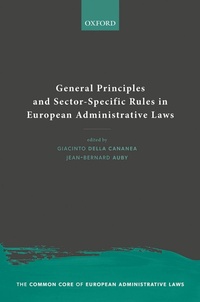
General Principles and Sector-Specific Rules in European Administrative Laws
Published on 4. July 2024
Book
Hardback
352 pages
978-0-19-886757-9 (ISBN)
Description
In the field of administrative law, there is no systematic body of rules similar to those characteristic of European civil codes. General principles are therefore of fundamental importance. This volume - the sixth in the series concerning the common core of European administrative laws - explores this importance through two strands.
Firstly, it examines in detail the relationship between general principles of law, such as due process, and sector-specific rules established by legislative and regulatory provisions, for example in licensing and disciplinary matters. Several questions about the nature of general principles emerge through this analysis. Are general principles about filling gaps? Or do they have a foundational role because they give meaning to the values that are shared by European legal systems, such as respect for the rule of law and for fundamental rights?
Secondly, this volume also explores the interaction between commonality and diversity in European administrative law. It considers whether there are shared standards of administrative conduct, including the duty to give reasons, or if there are fundamental differences with regard to non-European legal systems, such as that of China and Venezuela.
These questions are investigated through factual analysis, based on a set of hypothetical cases, which are discussed by national experts. This book then scrutinizes these questions to determine how commonality and diversity have extended and interact with one another, within and across legal systems, both diachronically and synchronically, over the course of a century. It shows that there are both unexpected areas of agreement between the European legal systems, notably concerning the right to be heard (expressed by the maxim audi alteram partem) and the duty to give reasons, and there are also areas of disagreement, for example as far as the right to remain silent vis a vis the administration (that is, nemo tenetur se detegere) is concerned.
Firstly, it examines in detail the relationship between general principles of law, such as due process, and sector-specific rules established by legislative and regulatory provisions, for example in licensing and disciplinary matters. Several questions about the nature of general principles emerge through this analysis. Are general principles about filling gaps? Or do they have a foundational role because they give meaning to the values that are shared by European legal systems, such as respect for the rule of law and for fundamental rights?
Secondly, this volume also explores the interaction between commonality and diversity in European administrative law. It considers whether there are shared standards of administrative conduct, including the duty to give reasons, or if there are fundamental differences with regard to non-European legal systems, such as that of China and Venezuela.
These questions are investigated through factual analysis, based on a set of hypothetical cases, which are discussed by national experts. This book then scrutinizes these questions to determine how commonality and diversity have extended and interact with one another, within and across legal systems, both diachronically and synchronically, over the course of a century. It shows that there are both unexpected areas of agreement between the European legal systems, notably concerning the right to be heard (expressed by the maxim audi alteram partem) and the duty to give reasons, and there are also areas of disagreement, for example as far as the right to remain silent vis a vis the administration (that is, nemo tenetur se detegere) is concerned.
More details
Series
Language
English
Place of publication
Oxford
United Kingdom
Target group
Professional and scholarly
Product notice
sewn/stitched
Cloth over boards
Dimensions
Height: 231 mm
Width: 152 mm
Thickness: 30 mm
Weight
703 gr
ISBN-13
978-0-19-886757-9 (9780198867579)
Copyright in bibliographic data and cover images is held by Nielsen Book Services Limited or by the publishers or by their respective licensors: all rights reserved.
Schweitzer Classification
Other editions
Additional editions
Giacinto della Cananea | Jean-Bernard Auby
General Principles and Sector-Specific Rules in European Administrative Laws
E-Book
08/2024
1st Edition
OUP eBook
€121.99
Available for download
Giacinto della Cananea | Jean-Bernard Auby
General Principles and Sector-Specific Rules in European Administrative Laws
E-Book
06/2024
1st Edition
OUP eBook
€121.99
Available for download
Persons
Giacinto della Cananea is a professor and leading authority on EU administrative law and comparative administrative law. His publications include six monographs, 20 edited volumes, and over 150 articles and book chapters on national and EU administrative law, global administrative law, and comparative public law. His work is cross-disciplinary, often in cooperation with historians of law, experts of international law (particularly in the field of investment), political scientists and economists, addressing such topics as administrative procedures, judicial review, and regulation. He was awarded the 'Spinelli prize on European integration' in 2017.
Jean-Bernard Auby is professor emeritus and director of the Center on Changes in Governance and Public Law, at Sciences Po, Paris. He previously served as Dean of the Law School, University of Paris XII and professor of public law at the University of Paris II-Assas. He also served as Deputy Director of the Institute of European and Comparative Law at Oxford University.
Jean-Bernard Auby is professor emeritus and director of the Center on Changes in Governance and Public Law, at Sciences Po, Paris. He previously served as Dean of the Law School, University of Paris XII and professor of public law at the University of Paris II-Assas. He also served as Deputy Director of the Institute of European and Comparative Law at Oxford University.
Content
Part I - General Principles and Comparative Studies
1: Giacinto della Cananea: Introduction
Part II - The Legal Systems Selected for Comparison: Background and Perspectives
2: Stefan Storr: Austria
3: Xiaowei Sun: China
4: Sebastien Saunier: France
5: Dian Schefold: Germany
6: Theodore Fortsakis: Greece
7: Stefano Vaccari, Nicola Berti, and Mauro Silvestri: Italy
8: Dacian Drago,s: Romania
9: Marko Milenkovi'c: Serbia
10: Isaac Martin Delgado: Spain
11: Alexandre Flueckiger: Switzerland
12: Gordon Anthony and Conor McCormick: United Kingdom
13: Flavia Pesci-Feltri: Venezuela
Part III - Cases
14: Cases
Part IV - Comparative Analysis
15: Jean-Bernard Auby: About the Way General Principles Combine with Sector-Specific Rules in Administrative Procedural Law
16: Mads Andenas: General Principles at the European Level
17: Angela Ferrari Zumbini: The Legal Relevance and Significance of Administrative Procedure Legislation
18: Giacinto della Cananea: Same Problems, Same Solutions?
1: Giacinto della Cananea: Introduction
Part II - The Legal Systems Selected for Comparison: Background and Perspectives
2: Stefan Storr: Austria
3: Xiaowei Sun: China
4: Sebastien Saunier: France
5: Dian Schefold: Germany
6: Theodore Fortsakis: Greece
7: Stefano Vaccari, Nicola Berti, and Mauro Silvestri: Italy
8: Dacian Drago,s: Romania
9: Marko Milenkovi'c: Serbia
10: Isaac Martin Delgado: Spain
11: Alexandre Flueckiger: Switzerland
12: Gordon Anthony and Conor McCormick: United Kingdom
13: Flavia Pesci-Feltri: Venezuela
Part III - Cases
14: Cases
Part IV - Comparative Analysis
15: Jean-Bernard Auby: About the Way General Principles Combine with Sector-Specific Rules in Administrative Procedural Law
16: Mads Andenas: General Principles at the European Level
17: Angela Ferrari Zumbini: The Legal Relevance and Significance of Administrative Procedure Legislation
18: Giacinto della Cananea: Same Problems, Same Solutions?