

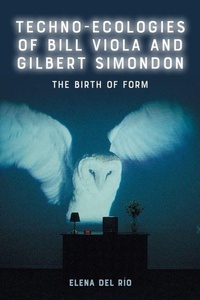
Techno-Ecologies of Bill Viola and Gilbert Simondon
The Birth of Form
Will be published approx. on 30. November 2025
Book
Hardback
280 pages
978-1-3995-5477-0 (ISBN)
Description
Both Viola and Simondon prioritise a techno-aesthetic experience that reveals a consistent pattern of interdependence between form and matter, nature and culture, human and nonhuman. Inspired by Simondon's ideas on individuation as process, and by other major figures of process philosophy such as Raymond Ruyer, Deleuze and Guattari, and Brian Massumi, Elena del Rio delves deep into Viola's art and finds a politics of nature that is also a politics of the affects. In taking full account of the interrelation between collective affects and living milieus, this politics exceeds the still anthropocentric project of a politics reductively focused on environmental degradation.
The book works with a broad concept of ecology that encompasses a nature-culture continuum - from Simondon's associated milieu to Guattari's tripartite ecological praxis, from Deleuze and Guattari's existential territories to Massumi's affective events. Attending to this nature-culture continuum and activating our collective energies are prime strategies in tackling the overwhelming psycho-social and environmental crises we face.
The book works with a broad concept of ecology that encompasses a nature-culture continuum - from Simondon's associated milieu to Guattari's tripartite ecological praxis, from Deleuze and Guattari's existential territories to Massumi's affective events. Attending to this nature-culture continuum and activating our collective energies are prime strategies in tackling the overwhelming psycho-social and environmental crises we face.
Reviews / Votes
Techno-Ecologies of Bill Viola and Gilbert Simondon by Elena del Rio is a beautifully crafted and timely exploration of the dynamic interplay between art, technology, and ecology. By weaving together Bill Viola's immersive video installations and Gilbert Simondon's philosophy of individuation, del Rio illuminates how techno-ecologies redefine our understanding of existence, ecological interconnectedness, and collective transformation. A must-read for anyone seeking to grasp the creative potential of these intersections. -- Gregg Lambert, Syracuse University Powerful and precise, del Rio's new book asks us to rethink nothing less than the techno-aesthetic processes through which we come into being. Here the wondrous experimentations of artist-technician Bill Viola stand as an antidote to the violence of instrumental reason and the extractive drive of our image economy. A most timely intervention. -- Domietta Torlasco, Northwestern University Reading Viola and Simondon together, del Rio formulates two bold and marvelous propositions: video (and by extension, cinema) belongs to nature, and the camera is a philosophical system. Her book lives up to the challenge of these propositions, offering luminous readings of Viola video works while upending received understandings of nature and culture, technology and ecology. -- Thomas Lamarre, The University of Chicago Bill Viola's video works give a sense of being in the presence of an ever-expanding infinite-as in his works where imperceptibly slow movement, rather than grasping the visible world, renders the field of vision even more infinite. While Viola's great body of work is often interpreted as religious or mystical, Elena del Rio argues convincingly that the infinite presence palpable in his work is an infinity immanent to this world: an ever-changing individuation in rhythm with the humans, machines, and other entities that compose it. -- Laura U. Marks, Simon Fraser UniversityMore details
Language
English
Place of publication
Edinburgh
United Kingdom
Target group
College/higher education
Illustrations
17 colour illustrations and 2 black and white illustrations
Dimensions
Height: 243 mm
Width: 163 mm
Thickness: 21 mm
Weight
592 gr
ISBN-13
978-1-3995-5477-0 (9781399554770)
Copyright in bibliographic data and cover images is held by Nielsen Book Services Limited or by the publishers or by their respective licensors: all rights reserved.
Schweitzer Classification
Person
Elena del Rio is Professor Emerita of Film Studies at the University of Alberta, Canada. Her essays on the intersections between cinema and philosophies of the body in the areas of technology, performance, and affect have been featured in journals such as Alphaville, Angelaki, Camera Obscura, Canadian Journal of Film Studies, Deleuze Studies, Discourse, Film-Philosophy, Image and Narrative, Necsus, The New Review of Film and Television Studies, Quarterly Review of Film and Video, Science Fiction Studies, Studies in French Cinema, and SubStance. She has also contributed to numerous edited volumes on the films of Atom Egoyan, Michael Haneke, and Rainer Fassbinder, and on topics such as Asian exploitation film, cinema and cruelty, the philosophy of film and new media, film noir, film phenomenologies, and Deleuze and cinema. She is the author of The Grace of Destruction: A Vital Ethology of Extreme Cinemas (Bloomsbury, 2016) and Deleuze and the Cinemas of Performance: Powers of Affection (Edinburgh University Press, 2008).
Content
List of Figures
Acknowledgements
Introduction: Bill Viola with Gilbert Simondon
Part I: Nature's Gestures
1. Aesthetic Gestures in the Animal-/Nature-Continuum
2. Artful Politics of Nature
Intermezzo: Video and the Digital Convergence
Part II: More-than-Human Ecologies
3. Affective Ecologies, a People to Come
4. Electronic Water, Figures of Submersion
5. Disaster Ecologies, Collective Individuation
6. Mental Ecologies, Transversal Cinema
Coda: A Journey backwards is a Journey forward
References
Acknowledgements
Introduction: Bill Viola with Gilbert Simondon
Part I: Nature's Gestures
1. Aesthetic Gestures in the Animal-/Nature-Continuum
2. Artful Politics of Nature
Intermezzo: Video and the Digital Convergence
Part II: More-than-Human Ecologies
3. Affective Ecologies, a People to Come
4. Electronic Water, Figures of Submersion
5. Disaster Ecologies, Collective Individuation
6. Mental Ecologies, Transversal Cinema
Coda: A Journey backwards is a Journey forward
References