

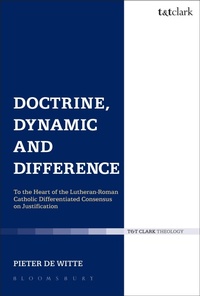
Doctrine, Dynamic and Difference
To the Heart of the Lutheran-Roman Catholic Differentiated Consensus on Justification
Published on 7. November 2013
Book
Paperback/Softback
272 pages
978-0-567-31682-0 (ISBN)
Description
One of the most divisive issues in Western Christianity since the Reformation is the question of how humans are justified by God. In 1999, after many decades of ecumenical dialogue, Lutherans and Roman Catholics have declared that this issue of 'justification by faith' is no longer a cause of division between them. One of the fascinating features of this Joint Declaration on the Doctrine of Justification (JDDJ) is that it expresses a 'differentiated consensus' on justification.
The method of differentiated consensus is generally regarded as an important methodological step forward in the ecumenical dialogue. It has been used and referred to in ecumenical documents published after 1999. But what are its meaning and implications? This study attempts to clarify the method of differentiated consensus by (1) investigating the process of doctrinal rapprochement which led up to the JDDJ, (2) examining the way the consensus takes shape in the document itself, (3) analyzing arguments offered by critics and advocates of the official dialogue and (4) reflecting on the concept of doctrinal difference.
The method of differentiated consensus is generally regarded as an important methodological step forward in the ecumenical dialogue. It has been used and referred to in ecumenical documents published after 1999. But what are its meaning and implications? This study attempts to clarify the method of differentiated consensus by (1) investigating the process of doctrinal rapprochement which led up to the JDDJ, (2) examining the way the consensus takes shape in the document itself, (3) analyzing arguments offered by critics and advocates of the official dialogue and (4) reflecting on the concept of doctrinal difference.
Reviews / Votes
'The Joint Declaration on the Doctrine of Justification is a major ecumenical agreement whose theological rationale requires rigorous exploration for the future of Lutheran-Roman Catholic dialogue. In an exemplary manner Dr. De Witte offers such an examination which will contribute significantly to the ongoing debate about the Joint Declaration. Anyone interested in the contemporary church will discover this work to be indispensable, even if not everyone will concur with all of its conclusions. It is a highly important piece of scholarship.' - William G. Rusch, Yale Divinity School, USA -- William G. Rusch This detailed, critical treatment of the Joint Declaration on the Doctrine of Justification raises several tantalizing issues ... It stands as a major academic treatment, clearly written, of an historic agreement and an essential resource for anyone making a scholarly study and evaluation of the Joint Declaration on the Doctrine of Justification. -- Paul Avis, University of Exeter, UK * Theologische Literatrzeitung *More details
Series
Language
English
Place of publication
Edinburgh
United Kingdom
Publishing group
Bloomsbury Publishing PLC
Target group
Professional and scholarly
Dimensions
Height: 234 mm
Width: 156 mm
Thickness: 15 mm
Weight
412 gr
ISBN-13
978-0-567-31682-0 (9780567316820)
DOI
CBID182419
Copyright in bibliographic data and cover images is held by Nielsen Book Services Limited or by the publishers or by their respective licensors: all rights reserved.
Schweitzer Classification
Other editions
Additional editions
Pieter de Witte
Doctrine, Dynamic and Difference
To the Heart of the Lutheran-Roman Catholic Differentiated Consensus on Justification
E-Book
03/2012
1st Edition
T.& T.Clark Ltd
€42.99
Available for download
Pieter de Witte
Doctrine, Dynamic and Difference
To the Heart of the Lutheran-Roman Catholic Differentiated Consensus on Justification
E-Book
03/2012
1st Edition
T.& T.Clark Ltd
€43.49
Available for download
Person
Pieter de Witte is a lecturer at the Hogeschool-Universiteit Brussel, Belgium, and a Postdoctoral Research Fellow in the Faculty of Theology and Religious Studies at KULeuven, Belgium.
Content
1. Introduction
2. The Joint Declaration on Justification: Basis Issues
3. Reception of Theological Advances
4. The Reception of Previous Dialogue Results
5. The Joint Declaration: A Textual Analysis
6. Conclusion
2. The Joint Declaration on Justification: Basis Issues
3. Reception of Theological Advances
4. The Reception of Previous Dialogue Results
5. The Joint Declaration: A Textual Analysis
6. Conclusion