

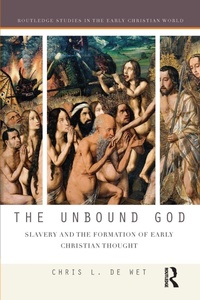
The Unbound God
Slavery and the Formation of Early Christian Thought
1st Edition
Published on 13. December 2021
Book
Paperback/Softback
190 pages
978-0-367-41791-8 (ISBN)
Description
This volume examines the prevalence, function, and socio-political effects of slavery discourse in the major theological formulations of the late third to early fifth centuries AD, arguably the most formative period of early Christian doctrine. The question the book poses is this: in what way did the Christian theologians of the third, fourth, and early fifth centuries appropriate the discourse of slavery in their theological formulations, and what could the effect of this appropriation have been for actual physical slaves? This fascinating study is crucial reading for anyone with an interest in early Christianity or Late Antiquity, and slavery more generally.
Reviews / Votes
Judicious in its handling of primary sources and theoretically sophisticated, Chris de Wet's The Unbound God: Slavery and the Formation of Early Christian Thought is an incisive analysis of the extent to which "doulology"-his apt neologism-shaped early Christian thought, informing basic Christian teachings on Christology, pneumatology, and sin.- Jennifer Glancy, Professor of Religious Studies, Le Moyne College, USA "Judicious in its handling of primary sources and theoretically sophisticated, Chris de Wet's The Unbound God: Slavery and the Formation of Early Christian Thought is an incisive analysis of the extent to which "doulology"-his apt neologism-shaped early Christian thought, informing basic Christian teachings on Christology, pneumatology, and sin."
- Jennifer Glancy, Le Moyne College, USA
"This is a very important book. The small volume of 178 pages (5 chapters) is interesting and intriguing for its sheer beauty in exposition and daring analysis and propositions ... This book is a reflection on the past and its bearings on the present via the development of early Christian thoughts, and how one may creatively reimagine various religious discourses and habits in order to work for a better future. It is a great accomplishment."
- Ronald Charles, Saint Francis Xavier University, Canada, Bryn Mawr Classical Review 2018
"With his book De Wet makes an important contribution to the growing field of scholarly works on Early Christianity and ancient slavery, arguing convincingly for the importance of doulology in Early Christian texts. ... De Wet's book will challenge future scholarship to keep reflecting on the use of slavery in ancient (Christian) thought. "
- Martijn Stoutjesdijk, Tilburg University, Netherlands, NTT Journal for Theology and the Study of Religion, 72/3
"This book is an important contribution to the cultural and intellectual history of Christianity in late antiquity. The Unbound God ranges widely among Greek, Latin, Coptic, and Syriac patristic and monastic sources to investigate the complex ways in which the discursive practices of ancient slavery formed the central doctrines of church theology."
- J. Albert Harrill, Ohio State University, USA, Church History journal 2019
"The Unbound God makes a genuinely vital contribution to the growing interest in slavery's enduring place in Christian thought, and it deserves to be read, taught, and discussed widely."
- Matthew Elia, Duke University, Reading Religion
"This volume examines the prevalence, function, and socio-political effects of slavery discourse in the major theological formulations of the late third to early fifth centuries CE, arguably the most formative period of early Christian doctrine.[...]This study is important reading for anyone with an interest in early Christianity or late antiquity, and slavery more generally."
-A Journal of Bible and Theology
More details
Series
Language
English
Place of publication
London
United Kingdom
Publishing group
Taylor & Francis Ltd
Target group
College/higher education
Dimensions
Height: 234 mm
Width: 156 mm
Thickness: 11 mm
Weight
301 gr
ISBN-13
978-0-367-41791-8 (9780367417918)
Copyright in bibliographic data and cover images is held by Nielsen Book Services Limited or by the publishers or by their respective licensors: all rights reserved.
Schweitzer Classification
Other editions
Additional editions
E-Book
07/2017
Routledge
€60.49
Available for download
E-Book
07/2017
Routledge
€60.49
Available for download
Book
06/2017
1st Edition
Routledge
€215.41
Shipment within 10-20 days
Person
Chris L. de Wet is Associate Professor of New Testament and Early Christian Studies at the University of South Africa, and the Editor of the Journal of Early Christian History. He is also the author of Preaching Bondage: John Chrysostom and the Discourse of Slavery in Early Christianity (2015).
Content
Chapter 1 Introducing Early Christian Doulology: Slavery to God, Doulological Classifications, and Early Christian Identity
Chapter 2 Savior or Slave? Philippians 2:6-11 and the Problem of Slavery in Origen's Christology
Chapter 3 Emancipating the Spirit: Slavery and Early Christian Pneumatology in Eunomius and Basil of Caesarea
Chapter 4 The Curse of Ham (Gen. 9:18-27): Slavery, Sin, and Punishment in John Chrysostom, Augustine, and the Cave of Treasures
Chapter 5 Conclusion: The Unbound God
Primary Sources
Secondary Sources
Index
Chapter 2 Savior or Slave? Philippians 2:6-11 and the Problem of Slavery in Origen's Christology
Chapter 3 Emancipating the Spirit: Slavery and Early Christian Pneumatology in Eunomius and Basil of Caesarea
Chapter 4 The Curse of Ham (Gen. 9:18-27): Slavery, Sin, and Punishment in John Chrysostom, Augustine, and the Cave of Treasures
Chapter 5 Conclusion: The Unbound God
Primary Sources
Secondary Sources
Index