

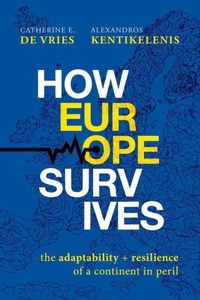
How Europe Survives
The Adaptability and Resilience of a Continent in Peril
Will be published approx. on 22. October 2026
Book
Hardback
272 pages
978-0-19-790805-1 (ISBN)
Description
A bold new take on how Europe adapts, endures, and remains powerful in a rapidly shifting world order.
Europe is often cast as lurching from one near-death experience to the next-from the eurozone crisis and Brexit to a pandemic and war on its borders. And yet, it endures. Not because it has resolved its contradictions, but because it has adapted through them. Challenging the familiar image of the European Union as fragile or intrinsically flawed, How Europe Survives reimagines Europe and its strengths.
Catherine E. De Vries and Alexandros Kentikelenis reframe Europe as a living organism: imperfect, evolving, and responsive to its environment. That messiness is part of its strength. Like an organism, the EU survives by improvising, recalibrating, and absorbing internal tensions and external shocks. Its strengths lie in its malleability and flexibility, which enable it to constantly reinvent itself. It does so both in moments of crisis and in its normal functioning.
How Europe Survives is both a reinterpretation of Europe's past and a guide to its future. This is not a triumphalist story. Europe's adaptability has costs and limits. But it offers a practical lesson for governing in an age of permanent crisis: flexible institutions, open contestation, and a willingness to learn can keep a political project alive.
Clear-eyed and accessible, How Europe Survives explains how the EU has endured-and what that means for its citizens and its role in the world.
Europe is often cast as lurching from one near-death experience to the next-from the eurozone crisis and Brexit to a pandemic and war on its borders. And yet, it endures. Not because it has resolved its contradictions, but because it has adapted through them. Challenging the familiar image of the European Union as fragile or intrinsically flawed, How Europe Survives reimagines Europe and its strengths.
Catherine E. De Vries and Alexandros Kentikelenis reframe Europe as a living organism: imperfect, evolving, and responsive to its environment. That messiness is part of its strength. Like an organism, the EU survives by improvising, recalibrating, and absorbing internal tensions and external shocks. Its strengths lie in its malleability and flexibility, which enable it to constantly reinvent itself. It does so both in moments of crisis and in its normal functioning.
How Europe Survives is both a reinterpretation of Europe's past and a guide to its future. This is not a triumphalist story. Europe's adaptability has costs and limits. But it offers a practical lesson for governing in an age of permanent crisis: flexible institutions, open contestation, and a willingness to learn can keep a political project alive.
Clear-eyed and accessible, How Europe Survives explains how the EU has endured-and what that means for its citizens and its role in the world.
More details
Language
English
Place of publication
Oxford
United Kingdom
Target group
College/higher education
Dimensions
Height: 234 mm
Width: 156 mm
ISBN-13
978-0-19-790805-1 (9780197908051)
Copyright in bibliographic data and cover images is held by Nielsen Book Services Limited or by the publishers or by their respective licensors: all rights reserved.
Schweitzer Classification
Persons
Catherine E. De Vries is Vice Dean of the School of Politics, Economics, and Global Affairs, and Professor of Political Science at IE University in Madrid. A leading scholar of European politics, she offers deep insight into European governance, democratic politics, and political change. Her research has appeared in award-winning books, leading academic journals, and major international media outlets. Her book Euroscepticism and the Future of European Integration (Oxford University Press, 2018) received the European Union Studies Association's Best Book in EU Studies Award and was listed as a top 5 book on Europe's future by the Financial Times.
Alexandros Kentikelenis is Professor of Political Economy and Sociology and Director of the PhD Program in Social and Political Sciences at Bocconi University in Milan. A leading scholar of global governance, he studies how international cooperation is sustained and the societal consequences of globally devised policies. He has published more than fifty award-winning articles and three books. His research has attracted wide coverage in major international media outlets and informed debates in parliaments and international organizations.
Alexandros Kentikelenis is Professor of Political Economy and Sociology and Director of the PhD Program in Social and Political Sciences at Bocconi University in Milan. A leading scholar of global governance, he studies how international cooperation is sustained and the societal consequences of globally devised policies. He has published more than fifty award-winning articles and three books. His research has attracted wide coverage in major international media outlets and informed debates in parliaments and international organizations.
Author
Vice Dean of the School of Politics, Economics, and Global Affairs, and Professor of Political ScienceVice Dean of the School of Politics, Economics, and Global Affairs, and Professor of Political Science, IE University
Professor of Political Economy and Sociology and Director of the PhD Program in Social and Political SciencesProfessor of Political Economy and Sociology and Director of the PhD Program in Social and Political Sciences, Bocconi University
Content
Introduction: The Strange Non-Death of Europe Part I. Recasting the European Project 1: An Organism, Not a Machine 2: Redefining Europe's Success Part II. Revisiting the Post-War European Order (1940s-2000s) 3: The Stories Europeans Tell Themselves 4: A Break from Geopolitics 5: A Social Model Like No Other 6: Elite Closure and its Discontents Part III. Dealing with Permanent Crisis (2010s-2020s) 7: Breaking the Social Contract 8: A Pre-War Era Conclusions: Europe's Adaptive Strength