

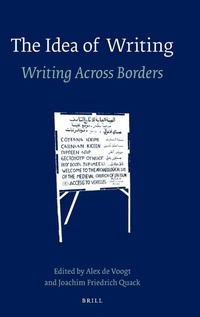
The Idea of Writing
Writing Across Borders
Published on 9. December 2011
Book
Hardback
264 pages
978-90-04-21545-0 (ISBN)
Description
The Idea of Writing is an exploration of the versatility of writing systems. This volume, the second in a series, is specifically concerned with the problems and possibilities of adapting a writing system to another language. Writing is studied as it is used across linguistic and cultural borders from ancient Egyptian, Cuneiform and Korean writing to Japanese, Kharosthi and Near Eastern scripts. This collection of articles aims to highlight the complexity of writing systems rather than to provide a first introduction. The different academic traditions in which these writing systems have been studied use linguistic, socio-historical and philological approaches that give complementary insights of the complex phenomena.
More details
Series
Language
English
Place of publication
Leiden
Netherlands
Target group
Professional and scholarly
Product notice
sewn/stitched
Cloth over boards
Dimensions
Height: 244 mm
Width: 168 mm
Thickness: 20 mm
Weight
567 gr
ISBN-13
978-90-04-21545-0 (9789004215450)
Copyright in bibliographic data and cover images is held by Nielsen Book Services Limited or by the publishers or by their respective licensors: all rights reserved.
Schweitzer Classification
Persons
Alex de Voogt, Ph.D. (1995) in Psychology, Leiden University, is an Assistant Curator at the American Museum of Natural History in New York. His studies on writing systems and the dispersal of board games focus on the Indian Ocean region.
Joachim Friedrich Quack, Ph.D. (1993) in Egyptology, University of Tuebingen, Habilitation (2003) in Egyptology, Free University of Berlin, is Professor of Egyptology at Heidelberg University. He is a leading specialist for Egyptian cursive writing systems.
Contributors include Hans-Joerg Doehla, Theo Krispijn, Reinhard Lehmann, Sven Osterkamp, Konstantin Pozdniakov, Joachim Friedrich Quack, Ingo Strauch, Aldo Tollini, Thorsten Traulsen and Alex de Voogt.
Joachim Friedrich Quack, Ph.D. (1993) in Egyptology, University of Tuebingen, Habilitation (2003) in Egyptology, Free University of Berlin, is Professor of Egyptology at Heidelberg University. He is a leading specialist for Egyptian cursive writing systems.
Contributors include Hans-Joerg Doehla, Theo Krispijn, Reinhard Lehmann, Sven Osterkamp, Konstantin Pozdniakov, Joachim Friedrich Quack, Ingo Strauch, Aldo Tollini, Thorsten Traulsen and Alex de Voogt.
Content
Acknowledgements
1. Invention and Borrowing in the Development and Dispersal of Writing Systems
Alex de Voogt
2. 27-30-22-26 - How Many Letters Needs an Alphabet? The Case of Semitic
Reinhard G. Lehmann
3. Nubian Grafffijiti Messages and the History of Writing in the Sudanese Nile Basin
Alex de Voogt & Hans-Joerg Doehla
4. About "Short" Names of Letters
Konstantin Pozdniakov
5. Early Adaptations of the Korean Script to Render Foreign Languages
Sven Osterkamp
6. Han'gul Reform Movement in the Twentieth Century: Roman Pressure on Korean Writing
Thorsten Traulsen
7. The Character of the Indian Kharo??hi Script and the "Sanskrit Revolution": A Writing System Between Identity and
Assimilation
Ingo Strauch
8. Symmetry and Asymmetry, Chinese Writing in Japan: The Case of Kojiki (712)
Aldo Tollini
9. Writing Semitic with Cuneiform Script. The Interaction of Sumerian and Akkadian Orthography in the Second Half of
the Third Millennium BC
Theo J.H. Krispijn
10. Old Wine in New Wineskins? How to Write Classical Egyptian Rituals in More Modern Writing Systems
Joachim Quack
Subject Index
Language (Group) and Script Index
Author Index
1. Invention and Borrowing in the Development and Dispersal of Writing Systems
Alex de Voogt
2. 27-30-22-26 - How Many Letters Needs an Alphabet? The Case of Semitic
Reinhard G. Lehmann
3. Nubian Grafffijiti Messages and the History of Writing in the Sudanese Nile Basin
Alex de Voogt & Hans-Joerg Doehla
4. About "Short" Names of Letters
Konstantin Pozdniakov
5. Early Adaptations of the Korean Script to Render Foreign Languages
Sven Osterkamp
6. Han'gul Reform Movement in the Twentieth Century: Roman Pressure on Korean Writing
Thorsten Traulsen
7. The Character of the Indian Kharo??hi Script and the "Sanskrit Revolution": A Writing System Between Identity and
Assimilation
Ingo Strauch
8. Symmetry and Asymmetry, Chinese Writing in Japan: The Case of Kojiki (712)
Aldo Tollini
9. Writing Semitic with Cuneiform Script. The Interaction of Sumerian and Akkadian Orthography in the Second Half of
the Third Millennium BC
Theo J.H. Krispijn
10. Old Wine in New Wineskins? How to Write Classical Egyptian Rituals in More Modern Writing Systems
Joachim Quack
Subject Index
Language (Group) and Script Index
Author Index