

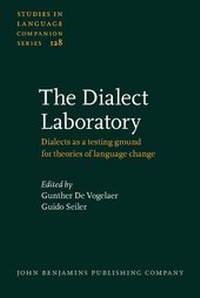
The Dialect Laboratory
Dialects as a testing ground for theories of language change
Published on 29. August 2012
Book
Hardback
297 pages
978-90-272-0595-7 (ISBN)
Description
Much theorizing in language change research is made without taking into account dialect data. Yet, dialects seem to be superior data to build a theory of linguistic change on, since dialects are relatively free of standardization and therefore more tolerant of variant competition in grammar. In addition, as compared to most cross-linguistic and diachronic data, dialect data are unusually high in resolution. This book shows that the study of dialect variation has indeed the potential, perhaps even the duty, to play a central role in the process of finding answers to fundamental questions of theoretical historical linguistics. It includes contributions which relate a clearly formulated theoretical question of historical linguistic interest with a well-defined, solid empirical base. The volume discusses phenomena from different domains of grammar (phonology, morphology and syntax) and a wide variety of languages and language varieties in the light of several current theoretical frameworks.
More details
Series
Language
English
Place of publication
Amsterdam
Netherlands
Target group
College/higher education
Illustrations
+ index
Weight
700 gr
ISBN-13
978-90-272-0595-7 (9789027205957)
Copyright in bibliographic data and cover images is held by Nielsen Book Services Limited or by the publishers or by their respective licensors: all rights reserved.
Schweitzer Classification
Other editions
Additional editions
Gunther de Vogelaer | Guido Seiler
The Dialect Laboratory
Dialects as a testing ground for theories of language change
E-Book
08/2012
1st Edition
John Benjamins Publishing Company
€123.99
Available for download
Persons
Content
1. The dialect laboratory: Introductory remarks (by De Vogelaer, Gunther); 2. The evolutionary-emergence model of language change (by Bigham, Douglas S.); 3. Dialect data, lexical frequency and the usage-based approach (by Clark, Lynn); 4. Dialect areas and linguistic change: Pronominal paradigms in Ibero-Romance dialects from a cross-linguistic and social typology perspective (by Fernandez-Ordonez, Ines); 5. The role of implicational universals in language change: Evidence from Tunisian Arabic dialects (by Gibson, Maik); 6. On the genesis of the German recipient passive - Two competing hypotheses in the light of current dialect data (by Lenz, Alexandra N.); 7. Paths to tone in the Tamang branch of Tibeto-Burman (Nepal) (by Mazaudon, Martine); 8. Dialect choice in Fiji: A variationist approach to language change in the South Pacific (by Park, Karen); 9. When diachrony meets synchrony.: Phonological change, phonological variation and Optimal Paradigms (by Pons-Moll, Claudia); 10. Geolinguistic data and the past tense debate: Linguistic and extralinguistic aspects of Dutch verb regularization (by Vosters, Rik); 11. Tense and aspect systems of Western and Eastern dialects in Japan: Split paths of diachronic development (by Watanabe, Kazuha); 12. The rise of DP-internal possessors: On the relationship of dialectal synchrony to diachrony (by Weiss, Helmut); 13. Index