

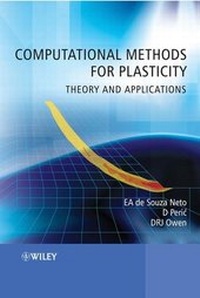
Computational Methods for Plasticity
Theory and Applications
Published on 17. October 2008
Book
Hardback
814 pages
978-0-470-69452-7 (ISBN)
Description
The subject of computational plasticity encapsulates the numerical methods used for the finite element simulation of the behaviour of a wide range of engineering materials considered to be plastic - i.e. those that undergo a permanent change of shape in response to an applied force. Computational Methods for Plasticity: Theory and Applications describes the theory of the associated numerical methods for the simulation of a wide range of plastic engineering materials; from the simplest infinitesimal plasticity theory to more complex damage mechanics and finite strain crystal plasticity models. It is split into three parts - basic concepts, small strains and large strains. Beginning with elementary theory and progressing to advanced, complex theory and computer implementation, it is suitable for use at both introductory and advanced levels. The book:
* Offers a self-contained text that allows the reader to learn computational plasticity theory and its implementation from one volume.
* Includes many numerical examples that illustrate the application of the methodologies described.
* Provides introductory material on related disciplines and procedures such as tensor analysis, continuum mechanics and finite elements for non-linear solid mechanics.
* Is accompanied by purpose-developed finite element software that illustrates many of the techniques discussed in the text, downloadable from the book's companion website.
This comprehensive text will appeal to postgraduate and graduate students of civil, mechanical, aerospace and materials engineering as well as applied mathematics and courses with computational mechanics components. It will also be of interest to research engineers, scientists and software developers working in the field of computational solid mechanics.
More details
Other editions
Additional editions
E-Book
09/2011
Wiley
€142.99
Available for download
E-Book
11/2008
Wiley
€142.99
Available for download
Persons
Eduardo de Souza Neto is a senior lecturer at the School of Engineering, University of Wales, Swansea, where he teaches a postgraduate course on the finite element method, and undergraduate courses on structural mechanics and soil mechanics. He also currently teaches external courses on computational plasticity; and his research interests include, amongst others, damage mechanics, computational plasticity, contact with friction and finite element technology. He is an international advisory board member for the Latin American Journal of Solids and Structures, and has authored 30 papers in refereed research journals as well as many conference papers, and 4 book contributions.
David Owen is Professor in Civil Engineering at the University of Wales, Swansea, and chairman of Rockfield Software Ltd. He is an international authority on finite element and discrete element techniques, and is the author of seven textbooks and over three hundred and fifty scientific publications. In addition to being the editor of over thirty monographs and conference proceedings, Professor Owen is also the editor of the International Journal for Engineering Computations and is a member of several Editorial Boards. His involvement in academic research has lead to the supervision of over sixty Ph.D. students. Professor Owen is a fellow of the RAE and ICE.
Djordje Peric is Professor in the Department of Civil Engineering, University of Wales, Swansea. He has an established reputation in the field of non-linear computational mechanics and is the author of over 150 research publications. He has also edited two special journal issues, and serves as an editorial board member of five international academic journals. Over the last decade Professor Peric has attracted approximately GBP2.5 million of research grants and funding from the UK Engineering and Physical Sciences Research Council, and various industries including Unilever, British Steel, Rolls Royce, MIC and Rockfield Software.
David Owen is Professor in Civil Engineering at the University of Wales, Swansea, and chairman of Rockfield Software Ltd. He is an international authority on finite element and discrete element techniques, and is the author of seven textbooks and over three hundred and fifty scientific publications. In addition to being the editor of over thirty monographs and conference proceedings, Professor Owen is also the editor of the International Journal for Engineering Computations and is a member of several Editorial Boards. His involvement in academic research has lead to the supervision of over sixty Ph.D. students. Professor Owen is a fellow of the RAE and ICE.
Djordje Peric is Professor in the Department of Civil Engineering, University of Wales, Swansea. He has an established reputation in the field of non-linear computational mechanics and is the author of over 150 research publications. He has also edited two special journal issues, and serves as an editorial board member of five international academic journals. Over the last decade Professor Peric has attracted approximately GBP2.5 million of research grants and funding from the UK Engineering and Physical Sciences Research Council, and various industries including Unilever, British Steel, Rolls Royce, MIC and Rockfield Software.
Content
Part One Basic concepts
1 Introduction
2 ELEMENTS OF TENSOR ANALYSIS
3 THERMODYNAMICS
4 The finite element method in quasi-static nonlinear solid mechanics
5 Overview of the program structure
Part Two Small strains
6 The mathematical theory of plasticity
7 Finite elements in small-strain plasticity problems
8 Computations with other basic plasticity models
9 Plane stress plasticity
10 Advanced plasticity models
11 Viscoplasticity
12 Damage mechanics
Part Three Large strains
13 Finite strain hyperelasticity
14 Finite strain elastoplasticity
15 Finite elements for large-strain incompressibility
16 Anisotropic finite plasticity: Single crystals
Appendices
A Isotropic functions of a symmetric tensor
B The tensor exponential
C Linearisation of the virtual work
D Array notation for computations with tensors
References
Index