

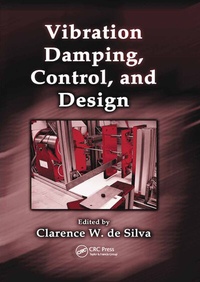
Vibration Damping, Control, and Design
1st Edition
Published on 10. October 2019
Book
Paperback/Softback
634 pages
978-0-367-38926-0 (ISBN)
Description
Reducing and controlling the level of vibration in a mechanical system leads to an improved work environment and product quality, reduced noise, more economical operation, and longer equipment life. Adequate design is essential for reducing vibrations, while damping and control methods help further reduce and manipulate vibrations when design strategies reach their limits. There are also useful types of vibration, which may require enhancement or control. Vibration Damping, Control, and Design balances theoretical and application-oriented coverage to enable optimal vibration and noise suppression and control in nearly any system.
Drawn from the immensely popular Vibration and Shock Handbook, each expertly crafted chapter of this book includes convenient summary windows, tables, graphs, and lists to provide ready access to the important concepts and results. Working systematically from general principles to specific applications, coverage spans from theory and experimental techniques in vibration damping to isolation, passive control, active control, and structural dynamic modification. The book also discusses specific issues in designing for and controlling vibrations and noise such as regenerative chatter in machine tools, fluid-induced vibration, hearing and psychological effects, instrumentation for monitoring, and statistical energy analysis. This carefully edited work strikes a balance between practical considerations, design issues, and experimental techniques.
Complemented by design examples and case studies, Vibration Damping, Control, and Design builds a deep understanding of the concepts and demonstrates how to apply these principles to real systems.
Drawn from the immensely popular Vibration and Shock Handbook, each expertly crafted chapter of this book includes convenient summary windows, tables, graphs, and lists to provide ready access to the important concepts and results. Working systematically from general principles to specific applications, coverage spans from theory and experimental techniques in vibration damping to isolation, passive control, active control, and structural dynamic modification. The book also discusses specific issues in designing for and controlling vibrations and noise such as regenerative chatter in machine tools, fluid-induced vibration, hearing and psychological effects, instrumentation for monitoring, and statistical energy analysis. This carefully edited work strikes a balance between practical considerations, design issues, and experimental techniques.
Complemented by design examples and case studies, Vibration Damping, Control, and Design builds a deep understanding of the concepts and demonstrates how to apply these principles to real systems.
More details
Language
English
Place of publication
London
United Kingdom
Publishing group
Taylor & Francis Ltd
Target group
College/higher education
Professional and scholarly
Professional Practice & Development
Dimensions
Height: 246 mm
Width: 174 mm
Weight
1180 gr
ISBN-13
978-0-367-38926-0 (9780367389260)
Copyright in bibliographic data and cover images is held by Nielsen Book Services Limited or by the publishers or by their respective licensors: all rights reserved.
Schweitzer Classification
Other editions
Additional editions
Clarence W. de Silva
Vibration Damping, Control, and Design
E-Book
04/2007
CRC Press
€88.49
Available for download
Clarence W. de Silva
Vibration Damping, Control, and Design
Book
04/2007
1st Edition
CRC Press
€259.98
Shipment within 15-20 days
Clarence W. de Silva
Vibration Damping, Control, and Design
E-Book
04/2007
1st Edition
CRC Press
€88.49
Available for download
Person
Clarence W. de Silva
Content
Vibration Damping. Damping Theory. Experimental Techniques in Damping. Structure and Equipment Isolation. Vibration Control. Helicopter Rotor Tuning. Vibration Design and Control. Structural Dynamic Modification and Sensitivity Analysis. Vibration in Rotating Machinery. Regenerative Chatter in Machine Tools. Fluid-Induced Vibration. Sound Levels and Decibels. Hearing and Psychological Effects. Noise Control Criteria and Regulations. Instrumentation. Source of Noise. Design of Absorption. Design of Reactive Mufflers. Design of Sound Insulation. Statistical Energy Analysis. Index.