

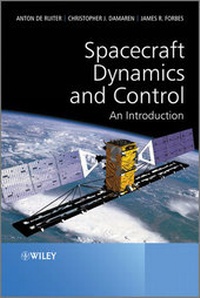
Spacecraft Dynamics and Control
An Introduction
Published on 4. January 2013
Book
Hardback
588 pages
978-1-118-34236-7 (ISBN)
Description
Provides the basics of spacecraft orbital dynamics plus attitude dynamics and control, using vectrix notation
Spacecraft Dynamics and Control: An Introduction presents the fundamentals of classical control in the context of spacecraft attitude control. This approach is particularly beneficial for the training of students in both of the subjects of classical control as well as its application to spacecraft attitude control. By using a physical system (a spacecraft) that the reader can visualize (rather than arbitrary transfer functions), it is easier to grasp the motivation for why topics in control theory are important, as well as the theory behind them. The entire treatment of both orbital and attitude dynamics makes use of vectrix notation, which is a tool that allows the user to write down any vector equation of motion without consideration of a reference frame. This is particularly suited to the treatment of multiple reference frames. Vectrix notation also makes a very clear distinction between a physical vector and its coordinate representation in a reference frame. This is very important in spacecraft dynamics and control problems, where often multiple coordinate representations are used (in different reference frames) for the same physical vector.
* Provides an accessible, practical aid for teaching and self-study with a layout enabling a fundamental understanding of the subject
* Fills a gap in the existing literature by providing an analytical toolbox offering the reader a lasting, rigorous methodology for approaching vector mechanics, a key element vital to new graduates and practicing engineers alike
* Delivers an outstanding resource for aerospace engineering students, and all those involved in the technical aspects of design and engineering in the space sector
* Contains numerous illustrations to accompany the written text. Problems are included to apply and extend the material in each chapter
Essential reading for graduate level aerospace engineering students, aerospace professionals, researchers and engineers.
Reviews / Votes
"In conclusion, this book covers a broad range of areas - including some more in-depth content (stabilisation techniques, practical design issues) - and is best used as an introductory text to the field for latter year undergraduates." (The Aeronautical Journal, 1 November 2014)"Overall, this book provides a good, comprehensive examination of the fundamentals of translational and rotational dynamics, determination, and control of spacecraft. Summing Up: Recommended. All academic and professional aerospace engineering collections." (Choice, 1 September 2013)
More details
Other editions
Additional editions
Anton H. de Ruiter | Christopher Damaren | James R. Forbes
Spacecraft Dynamics and Control
An Introduction
E-Book
12/2012
Wiley
€89.99
Available for download
Anton H. de Ruiter | Christopher Damaren | James R. Forbes
Spacecraft Dynamics and Control
An Introduction
E-Book
11/2012
Wiley
€89.99
Available for download
Persons
Anton de Ruiter, Assistant Professor, Mechanical and Aerospace Engineering Department, Carleton University, Ottawa, Canada.
Obtained his PhD in Aerospace Engineering from the University of Toronto in 2005.? Until 2006 he was a Visiting Research Fellow at the Space Technologies Branch of the Canadian Space Agency.?His interests include Nano-Satellite Technologies, Interplanetary Missions, Spacecraft Formation Flying, Spacecraft Attitude and Orbit Determination and Control, GPS-based Spacecraft Navigation, Control Systems, and Optimization Theory and Applications.?Professor De Ruiter has written extensively on spacecraft dynamics and related topics for journals, articled papers and conference proceedings.
Christopher J. Damaren, Professor, University of Toronto Institute for Aerospace Studies.
Obtained his doctorate at UTIAS in 1990 in the area of control systems for flexible spacecraft. In the 1990's most of his research concentrated on control system design for large structurally flexible robot manipulator systems such as the Space Station robotic systems developed by Canada. Since joining the faculty of UTIAS in 1999, his research group has been involved in the dynamics and control of spacecraft including the orbital, attitude, and structural motions of these systems.
James R. Forbes, Assistant Professor, Department of Mechanical Engineering, McGill University.
Obtained his doctorate at UTIAS in 2011 in the area of control system design with applications to aerospace systems, including spacecraft attitude control. His teaching duties at McGill University include spacecraft dynamics and control courses at the upper undergraduate/beginning graduate level
Obtained his PhD in Aerospace Engineering from the University of Toronto in 2005.? Until 2006 he was a Visiting Research Fellow at the Space Technologies Branch of the Canadian Space Agency.?His interests include Nano-Satellite Technologies, Interplanetary Missions, Spacecraft Formation Flying, Spacecraft Attitude and Orbit Determination and Control, GPS-based Spacecraft Navigation, Control Systems, and Optimization Theory and Applications.?Professor De Ruiter has written extensively on spacecraft dynamics and related topics for journals, articled papers and conference proceedings.
Christopher J. Damaren, Professor, University of Toronto Institute for Aerospace Studies.
Obtained his doctorate at UTIAS in 1990 in the area of control systems for flexible spacecraft. In the 1990's most of his research concentrated on control system design for large structurally flexible robot manipulator systems such as the Space Station robotic systems developed by Canada. Since joining the faculty of UTIAS in 1999, his research group has been involved in the dynamics and control of spacecraft including the orbital, attitude, and structural motions of these systems.
James R. Forbes, Assistant Professor, Department of Mechanical Engineering, McGill University.
Obtained his doctorate at UTIAS in 2011 in the area of control system design with applications to aerospace systems, including spacecraft attitude control. His teaching duties at McGill University include spacecraft dynamics and control courses at the upper undergraduate/beginning graduate level
Content
Preface xvii
1 Kinematics 1
Notes 44
References 45
2 Rigid Body Dynamics 47
Notes 63
References 63
3 The Keplerian Two-Body Problem 65
Notes 98
References 98
4 Preliminary Orbit Determination 99
Notes 114
References 114
5 Orbital Maneuvers 115
Notes 128
Reference 128
6 Interplanetary Trajectories 129
Notes 146
References 147
7 Orbital Perturbations 149
Notes 180
References 181
8 Low Thrust Trajectory Analysis and Design 183
Notes 188
References 188
9 Spacecraft Formation Flying 189
Notes 207
Reference 207
10 The Restricted Three-Body Problem 209
Notes 218
References 218
11 Introduction to Spacecraft Attitude Stabilization 219
12 Disturbance Torques on a Spacecraft 227
Notes 234
Reference 234
13 Torque-Free Attitude Motion 235
Notes 245
References 245
14 Spin Stabilization 247
Notes 253
References 253
15 Dual-Spin Stabilization 255
Notes 266
References 266
16 Gravity-Gradient Stabilization 267
Notes 277
References 277
17 Active Spacecraft Attitude Control 279
JWST251-FM JWST251-De-Ruiter Printer: Yet to Come November 2, 2012 14:18 Trim: 244mm
×
168mm
viii
Contents
57
58
59
Notes
63
References 63
3 The Keplerian Two-Body Problem 65
67
67
68
72
83
84
88
89
89
90
Notes
98
References 98
4 Preliminary Orbit Determination 99
Problem) 109
110
Notes
114
References 114
5 Orbital Maneuvers 115
118
120
FOR SCREEN VIEWING IN DART ONLY
JWST251-FM JWST251-De-Ruiter Printer: Yet to Come November 2, 2012 14:18 Trim: 244mm
×
168mm
Contents
ix
Notes
128
Reference 128
6 Interplanetary Trajectories 129
139
141
Notes
146
References 147
7 Orbital Perturbations 149
151
151
2
163
J
2
on the Orbital Elements 164
168
169
Notes
180
References 181
8 Low Thrust Trajectory Analysis and Design 183
Notes
188
References 188
9 Spacecraft Formation Flying 189
195
195
FOR SCREEN VIEWING IN DART ONLY
JWST251-FM JWST251-De-Ruiter Printer: Yet to Come November 2, 2012 14:18 Trim: 244mm
×
168mm
x
Contents
198
200
202
203
204
207
Notes
207
Reference 207
10 The Restricted Three-Body Problem 209
211
212
213
215
216
218
Notes
218
References 218
11 Introduction to Spacecraft Attitude Stabilization 219
220
221
224
12 Disturbance Torques on a Spacecraft 227
Notes
234
Reference 234
13 Torque-Free Attitude Motion 235
Notes
245
References 245
FOR SCREEN VIEWING IN DART ONLY
JWST251-FM JWST251-De-Ruiter Printer: Yet to Come November 2, 2012 14:18 Trim: 244mm
×
168mm
Contents
xi
14 Spin Stabilization 247
252
253
Notes
253
References 253
15 Dual-Spin Stabilization 255
Notes
266
References 266
16 Gravity-Gradient Stabilization 267
272
273
277
Notes
277
References 277
17 Active Spacecraft Attitude Control 279
Notes 320
References 320
18 Routh's Stability Criterion 321
Notes 330
References 330
19 The Root Locus 331
Notes 353
References 353
20 Control Design by the Root Locus Method 355
Notes 369
References 369
21 Frequency Response 371
Notes 385
References 385
22 Relative Stability 387
Notes 410
References 410
23 Control Design in the Frequency Domain 411
Notes 435
References 435
24 Nonlinear Spacecraft Attitude Control 437
Notes 456
References 457
25 Spacecraft Navigation 459
Notes 496
References 497
26 Practical Spacecraft Attitude Control Design Issues 499
Notes 539
References
Appendix A: Review of Complex Variables 541
Appendix B: Numerical Simulation of Spacecraft Motion 557
Notes 561
Reference 561
Index 563