

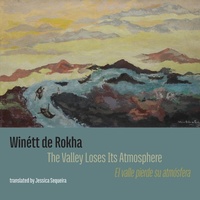
The Valley Loses Its Atmosphere
El valle pierde su atmosfera
Published on 19. November 2021
Book
Paperback/Softback
114 pages
978-1-84861-783-4 (ISBN)
Description
The Valley Loses Its Atmosphere is the final collection by Chilean poet Winett de Rokha. A book of 48 poems written during a journey across Latin America, it is a canto americano, an epic poem that sings of a united America through its land and peoples. The poems give attention to the geography and social conditions, mentioning the "banana plantations, rubber plantations, farmlands that produce bloodsuckers", the indigenous peoples such as the jivaro of Peru and Ecuador, local fauna like wolves and wasps, local flora like the clavel del aire or copihue, and popular protests like the Baltimore Workers' Congress. Winett proposes a new kind of language and a new kind of person, within new economic structures. She does so through the performance of a neobaroque rhetoric that mirrors the America she finds, a mottled variety to it, a "convulsive labyrinth, uneven, baroque, communicating", with "jumbled qualities". One feels Winett's pleasure in making her way across an America whose territories had already been given a hundred names by indigenous peoples before Columbus arrived, as she makes visits with her husband Pablo on behalf of a Communist Party that in theory stands for the friendship of peoples and the pursuit of economic and social justice. The world, shaken by recent and ongoing civil and global wars as Winett and Pablo travelled, seems to vibrate with imminent catastrophe and change. Winett's introductory poem announces her intention to create a "song of gold dust" and a "strophe of the day's necessity". "The Valley Loses Its Atmosphere is incorruptibly American," she proclaims. As the critic Javier Bello puts it: "The Valley Loses Its Atmosphere is a book that will require many readings to give an account of its complexity and restore it to the place I believe it should have held - and should still hold - in contemporary Chilean poetry, as one of its most intense and particular moments."
More details
Language
English
Spanish
Place of publication
Exeter
United Kingdom
Dimensions
Height: 203 mm
Width: 203 mm
Thickness: 6 mm
Weight
211 gr
ISBN-13
978-1-84861-783-4 (9781848617834)
Copyright in bibliographic data and cover images is held by Nielsen Book Services Limited or by the publishers or by their respective licensors: all rights reserved.
Schweitzer Classification
Persons
Winett de Rokha (1894-1951) was the pen name of the Chilean poet Luisa Victoria Anabalon Sanderson. She published four collections of poetry - "Formas del sueno" (1927), "Cantoral" (1936), "Oniromancia" (1943) and "El valle pierde su atmosfera" (1949). The first two of these were written under the pseudonym Juana Ines de la Cruz, in homage to the famous 17th-century Mexican poet and nun. In 1916 she married Pablo de Rokha, who would become one of Chile's most famous poets. They founded the Communist and anti-fascist literary journal and publishing house Multitud, had nine children together, and mutually influenced each other's literary and political work in profound ways. This book was originally published inside Pablo's "Arenga sobre el arte" (Tirade on Art, 1949).
Jessica Sequeira has published the novel A Furious Oyster, the story collection Rhombus and Oval, the essay collection Other Paradises: Poetic Approaches to Thinking in a Technological Age and the hybrid work A Luminous History of the Palm. She has translated many books by Latin American authors, and in 2019 was awarded the Premio Valle-Inclan. Currently she lives between Chile and the UK, where she is based at the Centre of Latin American Studies at the University of Cambridge.
Jessica Sequeira has published the novel A Furious Oyster, the story collection Rhombus and Oval, the essay collection Other Paradises: Poetic Approaches to Thinking in a Technological Age and the hybrid work A Luminous History of the Palm. She has translated many books by Latin American authors, and in 2019 was awarded the Premio Valle-Inclan. Currently she lives between Chile and the UK, where she is based at the Centre of Latin American Studies at the University of Cambridge.