

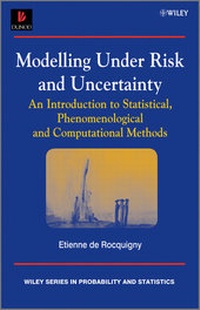
Modelling Under Risk and Uncertainty
An Introduction to Statistical, Phenomenological and Computational Methods
Will be published approx. on 19. April 2012
Book
Hardback
484 pages
978-0-470-69514-2 (ISBN)
Description
Modelling has permeated virtually all areas of industrial, environmental, economic, bio-medical or civil engineering: yet the use of models for decision-making raises a number of issues to which this book is dedicated:
How uncertain is my model ? Is it truly valuable to support decision-making ? What kind of decision can be truly supported and how can I handle residual uncertainty ? How much refined should the mathematical description be, given the true data limitations ? Could the uncertainty be reduced through more data, increased modeling investment or computational budget ? Should it be reduced now or later ? How robust is the analysis or the computational methods involved ? Should / could those methods be more robust ? Does it make sense to handle uncertainty, risk, lack of knowledge, variability or errors altogether ? How reasonable is the choice of probabilistic modeling for rare events ? How rare are the events to be considered ? How far does it make sense to handle extreme events and elaborate confidence figures ? Can I take advantage of expert / phenomenological knowledge to tighten the probabilistic figures ? Are there connex domains that could provide models or inspiration for my problem ?
Written by a leader at the crossroads of industry, academia and engineering, and based on decades of multi-disciplinary field experience, Modelling Under Risk and Uncertainty gives a self-consistent introduction to the methods involved by any type of modeling development acknowledging the inevitable uncertainty and associated risks. It goes beyond the "black-box" view that some analysts, modelers, risk experts or statisticians develop on the underlying phenomenology of the environmental or industrial processes, without valuing enough their physical properties and inner modelling potential nor challenging the practical plausibility of mathematical hypotheses; conversely it is also to attract environmental or engineering modellers to better handle model confidence issues through finer statistical and risk analysis material taking advantage of advanced scientific computing, to face new regulations departing from deterministic design or support robust decision-making.
Modelling Under Risk and Uncertainty:
* Addresses a concern of growing interest for large industries, environmentalists or analysts: robust modeling for decision-making in complex systems.
* Gives new insights into the peculiar mathematical and computational challenges generated by recent industrial safety or environmental control analysis for rare events.
* Implements decision theory choices differentiating or aggregating the dimensions of risk/aleatory and epistemic uncertainty through a consistent multi-disciplinary set of statistical estimation, physical modelling, robust computation and risk analysis.
* Provides an original review of the advanced inverse probabilistic approaches for model identification, calibration or data assimilation, key to digest fast-growing multi-physical data acquisition.
* Illustrated with one favourite pedagogical example crossing natural risk, engineering and economics, developed throughout the book to facilitate the reading and understanding.
* Supports Master/PhD-level course as well as advanced tutorials for professional training
Analysts and researchers in numerical modeling, applied statistics, scientific computing, reliability, advanced engineering, natural risk or environmental science will benefit from this book.
Reviews / Votes
"In my opinion, reviewed book is well organized textbook for risk management." (Zentralblatt MATH, 1 December 2012)More details
Product info
gebunden
Series
Edition
1. Auflage
Language
English
Place of publication
New York
United States
Target group
Professional and scholarly
Product notice
sewn/stitched
Paper over boards
Dimensions
Height: 249 mm
Width: 173 mm
Thickness: 25 mm
Weight
857 gr
ISBN-13
978-0-470-69514-2 (9780470695142)
Schweitzer Classification
Other editions
Additional editions
Etienne de Rocquigny
Modelling Under Risk and Uncertainty
An Introduction to Statistical, Phenomenological and Computational Methods
E-Book
04/2012
Wiley
€94.99
Available for download
Etienne de Rocquigny
Modelling Under Risk and Uncertainty
An Introduction to Statistical, Phenomenological and Computational Methods
E-Book
03/2012
Wiley
€94.99
Available for download
Person
Etienne De Rocquigny is Senior Research fellow in Statistics in Risk and Environment at Electricite' de France R&D He has 12 years of R&D and consulting experience in risk and environmental management. He has had consulting appointments and R&D contracts worldwide with the World Bank, the IMF, and UN as part of Sogreah consulting engineers. He is Chairman of the European Safety and Reliability & Data Society and Chairman of a consortium of French Industries on Uncertainty and Industry.
Content
Preface xv
Acknowledgements xvii
Introduction and reading guide xix
Notation xxxiii
Acronyms and abbreviations xxxvii
1 Applications and practices of modelling, risk and uncertainty 1
1.1 Protection against natural risk 1
1.2 Engineering design, safety and structural reliability analysis (SRA) 7
1.3 Industrial safety, system reliability and probabilistic risk assessment (PRA) 12
1.4 Modelling under uncertainty in metrology, environmental/sanitary assessment and numerical analysis 20
1.5 Forecast and time-based modelling in weather, operations research, economics or finance 27
1.6 Conclusion: The scope for generic modelling under risk and uncertainty 28
References 31
2 A generic modelling framework 34
2.1 The system under uncertainty 34
2.2 Decisional quantities and goals of modelling under risk and uncertainty 37
2.3 Modelling under uncertainty: Building separate system and uncertainty models 41
2.4 Modelling under uncertainty - the general case 50
2.5 Combining probabilistic and deterministic settings 60
2.6 Computing an appropriate risk measure or quantity of interest and associated sensitivity indices 64
2.7 Summary: Main steps of the studies and later issues 73
Exercises 74
References 75
3 A generic tutorial example: Natural risk in an industrial installation 77
3.1 Phenomenology and motivation of the example 77
3.2 A short introduction to gradual illustrative modelling steps 86
3.3 Summary of the example 99
Exercises 101
References 101
4 Understanding natures of uncertainty, risk margins and time bases for probabilistic decision-making 102
4.1 Natures of uncertainty: Theoretical debates and practical implementation 103
4.2 Understanding the impact on margins of deterministic vs. probabilistic formulations 110
4.3 Handling time-cumulated risk measures through frequencies and probabilities 121
4.4 Choosing an adequate risk measure - decision-theory aspects 135
Exercises 140
References 141
5 Direct statistical estimation techniques 143
5.1 The general issue 143
5.2 Introducing estimation techniques on independent samples 147
5.3 Modelling dependence 165
5.4 Controlling epistemic uncertainty through classical or Bayesian estimators 175
5.5 Understanding rare probabilities and extreme value statistical modelling 194
Exercises 203
References 204
6 Combined model estimation through inverse techniques 206
6.1 Introducing inverse techniques 206
6.2 One-dimensional introduction of the gradual inverse algorithms 216
6.3 The general structure of inverse algorithms: Residuals, identifiability, estimators, sensitivity and epistemic uncertainty 233
6.4 Specificities for parameter identification, calibration or data assimilation algorithms 251
6.5 Intrinsic variability identification 260
6.6 Conclusion: The modelling process and open statistical and computing challenges 267
Exercises 267
References 268
7 Computational methods for risk and uncertainty propagation 271
7.1 Classifying the risk measure computational issues 272
7.2 The generic Monte-Carlo simulation method and associated error control 283
7.3 Classical alternatives to direct Monte-Carlo sampling 299
7.4 Monotony, regularity and robust risk measure computation 317
7.5 Sensitivity analysis and importance ranking 330
7.6 Numerical challenges, distributed computing and use of direct or adjoint differentiation of codes 342
Exercises 342
References 343
8 Optimising under uncertainty: Economics and computational challenges 347
8.1 Getting the costs inside risk modelling - from engineering economics to financial modelling 347
8.2 The role of time - cash flows and associated risk measures 358
8.3 Computational challenges associated to optimisation 366
8.4 The promise of high performance computing 369
Exercises 372
References 372
9 Conclusion: Perspectives of modelling in the context of risk and uncertainty and further research 374
9.1 Open scientific challenges 374
9.2 Challenges involved by the dissemination of advanced modelling in the context of risk and uncertainty 377
References 377
10 Annexes 378
10.1 Annex 1 - refresher on probabilities and statistical modelling of uncertainty 378
10.2 Annex 2 - comments about the probabilistic foundations of the uncertainty models 386
10.3 Annex 3 - introductory reflections on the sources of macroscopic uncertainty 394
10.4 Annex 4 - details about the pedagogical example 397
10.5 Annex 5 - detailed mathematical demonstrations 414
References 426
Epilogue 427
Index 429