

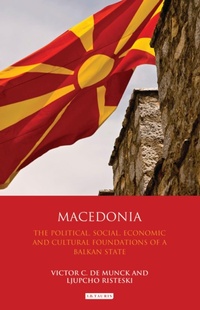
Macedonia
The Political, Social, Economic and Cultural Foundations of a Balkan State
Published on 18. December 2013
Book
Hardback
320 pages
978-1-84885-936-4 (ISBN)
Description
Macedonia has had a troubled and remarkable history. From Ancient Macedonia, the country of Alexander the Great, through Roman dependency, Bulgarian rule and Ottoman principality, the modern nation state is a complex mixture of ethnicities,historical allegiances and religious beliefs. United with Yugoslavia under Tito, and with a modern history of Albanian resistance and disputes with modern Greece, it is also absolutely central to the stability of the Balkan region. This is the first anthropological survey of the Republic of Macedonia, which seeks to untangle the many complexities of the country; addressing Sufism, Islamic influence, the role of ethnic Serbs, Albanians, Greeks and Bulgarians, the cultural heritage of Macedonia and its modern political relevance. This is essential reading for students and scholars of Balkan Studies, International Relations and Anthropology.
Reviews / Votes
'This edited volume,a timely and needed addition to the growing literature on the Republic of Macedonia,provides readers with a textured understanding of Macedonia's rich diversity and complexity. The contributors address a multitude of themes - including,among others,Sufi lodges,the Orthodox Church,and rural ecology-and offer new and refreshing insights into some of the challenges facing the country today.' Vasiliki P. Neofotistos, Assistant Professor, Department of Anthropology, State University of New York at Buffalo 'This volume consists of consistently well-written,content-rich articles.The chapters are not only rich with facts but with the insights derived from the commingling of experience and knowledge. Chapters are of a uniformly high quality and range in subject matter from cultural heritage,the political and cultural role of the orthodox church,to the troubled waters of Macedonia's relations with Greece,the EU,and with some of its internal minorities-Turks, Gypsies and Albanians.It also offers chapters on contemporary gender relations and environmental pollution. This is a must read for scholars and readers interested in Macedonia or the Balkans.' Andrey Korotayev, Professor and Head of the Department of Modern Asia and Africa, Russian State University for the Humanities 'Anthropological writing about contested lands and people from the attractive but sometimes troubled "wild" part of Europe-the Balkans -is always tricky. This volume on Macedonia is a good example of balanced collaborative work from domestic and foreign scholars.From various perspectives,and based on different kinds of fieldwork and research,they present and discuss Macedonia and Macedonians,a country with contested name, and a people with renounced nationhood.' Rajko Mursic?, Professor of Cultural Anthropology, University of LjubljanaMore details
Language
English
Place of publication
United Kingdom
Publishing group
Bloomsbury Publishing PLC
Target group
College/higher education
Product notice
Laminated cover
Dimensions
Height: 216 mm
Width: 140 mm
Thickness: 19 mm
Weight
521 gr
ISBN-13
978-1-84885-936-4 (9781848859364)
Copyright in bibliographic data and cover images is held by Nielsen Book Services Limited or by the publishers or by their respective licensors: all rights reserved.
Schweitzer Classification
Persons
Victor C. de Munck is Associate Professor in Anthropology at the State University of New York (SUNY), USA.
Ljupcho Risteski is Associate Professor in Ethnography and Anthropolgy at Sts. Cyril and Methodius University, Macedonia.
Ljupcho Risteski is Associate Professor in Ethnography and Anthropolgy at Sts. Cyril and Methodius University, Macedonia.
Content
List of Captions
Map
List of Contributors
Introduction
Victor C de Munck and Ljupcho Risteski
Section One: Macedonians in Transition
1. A Tantrum from the Cradle of Democracy: On the Dangers of Studying Macedonian
Victor A. Friedman
2. 'Eu as Future?: From a Macedonian Viewpoint The multiple ways of being European in Macedonia and not being in Europe
Ilka Theissen
3. 'My Faith, My Nation': Exploring the 'Natural' Affinity Between Orthodox Christianity and National Identity in Macedonia
Violeta Duklevska Schubert
4. Nationalism and the Use of Cultural Heritage: Three Post-Socialist Macedonian Examples
Davorin Trpeski
5. Conceptualizing Gender in Macedonia
Victor C. de Munck & Davorin Trpeski
Section Two: Towards Making Macedonia Multicultural
6. Is It Just a Song That Remains? Reflections On Turkish Minorities in Macedonia
Burcu Akan Ellis
7. Why a Gypsy in Macedonia Does Not Know 'Correct' Islam
Galina Oustinova-Stjepanovic
8. Absent Roma, Imported Interest: 'Roma' as Subject and Agent in the Republic of Macedonia
Shayna Plaut
9. Topography of Spatial and Temporal Ruptures: (Im)materialities of (post)socialism in a northern town in Macedonia
Rozita Dimova
10. Africa:Europe::Albania:Macedonia- A zero-sum, ecological fallacy theory of ethnic divisiveness
Victor C. de Munck & Joseph Moldow
Section Three: Nationalism and the Environment
11. National Purities, Ecological Disasters: Greek modernity and the war on nature
Anastasia Karakasidou
12. 'Kapka po kapka' (drop by drop): Civil Society and Rural Ecology in the Prespa Lake region of Macedonia
Jonathan Matthew Schwartz
Index
Map
List of Contributors
Introduction
Victor C de Munck and Ljupcho Risteski
Section One: Macedonians in Transition
1. A Tantrum from the Cradle of Democracy: On the Dangers of Studying Macedonian
Victor A. Friedman
2. 'Eu as Future?: From a Macedonian Viewpoint The multiple ways of being European in Macedonia and not being in Europe
Ilka Theissen
3. 'My Faith, My Nation': Exploring the 'Natural' Affinity Between Orthodox Christianity and National Identity in Macedonia
Violeta Duklevska Schubert
4. Nationalism and the Use of Cultural Heritage: Three Post-Socialist Macedonian Examples
Davorin Trpeski
5. Conceptualizing Gender in Macedonia
Victor C. de Munck & Davorin Trpeski
Section Two: Towards Making Macedonia Multicultural
6. Is It Just a Song That Remains? Reflections On Turkish Minorities in Macedonia
Burcu Akan Ellis
7. Why a Gypsy in Macedonia Does Not Know 'Correct' Islam
Galina Oustinova-Stjepanovic
8. Absent Roma, Imported Interest: 'Roma' as Subject and Agent in the Republic of Macedonia
Shayna Plaut
9. Topography of Spatial and Temporal Ruptures: (Im)materialities of (post)socialism in a northern town in Macedonia
Rozita Dimova
10. Africa:Europe::Albania:Macedonia- A zero-sum, ecological fallacy theory of ethnic divisiveness
Victor C. de Munck & Joseph Moldow
Section Three: Nationalism and the Environment
11. National Purities, Ecological Disasters: Greek modernity and the war on nature
Anastasia Karakasidou
12. 'Kapka po kapka' (drop by drop): Civil Society and Rural Ecology in the Prespa Lake region of Macedonia
Jonathan Matthew Schwartz
Index