

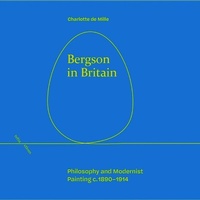
Bergson in Britain
Philosophy and Modernist Painting, c. 1890-1914
Published on 22. November 2023
Book
Hardback
400 pages
978-1-4744-9238-6 (ISBN)
Description
Charlotte de Mille shows that the reception of the philosophy of Henri Bergson by British artists and critics was far more wide spread and of far greater importance in the UK than has been previously thought.
Based on archival material in Paris and the US, not all previously accessed, along with primary UK sources, she opens new avenues of research and interpretation on the work of artists Vanessa Bell, Duncan Grant, John Duncan Fergusson and artist-writers Roger Fry and Wyndham Lewis.
De Mille demonstrates the profound impact of Bergson's work in UK culture immediately prior to World War One. Her interdisciplinary approach integrates philosophy, art criticism and art history. An Epilogue considers the proximity of Bergson's thought on temporality, perception, intuition and subjectivity to art history, from Alois Riegl and Aby Warburg, to practitioners today.
Based on archival material in Paris and the US, not all previously accessed, along with primary UK sources, she opens new avenues of research and interpretation on the work of artists Vanessa Bell, Duncan Grant, John Duncan Fergusson and artist-writers Roger Fry and Wyndham Lewis.
De Mille demonstrates the profound impact of Bergson's work in UK culture immediately prior to World War One. Her interdisciplinary approach integrates philosophy, art criticism and art history. An Epilogue considers the proximity of Bergson's thought on temporality, perception, intuition and subjectivity to art history, from Alois Riegl and Aby Warburg, to practitioners today.
Reviews / Votes
An incredible knowledge of Modernist art is intertwined here with scholarship in Bergsonian philosophy second to none. Not only has Charlotte de Mille forcefully demonstrated the importance of Bergson to British Modernism through figures such as Fry, Fergusson, and Lewis (among many others), she does so with a dexterity and aptitude for conceptual analysis that is dazzling. An extraordinary achievement. * John O Maoilearca, Kingston University * Bergson in Britain interpolates the first synthetic study of the French philosopher's multifaceted impact on the visual arts in Britain with an experimental form of art writing, building upon the author's innovative interpretation of Bergson's "philosophy of immanence." Based on extensive archival research, this timely book is certain to stimulate cross-disciplinary debate. * Mark Antliff, Duke University *More details
Series
Language
English
Place of publication
Edinburgh
United Kingdom
Target group
Professional and scholarly
Illustrations
13 black and white illustrations, 7 colour illustrations
Dimensions
Height: 218 mm
Width: 215 mm
Thickness: 42 mm
Weight
1206 gr
ISBN-13
978-1-4744-9238-6 (9781474492386)
Copyright in bibliographic data and cover images is held by Nielsen Book Services Limited or by the publishers or by their respective licensors: all rights reserved.
Schweitzer Classification
Other editions
Additional editions

E-Book
11/2023
Edinburgh University Press
€97.49
Available for download

E-Book
08/2023
1st Edition
Edinburgh University Press
€97.49
Available for download
Person
Charlotte de Mille is Associate Lecturer at The Courtauld Institute and curates The Courtauld Gallery's music programme. She is co-editor with John O' Maoilearca of Bergson and the Art of Immanence ?(EUP, 2013) and editor of Music and Modernism, c. 1849-1950?(CSP, 2011). The Bloomsbury Handbook to Music and Art, co-edited with Sarah Mahler Kraaz will be published with Bloomsbury Academic in 2023.
Content
Acknowledgements
List of Illustrations
Introduction: The 'Age of Bergson'
?
Chapter 1: Bergson in Britain?
'I am not an "Intuitionist'''
The Independent Review: Considering the world from a moral point of view
The Reality of Time
The UK Lectures
Society of Psychical Research
T. E. Hulme's original sin
Karin Costelloe's 'Interpenetration'
Multiple Modernities?
The Bergson Phenomenon
Being British and Bergsonian
?
Chapter 2: Metaphysics of Non-Representation: Bloomsbury's Bergson
'Our tactile imagination'
Bergson's intuition
Fry's Essay in Aesthetics
Intuition in Post Impressionism
'Art is philosophy': Matthew Stewart Prichard
Art writing philosophy
Bathing with the Byzantines
Embodying Experience: Grant's Scroll
Temporality in Painting and the Cinematic Challenge
Plurality in painting and multiple memory
Re-Membering the thing
?
Chapter 3: New Spirits: Moina MacGregor
'Psychical phosphorescence'
Psychic Vertigo
'A wild phantasmagoric dance'
'A bizarre assemblage of images'
Re-tracing steps
?
Chapter 4: Rhythmist (E-)Utopias: Fergusson's Bergson and the evolution of creation
Bergsonian Origins
Durational Portraiture
Intuitive (E-)utopias
'Primordial' perception and Neo-Barbarism
Rhythmist elan vital in Fergusson's Rhythm (1911): a new deity?
Immanence against Symbolism
From rhythm to crystallisation
Conclusions
?
Chapter 5: Blasted Devolution: Wyndham Lewis and Henri Bergson
Devolution and Mediocrity: Laughter; Lewis in Paris; The Wild Body
Creative Evolution inside out: Lewis's marginalia
Autocracy: Timon in Athens (1912-13); Blast; The Crowd (1915)
Multiplicity of self in Bergson and Lewis
Transgression: Bergson's consciousness contra Enemy of the Stars (c.1913)
Imaging the all-embracing
?
Conclusion
?
Epilogue: - 'a momentary displacement of our equilibrium'
Recapitulating Art History
Bergson and History
Immanence and Art History
Animating Art History
Towards a holobiont history of art
List of Illustrations
Introduction: The 'Age of Bergson'
?
Chapter 1: Bergson in Britain?
'I am not an "Intuitionist'''
The Independent Review: Considering the world from a moral point of view
The Reality of Time
The UK Lectures
Society of Psychical Research
T. E. Hulme's original sin
Karin Costelloe's 'Interpenetration'
Multiple Modernities?
The Bergson Phenomenon
Being British and Bergsonian
?
Chapter 2: Metaphysics of Non-Representation: Bloomsbury's Bergson
'Our tactile imagination'
Bergson's intuition
Fry's Essay in Aesthetics
Intuition in Post Impressionism
'Art is philosophy': Matthew Stewart Prichard
Art writing philosophy
Bathing with the Byzantines
Embodying Experience: Grant's Scroll
Temporality in Painting and the Cinematic Challenge
Plurality in painting and multiple memory
Re-Membering the thing
?
Chapter 3: New Spirits: Moina MacGregor
'Psychical phosphorescence'
Psychic Vertigo
'A wild phantasmagoric dance'
'A bizarre assemblage of images'
Re-tracing steps
?
Chapter 4: Rhythmist (E-)Utopias: Fergusson's Bergson and the evolution of creation
Bergsonian Origins
Durational Portraiture
Intuitive (E-)utopias
'Primordial' perception and Neo-Barbarism
Rhythmist elan vital in Fergusson's Rhythm (1911): a new deity?
Immanence against Symbolism
From rhythm to crystallisation
Conclusions
?
Chapter 5: Blasted Devolution: Wyndham Lewis and Henri Bergson
Devolution and Mediocrity: Laughter; Lewis in Paris; The Wild Body
Creative Evolution inside out: Lewis's marginalia
Autocracy: Timon in Athens (1912-13); Blast; The Crowd (1915)
Multiplicity of self in Bergson and Lewis
Transgression: Bergson's consciousness contra Enemy of the Stars (c.1913)
Imaging the all-embracing
?
Conclusion
?
Epilogue: - 'a momentary displacement of our equilibrium'
Recapitulating Art History
Bergson and History
Immanence and Art History
Animating Art History
Towards a holobiont history of art