

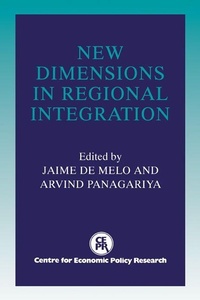
New Dimensions in Regional Integration
Published on 29. March 1996
Book
Paperback/Softback
504 pages
978-0-521-55668-2 (ISBN)
Description
Interest in regional integration has recently revived in both developed and developing countries. The US has responded to the lack of progress in the Uruguay Round of the GATT by pursuing bilateral trade negotiations, while developing countries have been prompted to re-evaluate the potential benefits of regional integration. The tendency for the world trading system to divide into three blocs - the European Community, the Americas and East Asia - is providing their members with guaranteed access to large markets; however, poor non-member countries will suffer from the loss of access and the risk of trade wars is increased. In this book leading international experts assess the renewed attractiveness of regional integration to individual countries, the types of integration that are suitable to various circumstances, the conditions necessary to their success, and the relationship of regionalism to multilateral free trade.
More details
Language
English
Place of publication
Cambridge
United Kingdom
Target group
Professional and scholarly
Product notice
Paperback (trade)
Illustrations
53 Tables, unspecified; 11 Line drawings, unspecified
Dimensions
Height: 229 mm
Width: 152 mm
Thickness: 29 mm
Weight
810 gr
ISBN-13
978-0-521-55668-2 (9780521556682)
Copyright in bibliographic data and cover images is held by Nielsen Book Services Limited or by the publishers or by their respective licensors: all rights reserved.
Schweitzer Classification
Other editions
Additional editions
Jaime de Melo | Arvind Panagariya
New Dimensions in Regional Integration
Book
07/1993
Cambridge University Press
€61.90
Article exhausted; check for reprint
Previous edition
Jaime de Melo | Arvind Panagariya
New Dimensions in Regional Integration
Book
07/1993
Cambridge University Press
€61.90
Article exhausted; check for reprint
Persons
Content
Preface; Foreword Richard Portes and Lawrence Summers; Acknowledgements; List of conference participants; Part I. Systemic Issues: 1. Introduction Jaime de Melo and Arvind Panagariya; 2. Regionalism and multilateralism: an overview Jagdish Bhagwati; Discussion Robert Baldwin and Richard Blackhurst; 3. Regionalism versus multilateralism: analytical notes Paul Krugman; Discussion Ronald Jones and T. N. Srinivasan; 4. Multilateral and bilateral trade policies in the world trading system: an historical perspective Douglas A. Irwin; Discussion Barry Eichengreen and Mancur Olson; 5. Gatt's influence on regional arrangements J. Michael Finger; Discussion Jean Baneth and Robert Hudec;Part II. Country Issues: 6. The new regionalism: a country perspective Jaime de Melo, Arvind Panagariya and Dani Rodrik; Discussion Ronald Findlay and Constantine Michalopoulos; 7. The European Community: a case of successful integration? L. Alan Winters; Discussion Ravi Kanbur and Andre Sapir; 8. Regional integration in Sub-Saharan Africa: past experience and future prospects Faezeh Foroutan; Discussion Christopher Bliss and Ishrat Hussain; 9. Latin America's integration and the multilateral trading system Julio Nogues and Rosalinda Quintanilla; Discussion Christopher Clague and Jesus Seade; 10. Regional integration in Eastern Europe: prospects for integration within the region and with the European Community Josef C. Brada; Discussion Alan Gelb and Gabor Oblath; 11. Regional trade arrangements in North America: CUSTA and NAFTA John Whalley; Discussion Fernando Clavijo and Ulrich Laechler;12. Trading Blocs and East Asia Gary R. Saxonhouse; Discussion Hugh Patrick and Vinod Thomas; 13. Prospects for regional integration in the Middle East Stanley Fischer; Discussion Richard Baldwin and Enzo Grilli; Round Table Discussion Richard N. Cooper, W. Max Corden, Rudiger Dornbusch; Index.