

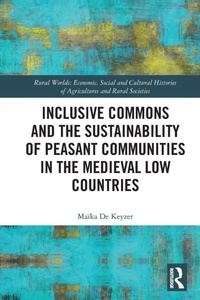
Inclusive Commons and the Sustainability of Peasant Communities in the Medieval Low Countries
1st Edition
Published on 29. August 2022
Book
Paperback/Softback
150 pages
978-1-032-40193-5 (ISBN)
Description
Is inclusiveness in the commons and sustainability a paradox? Late medieval and Early Modern rural societies encountered challenges because of growing population pressure, urbanisation and commercialisation. While some regions went along this path and commercialised and intensified production, others sailed a different course, maintaining communal property and managing resources via common pool resource institutions. To prevent overexploitation and free riding, it was generally believed that strong formalised institutions, strict access regimes and restricted use rights were essential.
By looking at the late medieval Campine area, a sandy, infertile and fragile region, dominated by communal property and located at the core of the densely populated and commercialised Low Countries, it has become clear that sustainability, economic success and inclusiveness can be compatible. Because of a balanced distribution of power between smallholders and elites, strong property claims, a predominance of long-term agricultural strategies and the vitality of informal institutions and conflict resolution mechanisms, the Campine peasant communities were able to avert ecological distress while maintaining a positive economic climate.
By looking at the late medieval Campine area, a sandy, infertile and fragile region, dominated by communal property and located at the core of the densely populated and commercialised Low Countries, it has become clear that sustainability, economic success and inclusiveness can be compatible. Because of a balanced distribution of power between smallholders and elites, strong property claims, a predominance of long-term agricultural strategies and the vitality of informal institutions and conflict resolution mechanisms, the Campine peasant communities were able to avert ecological distress while maintaining a positive economic climate.
More details
Series
Language
English
Place of publication
London
United Kingdom
Publishing group
Taylor & Francis Ltd
Target group
College/higher education
Postgraduate and Undergraduate
Illustrations
14 s/w Abbildungen
14 Illustrations, black and white
Dimensions
Height: 229 mm
Width: 152 mm
Thickness: 8 mm
Weight
231 gr
ISBN-13
978-1-032-40193-5 (9781032401935)
Copyright in bibliographic data and cover images is held by Nielsen Book Services Limited or by the publishers or by their respective licensors: all rights reserved.
Schweitzer Classification
Other editions
Additional editions
Maika de Keyzer
Inclusive Commons and the Sustainability of Peasant Communities in the Medieval Low Countries
E-Book
04/2018
1st Edition
Routledge
€60.49
Available for download
Maika de Keyzer
Inclusive Commons and the Sustainability of Peasant Communities in the Medieval Low Countries
E-Book
04/2018
1st Edition
Routledge
€60.49
Available for download
Maika de Keyzer
Inclusive Commons and the Sustainability of Peasant Communities in the Medieval Low Countries
Book
04/2018
1st Edition
Routledge
€207.00
Shipment within 10-20 days
Person
Maika De Keyzer is a historian affiliated with the Department of History and Art History at Utrecht University, working within the ERC project "Coordinating for Life."
Content
1. The Dominance of Exclusive Commons: An Exploration and Re-evaluation 2. The Campine: An Overview 3. Inclusive Commons 4. Successful Commons: What's in a Name? 5. The Road to Success 6. Conclusion