

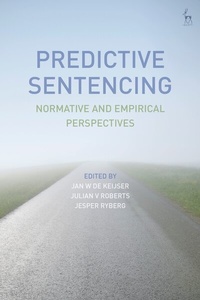
Predictive Sentencing
Normative and Empirical Perspectives
Published on 17. December 2020
Book
Paperback/Softback
320 pages
978-1-5099-4608-2 (ISBN)
Description
Predictive Sentencing addresses the role of risk assessment in contemporary sentencing practices. Predictive sentencing has become so deeply ingrained in Western criminal justice decision-making that despite early ethical discussions about selective incapacitation, it currently attracts little critique. Nor has it been subjected to a thorough normative and empirical scrutiny. This is problematic since much current policy and practice concerning risk predictions is inconsistent with mainstream theories of punishment. Moreover, predictive sentencing exacerbates discrimination and disparity in sentencing. Although structured risk assessments may have replaced 'gut feelings', and have now been systematically implemented in Western justice systems, the fundamental issues and questions that surround the use of risk assessment instruments at sentencing remain unresolved. This volume critically evaluates these issues and will be of great interest to scholars of criminal justice and criminology.
Reviews / Votes
The editors of this volume have assembled a distinguished group of scholars whose contributions incisively explore the many issues raised by predictive sentencing. The issues include its fit with standard views about the aims of legal punishment and with related moral concepts such as the rights and dignity of offenders. They also include the numerous complex and contested factors that go into making predictions about future offending, the accuracy of the resulting predictions, and the myriad uses to which they have been and might be put in sentencing. The volume is especially noteworthy for the range of disciplinary perspectives it contains, as well as for its well-informed and thoughtful analyses of the feasibility and defensibility of using predictions in sentencing. -- Professor Richard Lippke, Chair of the Department of Criminal Justice at Indiana UniversityMore details
Language
English
Place of publication
Oxford
United Kingdom
Publishing group
Bloomsbury Publishing PLC
Target group
College/higher education
Dimensions
Height: 234 mm
Width: 156 mm
Weight
454 gr
ISBN-13
978-1-5099-4608-2 (9781509946082)
Copyright in bibliographic data and cover images is held by Nielsen Book Services Limited or by the publishers or by their respective licensors: all rights reserved.
Schweitzer Classification
Other editions
Additional editions
Jan W. de Keijser | Julian V. Roberts | Jesper Ryberg
Predictive Sentencing
Normative and Empirical Perspectives
E-Book
05/2019
1st Edition
Hart Publishing
€43.99
Available for download
Jan W. de Keijser | Julian V. Roberts | Jesper Ryberg
Predictive Sentencing
Normative and Empirical Perspectives
E-Book
05/2019
1st Edition
Hart Publishing
€43.99
Available for download
Persons
Jan W de Keijser is Professor of Criminology at the University of Leiden, The Netherlands.
Julian V Roberts is Professor of Criminology at the University of Oxford, and Fellow of Worcester College, Oxford.
Jesper Ryberg is Professor of Ethics and Philosophy of Law at the Department of Philosophy at Roskilde University, Denmark.
Julian V Roberts is Professor of Criminology at the University of Oxford, and Fellow of Worcester College, Oxford.
Jesper Ryberg is Professor of Ethics and Philosophy of Law at the Department of Philosophy at Roskilde University, Denmark.
Content
1. Introduction: Normative and Empirical Perspectives on Predictive Sentencing
Jan W de Keijser, Julian V Roberts and Jesper Ryberg
2. The Use of Risk Assessment in Sentencing
Esther FJC van Ginneken
3. Why Legal Philosophers (Including Retributivists) Should Be Less Resistant to Risk-Based Sentencing
Douglas Husak
4. Risk and Retribution: On the Possibility of Reconciling Considerations of Dangerousness and Desert
Jesper Ryberg
5. Is Preventive Detention Morally Worse than Quarantine?
Th omas Douglas
6. Against Incapacitative Punishment
Zachary Hoskins
7. A Defence of Modern Risk-Based Sentencing 7
Christopher Slobogin
8. Some Dilemmas of Indeterminate Sentences: Risk and Uncertainty, Dignity and Hope
Andrew Ashworth and Lucia Zedner
9. The Problematic Role of Prior Record Enhancements in Predictive Sentencing
Julian V Roberts and Richard S Frase
10. Unpacking Sentencing Algorithms: Risk, Racial Accountability and Data Harms
Kelly Hannah-Moff at and Kelly Struthers Montford
11. The Scientific Validity of Current Approaches to Violence and Criminal Risk Assessment
Seena Fazel
12. Risk Assessment at Sentencing: The Pennsylvania Experience
Rhys Hester
13. Predictive Sentencing: An Analysis of Public Views
Jan W de Keijser and Sigrid GC van Wingerden
14. Sentencing and Prediction: Old Wine in Old Bottles
Michael Tonry
Jan W de Keijser, Julian V Roberts and Jesper Ryberg
2. The Use of Risk Assessment in Sentencing
Esther FJC van Ginneken
3. Why Legal Philosophers (Including Retributivists) Should Be Less Resistant to Risk-Based Sentencing
Douglas Husak
4. Risk and Retribution: On the Possibility of Reconciling Considerations of Dangerousness and Desert
Jesper Ryberg
5. Is Preventive Detention Morally Worse than Quarantine?
Th omas Douglas
6. Against Incapacitative Punishment
Zachary Hoskins
7. A Defence of Modern Risk-Based Sentencing 7
Christopher Slobogin
8. Some Dilemmas of Indeterminate Sentences: Risk and Uncertainty, Dignity and Hope
Andrew Ashworth and Lucia Zedner
9. The Problematic Role of Prior Record Enhancements in Predictive Sentencing
Julian V Roberts and Richard S Frase
10. Unpacking Sentencing Algorithms: Risk, Racial Accountability and Data Harms
Kelly Hannah-Moff at and Kelly Struthers Montford
11. The Scientific Validity of Current Approaches to Violence and Criminal Risk Assessment
Seena Fazel
12. Risk Assessment at Sentencing: The Pennsylvania Experience
Rhys Hester
13. Predictive Sentencing: An Analysis of Public Views
Jan W de Keijser and Sigrid GC van Wingerden
14. Sentencing and Prediction: Old Wine in Old Bottles
Michael Tonry