

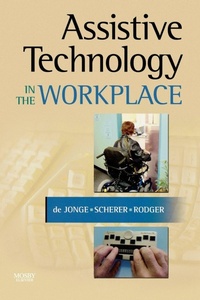
Assistive Technology in the Workplace
Published on 5. October 2007
Book
Paperback/Softback
272 pages
978-0-323-04130-0 (ISBN)
Description
The first book of its kind, this text outlines and defines the process for selecting, integrating, and utilizing assistive technology in the work environment. Each stage of the process is examined in depth, and effective strategies are presented to help overcome the barriers likely to be encountered at each stage. The book also provides insight into the client's experience by drawing on research that explores the experiences of people using assistive technology in the workplace and the issues they face in acquiring and using their technology in the work environment.
Results from the Assistive Technology User Study are explained - an extensive and unique research project undertaken by the authors that examines the experiences of AT users in the workplace, the barriers they experience, and the support strategies they use to function in the work environment.
AT user quotes and anecdotes bring immediacy to obstacles faced in the workplace.
Vignettes and case studies throughout the text encourage students to apply principles to real-life situations.
Appendices include listings for various professional organizations, funding, listservs, and research resources, as well as lists of questions therapists and clients should ask in various situations.
Material progresses in a logical manner, examining each facet of workplace AT beyond its theory and evaluation.
Consumer/client-centered focus takes the client's needs into account, featuring anecdotes from the users interviewed in the AT User Study.
Employer concerns are addressed, using anecdotes to illustrate issues from the employer's perspective - an essential factor to consider when selecting appropriate technology.
Results from the Assistive Technology User Study are explained - an extensive and unique research project undertaken by the authors that examines the experiences of AT users in the workplace, the barriers they experience, and the support strategies they use to function in the work environment.
AT user quotes and anecdotes bring immediacy to obstacles faced in the workplace.
Vignettes and case studies throughout the text encourage students to apply principles to real-life situations.
Appendices include listings for various professional organizations, funding, listservs, and research resources, as well as lists of questions therapists and clients should ask in various situations.
Material progresses in a logical manner, examining each facet of workplace AT beyond its theory and evaluation.
Consumer/client-centered focus takes the client's needs into account, featuring anecdotes from the users interviewed in the AT User Study.
Employer concerns are addressed, using anecdotes to illustrate issues from the employer's perspective - an essential factor to consider when selecting appropriate technology.
More details
Language
English
Place of publication
St Louis
United States
Publishing group
Elsevier - Health Sciences Division
Target group
College/higher education
Product notice
Paperback (trade)
Dimensions
Height: 230 mm
Width: 154 mm
Thickness: 12 mm
Weight
367 gr
ISBN-13
978-0-323-04130-0 (9780323041300)
Copyright in bibliographic data and cover images is held by Nielsen Book Services Limited or by the publishers or by their respective licensors: all rights reserved.
Schweitzer Classification
Persons
Director, Institute for Matching Person and Technology, University of Rochester Medical Center; Adjunct Associate Professor of Physical Medicine and Rehabilitation and Senior Research Associate, International Center for Hearing and Speech Research, Webster, NY, USA
Author
Lecturer, Occupational Therapy, The University of Queensland, Brisbane, Australia
Director, Institute for Matching Person and Technology, University of Rochester Medical Center; Adjunct Associate Professor of Physical Medicine and Rehabilitation and Senior Research Associate, International Center for Hearing and Speech Research, Webster, NY, USA
Senior Lecturer and Head, Department of Occupational Therapy, The University of Queensland, Brisbane, Australia
Content
1. Technology at Work
2. Review of the Development of Assistive Technology Models
3. Consumer-Centered Process for Technology Acquisition and Use
4. Identifying the Right Technology
5. Acquiring Technology for Work
6. Introducing Assistive Technology into the Workplace
7. Optimizing the Use of Technology in the Workplace
8. Issues for the Assistive Technology User in the Workplace
9. Evaluating the Effectiveness of Technology in the Workplace
Appendix A. Questions to Guide Identifying Potential Technologies
Appendix B. Questions to Guide Choosing a Supplier
Appendix C. Questions to Guide Trialing Devices
Appendix D. Questions to Guide Choosing the Best Technology
Appendix E. Questions to Guide the Acquisition of Technology
Appendix F. Questions to Guide Working with a Supplier
Appendix G. Questions to Guide Customization
Appendix H. Questions to Guide Learning to Use Your Technology
Appendix I. Questions to Guide the Long-Term Use of Assistive Technology in the Workplace
Appendix J. Resources and Weblinks
2. Review of the Development of Assistive Technology Models
3. Consumer-Centered Process for Technology Acquisition and Use
4. Identifying the Right Technology
5. Acquiring Technology for Work
6. Introducing Assistive Technology into the Workplace
7. Optimizing the Use of Technology in the Workplace
8. Issues for the Assistive Technology User in the Workplace
9. Evaluating the Effectiveness of Technology in the Workplace
Appendix A. Questions to Guide Identifying Potential Technologies
Appendix B. Questions to Guide Choosing a Supplier
Appendix C. Questions to Guide Trialing Devices
Appendix D. Questions to Guide Choosing the Best Technology
Appendix E. Questions to Guide the Acquisition of Technology
Appendix F. Questions to Guide Working with a Supplier
Appendix G. Questions to Guide Customization
Appendix H. Questions to Guide Learning to Use Your Technology
Appendix I. Questions to Guide the Long-Term Use of Assistive Technology in the Workplace
Appendix J. Resources and Weblinks