

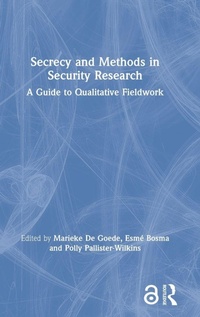
Secrecy and Methods in Security Research
A Guide to Qualitative Fieldwork
1st Edition
Published on 27. August 2019
Book
Hardback
330 pages
978-0-367-02723-0 (ISBN)
Description
This book analyses the challenges of secrecy in security research, and develops a set of methods to navigate, encircle and work with secrecy.
How can researchers navigate secrecy in their fieldwork, when they encounter confidential material, closed-off quarters or bureaucratic rebuffs? This is a particular challenge for researchers in the security field, which is by nature secretive and difficult to access. This book creatively assesses and analyses the ways in which secrecies operate in security research. The collection sets out new understandings of secrecy, and shows how secrecy itself can be made productive to research analysis. It offers students, PhD researchers and senior scholars a rich toolkit of methods and best-practice examples for ethically appropriate ways of navigating secrecy. It pays attention to the balance between confidentiality, and academic freedom and integrity. The chapters draw on the rich qualitative fieldwork experiences of the contributors, who did research at a diversity of sites, for example at a former atomic weapons research facility, inside deportation units, in conflict zones, in everyday security landscapes, in virtual spaces and at borders, bureaucracies and banks.
The book will be of interest to students of research methods, critical security studies and International Relations in general.
The Open Access version of this book, available at www.taylorfrancis.com, has been made available under a Creative Commons Attribution-Non Commercial-No Derivatives 4.0 license.
How can researchers navigate secrecy in their fieldwork, when they encounter confidential material, closed-off quarters or bureaucratic rebuffs? This is a particular challenge for researchers in the security field, which is by nature secretive and difficult to access. This book creatively assesses and analyses the ways in which secrecies operate in security research. The collection sets out new understandings of secrecy, and shows how secrecy itself can be made productive to research analysis. It offers students, PhD researchers and senior scholars a rich toolkit of methods and best-practice examples for ethically appropriate ways of navigating secrecy. It pays attention to the balance between confidentiality, and academic freedom and integrity. The chapters draw on the rich qualitative fieldwork experiences of the contributors, who did research at a diversity of sites, for example at a former atomic weapons research facility, inside deportation units, in conflict zones, in everyday security landscapes, in virtual spaces and at borders, bureaucracies and banks.
The book will be of interest to students of research methods, critical security studies and International Relations in general.
The Open Access version of this book, available at www.taylorfrancis.com, has been made available under a Creative Commons Attribution-Non Commercial-No Derivatives 4.0 license.
Reviews / Votes
'The volume succeeds in giving insights into a variety of research methodologies and at the same time gives a kaleidoscopic insight into how secrecy shapes contemporary security practices, its technologies, and most importantly its politics. The volume will be of interest not only to scholars of security sites but it will hopefully attract attention outside the field. The short chapters and the description of various research project make it a great addition for any syllabus on research methods in IR.'--Linda Monsees, Security DialogueMore details
Language
English
Place of publication
London
United Kingdom
Publishing group
Taylor & Francis Ltd
Target group
College/higher education
Professional and scholarly
Illustrations
13 s/w Abbildungen, 10 s/w Photographien bzw. Rasterbilder, 3 s/w Zeichnungen
3 Line drawings, black and white; 10 Halftones, black and white; 13 Illustrations, black and white
Dimensions
Height: 240 mm
Width: 161 mm
Thickness: 22 mm
Weight
663 gr
ISBN-13
978-0-367-02723-0 (9780367027230)
Copyright in bibliographic data and cover images is held by Nielsen Book Services Limited or by the publishers or by their respective licensors: all rights reserved.
Schweitzer Classification
Other editions
Additional editions
Marieke de Goede | Esme Bosma | Polly Pallister-Wilkins
Secrecy and Methods in Security Research
A Guide to Qualitative Fieldwork
Book
08/2019
1st Edition
Routledge
€64.20
Shipment within 15-20 days
Marieke de Goede | Esme Bosma | Polly Pallister-Wilkins
Secrecy and Methods in Security Research
A Guide to Qualitative Fieldwork
E-Book
08/2019
1st Edition
Routledge
€0.00
Available for download
Marieke de Goede | Esme Bosma | Polly Pallister-Wilkins
Secrecy and Methods in Security Research
A Guide to Qualitative Fieldwork
E-Book
08/2019
1st Edition
Routledge
€0.00
Available for download
Persons
Marieke de Goede is Professor of Political Science at the University of Amsterdam. She is author of Speculative Security: the Politics of Pursuing Terrorist Monies and Associate Editor of Security Dialogue. She currently holds a Consolidator Grant of the European Research Council (ERC) called FOLLOW: Following the Money from Transaction to Trial.
Esme Bosma is a Doctoral Candidate at the Department of Political Science of the University of Amsterdam and a member of project FOLLOW, funded by the European Research Council. For her research project she has conducted field research inside and around banks in Europe to analyse counter terrorism financing practices by financial institutions. She has taught qualitative research methods to political science students and holds a master's degree in Political Science from the University of Amsterdam.
Polly Pallister-Wilkins is an Assistant Professor in the Department of Political Science, at the University of Amsterdam. Her work has been published in Security Dialogue, Political Geography and International Political Sociology amongst others. She is a principal investigator in the European Union Horizon 2020 project 'ADMIGOV: Advancing Alternative Migration Governance' looking at issues of humanitarian protection in wider systems of migration governance.
Esme Bosma is a Doctoral Candidate at the Department of Political Science of the University of Amsterdam and a member of project FOLLOW, funded by the European Research Council. For her research project she has conducted field research inside and around banks in Europe to analyse counter terrorism financing practices by financial institutions. She has taught qualitative research methods to political science students and holds a master's degree in Political Science from the University of Amsterdam.
Polly Pallister-Wilkins is an Assistant Professor in the Department of Political Science, at the University of Amsterdam. Her work has been published in Security Dialogue, Political Geography and International Political Sociology amongst others. She is a principal investigator in the European Union Horizon 2020 project 'ADMIGOV: Advancing Alternative Migration Governance' looking at issues of humanitarian protection in wider systems of migration governance.
Content
Introduction: navigating secrecy in security research, Interlude: rigorous research in critical security studies, PART 1: Secrecy complexities; Section I: Secrecy, silence and obfuscation, 1. The problem of access: site visits, selective disclosure, and freedom of information in qualitative security research, 2. The state is the secret: for a relational approach to the study of border and mobility control in Europe, 3. Postsecrecy and place: secrecy research amidst the ruins of an atomic weapons research facility, Section II: Access, confidentiality and trust, 4. Navigating difficult terrain, 5. Accessing lifeworlds: getting people to say the unsayable. 6. Research dilemmas in dangerous places, PART 2: Mapping secrecy, Section III: Reflexive methodologies, 7. Writing secrecy, 8. Gender, ethics and critique in researching security and secrecy, 9. (In)visible security politics: reflections on photography and everyday security landscapes, Section IV: Ethnographies of technologies, 10. The black box and its dis/contents: complications in algorithmic devices research, 11. Multi-sited ethnography of digital security technologies, 12. Researching the emergent technologies of state control: the court-martial of Chelsea Manning, PART 3: Research secrets, Section V: Critique and advocacy, 13. Searching for the smoking gun? Methodology and modes of critique in the arms trade, 14. Critical engagement when studying those you oppose, 15. Secrecy vignettes, Section VI: Research ethics in practice, 16. Research ethics at work: account-abilities in fieldworkon security, 17. Material guides in ethically challenging fields: following deportation files, Index