

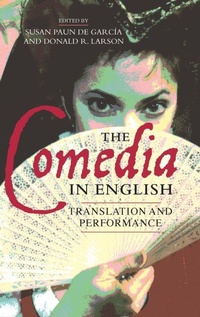
The Comedia in English
Translation and Performance
Published on 19. June 2008
Book
Hardback
316 pages
978-1-85566-169-1 (ISBN)
Description
How should a seventeenth-centry Spanish verse play be presented to a contemporary English-speaking audience?
For many reasons, but most usually the lack of playable modern translations, the plays of the seventeenth-century Spanish Comedia have appeared infrequently on the stages of the English-speaking world. Once such translations began to appear in the final decades of the twentieth century, productions followed and audiences were once again given the opportunity of discovering the enormous riches of this theatre.
The bringing of Spanish seventeenth-century verse plays to the contemporary English-speaking stage involves a number of fundamental questions. Are verse translations preferable to prose, and if so, what kind of verse? To what degree should translations aim to be "faithful"? Which kinds of plays "work", and which do not? Which values and customs of the past present no difficulties for contemporary audiences, and which need to be decoded in performance? Which kinds of staging are suitable, and which are not? To what degree, if any, should one aim for "authenticity" in staging? And so on.
In this volume, a distinguished group of translators, directors, and scholars explores these and related questions in illuminating and thought-provoking essays.
EDITORS: Susan Paun de Garcia and Donald Larson are Associate Professors of Spanish at the Universities of Denison and Ohio State respectively. OTHER CONTRIBUTORS: Isaac Benabu, Catherine Boyle, Victor Dixon, Susan Fischer, Michael Halberstam, David Johnston, Catherine Larson, A. Robert Lauer, Dakin Matthews, Anne McNaughton, Barbara Mujica, James Parr, Dawn Smith, Jonathan Thacker, Sharon Voros
For many reasons, but most usually the lack of playable modern translations, the plays of the seventeenth-century Spanish Comedia have appeared infrequently on the stages of the English-speaking world. Once such translations began to appear in the final decades of the twentieth century, productions followed and audiences were once again given the opportunity of discovering the enormous riches of this theatre.
The bringing of Spanish seventeenth-century verse plays to the contemporary English-speaking stage involves a number of fundamental questions. Are verse translations preferable to prose, and if so, what kind of verse? To what degree should translations aim to be "faithful"? Which kinds of plays "work", and which do not? Which values and customs of the past present no difficulties for contemporary audiences, and which need to be decoded in performance? Which kinds of staging are suitable, and which are not? To what degree, if any, should one aim for "authenticity" in staging? And so on.
In this volume, a distinguished group of translators, directors, and scholars explores these and related questions in illuminating and thought-provoking essays.
EDITORS: Susan Paun de Garcia and Donald Larson are Associate Professors of Spanish at the Universities of Denison and Ohio State respectively. OTHER CONTRIBUTORS: Isaac Benabu, Catherine Boyle, Victor Dixon, Susan Fischer, Michael Halberstam, David Johnston, Catherine Larson, A. Robert Lauer, Dakin Matthews, Anne McNaughton, Barbara Mujica, James Parr, Dawn Smith, Jonathan Thacker, Sharon Voros
Reviews / Votes
[B]ooks like The Comedia in English will prove indispensible in helping to bridge the gap between comediantes and English-speaking practitioners, audiences, and critics alike. ROMANISCHE FORSCHUNGEN [T]he book's variety of perspectives coupled with the quality of the articles, make this a work worthy of attention by anyone with an interest in the current state of the comedia in the Anglophone world, whether in Spanish or English translation. * BULLETIN OF SPANISH STUDIES * Due to the variety of approaches combined with the expertise, experience and cross-referencing of its contributors, this volume is indispensable for anyone interested in translating, producing, directing, performing, studying or simply viewing the Spanish comedia in English. * THE JOURNAL OF THEATRE RESEARCH INTERNATIONAL * A useful, inspiring collection for students of early modern Spanish drama. Summing Up: Highly recommended. * CHOICE *More details
Series
Language
English
Place of publication
Woodbridge
United Kingdom
Publishing group
Boydell & Brewer Ltd
Target group
Professional and scholarly
Product notice
Cloth over boards
Dimensions
Height: 240 mm
Width: 161 mm
Thickness: 22 mm
Weight
640 gr
ISBN-13
978-1-85566-169-1 (9781855661691)
Copyright in bibliographic data and cover images is held by Nielsen Book Services Limited or by the publishers or by their respective licensors: all rights reserved.
Schweitzer Classification
Other editions
Additional editions
E-Book
06/2008
1st Edition
De Gruyter
€48.99
Available for download
Persons
JONATHAN THACKER is King Alfonso XIII Professor of Spanish Studies at the University of Oxford and Professorial Fellow at Exeter College, Oxford.
Content
The Comedia in English: An Overview of Translation and Performance
Translating Comedias into English Verse for Modern Audiences - Dakin Matthews
Translating the Polymetric Comedia for Performance [with Special Ref erence to Lope de Vega's Sonnets] - Victor Dixon
Lope de Vega in English: The Historicised Imagination - David Johnston
Found in Translation: Maria de Zaya's Friendship Betrayed and the En glish-Speaking Stage - Catherine Larson
Transformation and Fluidity in the Translation of Classical Texts for Perfo rmance: The Case of Cervantes's Entremeses - Dawn L. Smith
Translation as Relocation - Ben Gunter
Rehearsing Spite for Spite - Michael Halberstam
Directing Don Juan, The Trickster Of Seville - Anne McNaughton
Directing the Comedia: Notes on a Process -
Tirso's Tamar Untamed: A Lesson of the Royal Shakespeare Company's Producti on - Jonathan W. Thacker
The Loss of Context and the Traps of Gender in Sor Juana's Los empenos de una casa/House of Desires - Catherine M. Boyle
Tirso's Burlador de Sevilla as Playtext in English - James Parr
Anne McNaughton's Don Juan: A Rogue for All Seasons - A. Robert Lauer
Aspectual, Performative, and "Foreign" Lope/Shakespeare: Staging Capulet s & Montagues and Peribanez in English and Romeo and Juliet in "Sicilian"I> in "Sicilian" - Susan L. Fischer
Zaya's Comic Sense: The First Performance in English of La traicion en la amistad - Sharon D Voros
Maria de Zaya's Friendship Betrayed a la Hollywood: Translation, Transculturation, and Production - Barbara Mujica
Translating Comedias into English Verse for Modern Audiences - Dakin Matthews
Translating the Polymetric Comedia for Performance [with Special Ref erence to Lope de Vega's Sonnets] - Victor Dixon
Lope de Vega in English: The Historicised Imagination - David Johnston
Found in Translation: Maria de Zaya's Friendship Betrayed and the En glish-Speaking Stage - Catherine Larson
Transformation and Fluidity in the Translation of Classical Texts for Perfo rmance: The Case of Cervantes's Entremeses - Dawn L. Smith
Translation as Relocation - Ben Gunter
Rehearsing Spite for Spite - Michael Halberstam
Directing Don Juan, The Trickster Of Seville - Anne McNaughton
Directing the Comedia: Notes on a Process -
Tirso's Tamar Untamed: A Lesson of the Royal Shakespeare Company's Producti on - Jonathan W. Thacker
The Loss of Context and the Traps of Gender in Sor Juana's Los empenos de una casa/House of Desires - Catherine M. Boyle
Tirso's Burlador de Sevilla as Playtext in English - James Parr
Anne McNaughton's Don Juan: A Rogue for All Seasons - A. Robert Lauer
Aspectual, Performative, and "Foreign" Lope/Shakespeare: Staging Capulet s & Montagues and Peribanez in English and Romeo and Juliet in "Sicilian"I> in "Sicilian" - Susan L. Fischer
Zaya's Comic Sense: The First Performance in English of La traicion en la amistad - Sharon D Voros
Maria de Zaya's Friendship Betrayed a la Hollywood: Translation, Transculturation, and Production - Barbara Mujica