

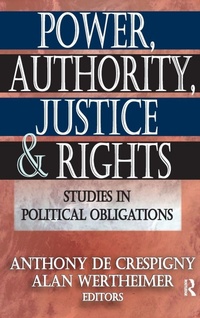
Power, Authority, Justice, and Rights
Studies in Political Obligations
1st Edition
Published on 2. August 2017
Book
Hardback
328 pages
978-1-138-53060-7 (ISBN)
Description
Although political scientists and their students tended, prior to the seventies, to approach political theory as the history of political ideas, a rapid growth of interest in political theory as the analysis of political concepts led to the publication of this book. The approach outlined here remains significant today not only for its contribution to normative analysis, but also because it shows how political scientists can view their subject matter with a more profound understanding of the concepts they deal with in their work.
De Crespigny and Wertheimer selected fourteen essays on seven fundamental political concepts for this volume: power, authority, liberty, equality, justice, rights, and political obligation. These essays explore the basic ideas and values of politics, and are the works of scholars with considerable reputations as theorists among their contemporaries. They continue to represent some of the best Anglo-American thinking of the century.
The editors discuss the nature and possibilities of political theory and, in particular, they examine the adequacy of the criticisms that have commonly been directed at the main works of "traditional" political thought. They provide an incisive introduction to each chapter. These explanatory materials result in a volume that can be used as the primary text in courses in political theory and political philosophy, in a course in the history of political thought, or as a guide to basic issues underlying political thought irrespective of its historical context.
De Crespigny and Wertheimer selected fourteen essays on seven fundamental political concepts for this volume: power, authority, liberty, equality, justice, rights, and political obligation. These essays explore the basic ideas and values of politics, and are the works of scholars with considerable reputations as theorists among their contemporaries. They continue to represent some of the best Anglo-American thinking of the century.
The editors discuss the nature and possibilities of political theory and, in particular, they examine the adequacy of the criticisms that have commonly been directed at the main works of "traditional" political thought. They provide an incisive introduction to each chapter. These explanatory materials result in a volume that can be used as the primary text in courses in political theory and political philosophy, in a course in the history of political thought, or as a guide to basic issues underlying political thought irrespective of its historical context.
More details
Language
English
Place of publication
London
United Kingdom
Publishing group
Taylor & Francis Ltd
Target group
College/higher education
Dimensions
Height: 235 mm
Width: 157 mm
Thickness: 22 mm
Weight
630 gr
ISBN-13
978-1-138-53060-7 (9781138530607)
Copyright in bibliographic data and cover images is held by Nielsen Book Services Limited or by the publishers or by their respective licensors: all rights reserved.
Schweitzer Classification
Other editions
Additional editions
E-Book
07/2017
Routledge
€64.49
Available for download
E-Book
07/2017
Routledge
€64.49
Available for download
Book
11/2009
1st Edition
AldineTransaction
€72.00
Shipment within 10-15 days
Person
Anthony de Crespigny
Content
Introduction
I. POWER
1. P. H. Partridge - Some Notes on the Concept of Power
2. Anthony de Crespigny - Power and Its Forms
Select Bibliography
II. AUTHORITY
3. R. S. Peters-Authority
4. C. W. Cassinelli - Political Authority: Its Exercise and Possession
Select Bibliography
III. LIBERTY
5. K. J. Scott - Liberty, License, and not being Free
6. Gerald C. MacCallum, Jr. - Negative and Positive Freedom
Select Bibliography
IV. EQUALITY
7. John H. Schaar - Equality of Opportunity, and Beyond
8. John Charvet - The Idea of Equality as a Substantive Principle of Society
Select Bibliography
V. JUSTICE
9. D. D. Raphael - Conservative and Prosthetic Justice
10. John Rawls - Justice as Fairness
Select Bibliography
VI. RIGHTS
11. Margaret Macdonald - Natural Rights
12. Stuart M. Brown - Inalienable Rights
Select Bibliography
VII. POLITICAL OBLIGATION
13. Richard A. Wasserstrom - The Obligation to Obey the Law
14. Michael Walzer - The Obligation to Disobey
Select Bibliography
Index
I. POWER
1. P. H. Partridge - Some Notes on the Concept of Power
2. Anthony de Crespigny - Power and Its Forms
Select Bibliography
II. AUTHORITY
3. R. S. Peters-Authority
4. C. W. Cassinelli - Political Authority: Its Exercise and Possession
Select Bibliography
III. LIBERTY
5. K. J. Scott - Liberty, License, and not being Free
6. Gerald C. MacCallum, Jr. - Negative and Positive Freedom
Select Bibliography
IV. EQUALITY
7. John H. Schaar - Equality of Opportunity, and Beyond
8. John Charvet - The Idea of Equality as a Substantive Principle of Society
Select Bibliography
V. JUSTICE
9. D. D. Raphael - Conservative and Prosthetic Justice
10. John Rawls - Justice as Fairness
Select Bibliography
VI. RIGHTS
11. Margaret Macdonald - Natural Rights
12. Stuart M. Brown - Inalienable Rights
Select Bibliography
VII. POLITICAL OBLIGATION
13. Richard A. Wasserstrom - The Obligation to Obey the Law
14. Michael Walzer - The Obligation to Disobey
Select Bibliography
Index